
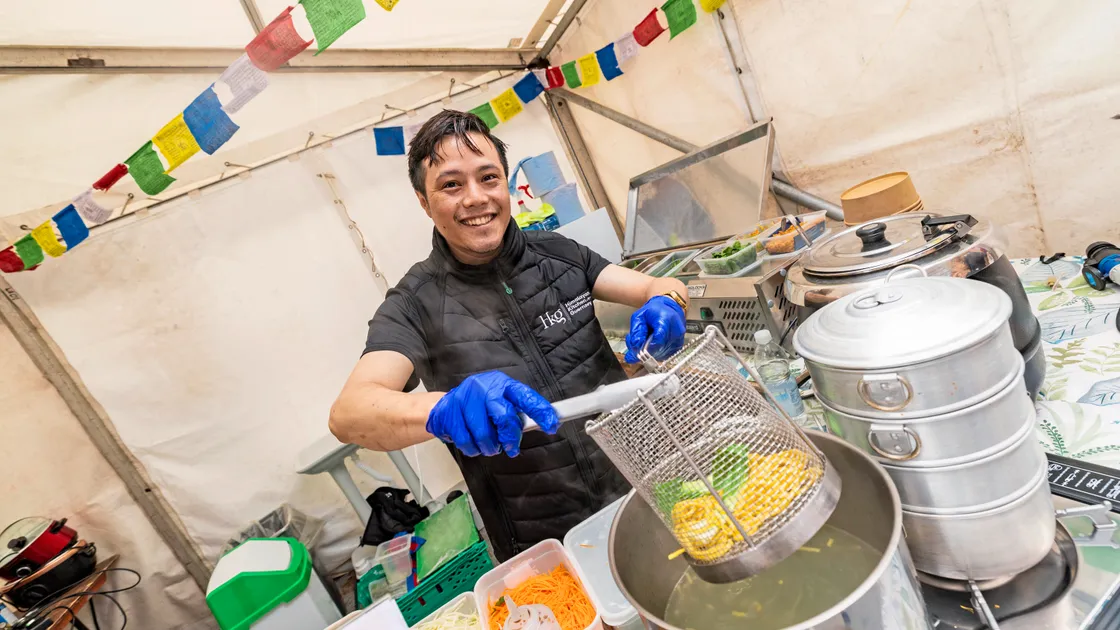
Local Nepali restaurant the Himalayan Kitchen was one of the many stalls set up around the Market Square, serving up their signature momo dumplings and Sherpa noodle soup.
Founder Ashutosh Lamichhane has lived on the island for more than a decade, and has witnessed the growth of local restaurants catering to international cuisines.
‘All the guys are all from Nepal, so it makes sense for us to bring something. When I opened the Himalayan Kitchen, I remember there was some Thai, but there were not many other cuisines,’ he said.
‘So it’s slowly developed, and now a lot of people have done it from small stalls, so you don’t necessarily need a whole restaurant.’
Now, he is looking to expand the Himalayan Kitchen further and open a new restaurant on the seafront as the Lost Yeti Kitchen, drawing on Nepali, Peruvian and Japanese-inspired cuisine.
Visiting chefs enjoyed the opportunity to connect with Guernsey’s food scene, with both guests having closer connections to the island than one might have expected.
Star Scottish chef Iain Gourlay worked in Herm Island’s kitchens 20 years ago, and in 2024 returned to Guernsey to do some cooking for the Pandora Hotel, so he had old faces to greet him.
Invited by the festival this year, Mr Gourlay was found again amongst the Pandora team, but this time around he was working on a tasting menu for them.
‘This is my holiday, so we fly back on Sunday night and then I’m back to work on Monday.
‘So it’ll be what it’ll be. No rest for the wicked.’
Wales-born chef Ayesha Kalaji has long been using yoghurt made from Guernsey cows in her Middle Eastern-inspired Glastonbury restaurant, and when the invitation to come to the festival came in she thought it would be a great idea to go to the source of her dishes. One of her staff members also has family on the island.
‘Food is such a a human experience. We come together over food. So events like this, they’re not only showcasing local producers and suppliers, but they’re supporting an industry that needs support at the moment,’ she said.
‘It’s also lovely to be able to chat with the people who are making it.
‘It gives us a connection to the food and it steps us away a little bit from supermarket fast food, where you actually have no link to where it’s from and the actual love that goes into it – whereas here, you’re speaking to the people who made it and you hear their stories.’
She sampled food from as many stalls as she could on the day.
‘If I didn’t have to cook for a living, I would eat,’ she said.
Ms Kalaji was yet to try bean jar, but immediately put it on her list.




You need to be logged in to comment.