

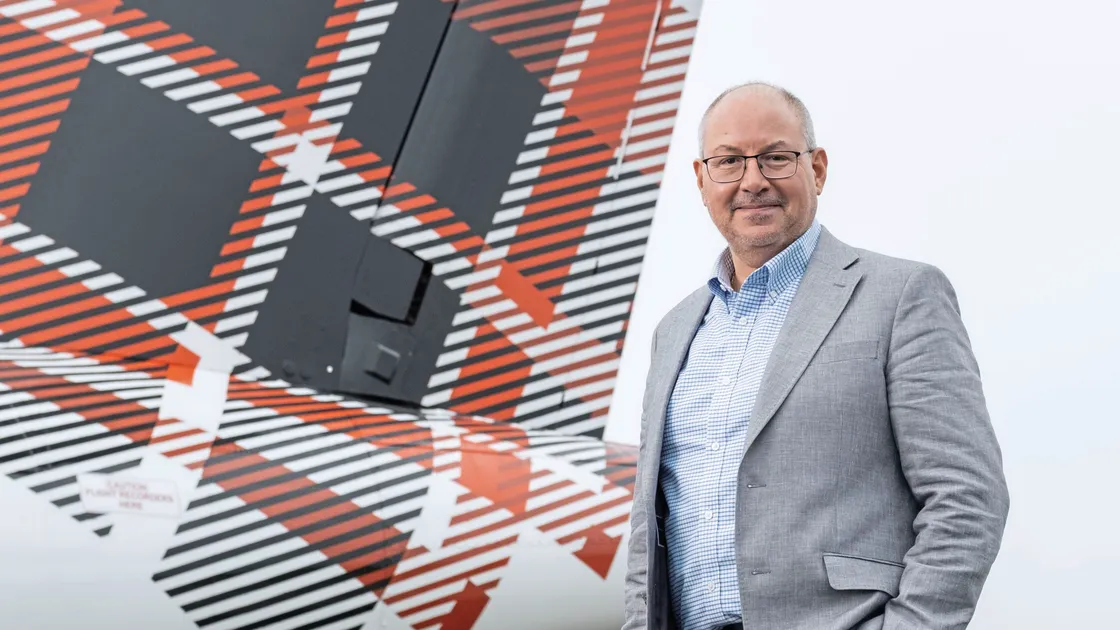
Luke Farajallah said he was also firmly of the view that taxpayers should not be subsidising airlines.
Loganair has not sought any financial help from the States of Guernsey in order to take on these routes, he said.
Although it would accept operating alongside another airline on the routes, his view was that it would be better for the taxpayer if an operator which did not require a subsidy was chosen.
‘Our primary function is to provide a good, dependable, resilient air service,’ he said.
Both of the islands had suffered from the problems that affect all small airlines – problems in the supply chain, problems with aircraft engines and issues with maintenance taking longer than expected, he said.
‘But when you’ve got 40 aircraft, you can provide resilience.’
By contrast, Aurigny did not have this, he said.
‘I’m sure Aurigny is a good, well run airline, but it is sub-scale, and it’s going to suffer from problems of resilience and reliability in the future because of the lack of aircraft availability that they have.
‘Why, with our network and the opportunity that you get with Loganair, would anyone want to pay public money over to an airline to provide routes when we can do them without having to ask for the subsidy?’
Mr Farajallah said he was grateful for the support for the airline’s applications for inter-island and Southampton routes.
‘That’s been really appreciated because we are new to the islands, and I think it’s testament to the fact that people are doing their research on who we are, and not forming a view parochially.’
Loganair was founded in 1962 and for more than 25 years it has been entirely owned by two brothers who started out operating Bond Helicopters, which flew offshore oil workers out of Aberdeen.
The airline is the only profitable regional operator in the UK and Mr Farajallah attributed this to caution.
‘Over many years, there’s been a financially prudent approach to the business,’ he said.
‘Aviation is full of opportunities to stretch yourself financially, and we resist those. And culturally, my chief executive predecessors and I have all taken the same conservative view, and that’s because we’ve all had the same leadership from the ownership structure. We know what good opportunities look like.’
As well as being cautious, he said that the company had worked hard not to have any debt and that was a unique selling point.
‘We’ve also reached that magical milestone of nearly 40 aircraft, which gives us scale, and the economies of scale that that brings.
‘So in every sense, we’ve broken through that glass ceiling that lots of airlines struggle to break through.’
Some of those aircraft are currently flying daily between Jersey and Guernsey after the Government of Jersey asked Loganair to take on the route when it stopped funding Blue Islands and the local airline collapsed.
This did not come as a surprise to Loganair, although Mr Farajallah said the timing could have been better – the news broke late on a Friday.
Should it be granted the Southampton and Jersey licences the airline would probably look at other routes, but even before that it already provided connectivity beyond Southampton, he said.
‘You get the option of travelling extensively through the UK, all the way as far north as the Shetland Islands, if that’s what you want to do.
‘In the event that we are not granted the licence, we will take a good long look at the alternatives. But the truth is we think there is plenty of scope for us to be sole operator between Jersey and Guernsey.’

You need to be logged in to comment.