

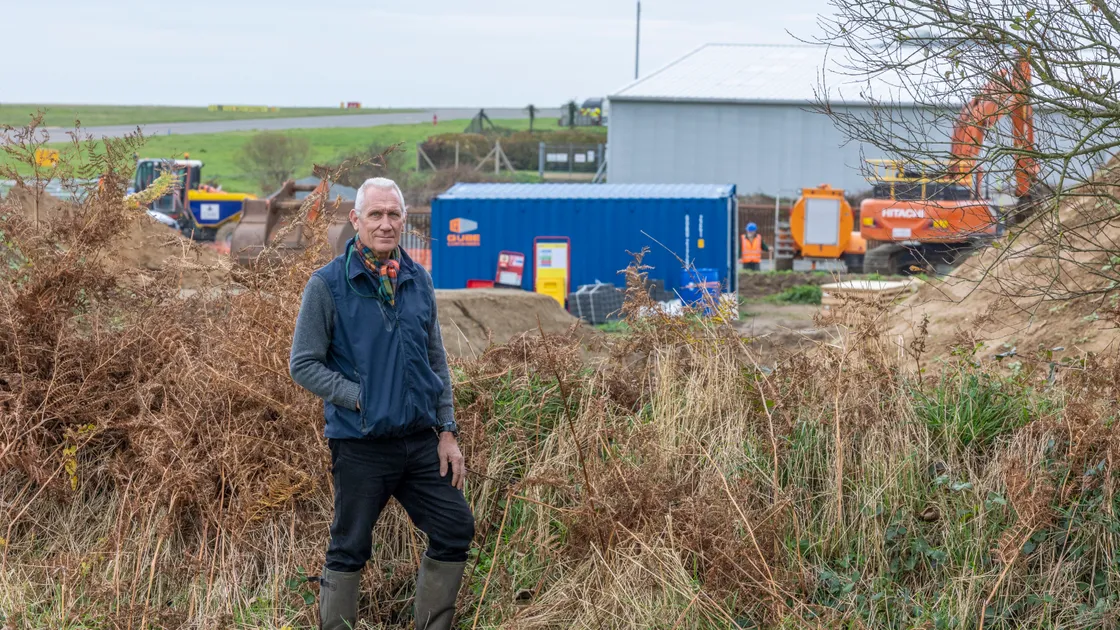
Concerns have been brought to the forefront recently by the development of a field near the airport that has seen trees stripped and earth piled all without the agreement of planning officers.
Colin Dodd, who owns a neighbouring field, and is also a committee member of Guernsey Trees, attended the meeting alongside Mike Brown, president of the National Trust, and La Societe president Trevor Bourgaize.
They met DPA president Neil Inder, director of planning Jim Rowles and Environment & Infrastructure president Adrian Gabriel.
‘We had come up with a list of sites where the felling of trees and land clearance had occurred that we could evidence,’ said Mr Dodd. ‘It was a constructive meeting and Deputy Inder agreed that this sort of thing should not happen, but whether it will change anything remains to be seen.’
Listen to our recent podcast with new DPA president Neil Inder
Mr Brown said he had been encouraged by the meeting which he hoped would become a regular occurrence.
‘It sent the right message that Deputies Inder and Gabriel were willing to meet us, and in fact, they reached out for us to go and meet them,’ he said.
‘What they both said, which I have a huge amount of sympathy for, is that if you can do things without having to go to the States, so by regulation rather than legislation, they can be done a lot quicker.’
Mr Brown gave the example of the airport field where a retrospective planning application has just been submitted for 10ft-high earth mounds that have been in place since October.
‘The developers started to do work without planning permission. The planners saw they were doing it wrong, and gave the developers two months to put in a retrospective planning application. But in the interim, they carried on working. Now, if they subsequently don’t get permission, the situation will be worse than it would have been.
‘What Deputy Inder talked about was a stop and desist until the applications are submitted, which I think is a very positive suggestion.’
Mr Brown said even this minor change would definitely be huge step in the right direction.
‘I’ve been doing this for long enough now to realise that there isn’t a silver bullet – there isn’t going to be an instant solution, and we have to make change incrementally.’
Mr Brown said he would love to see some sort of action taken against people carrying out work without permission but realised this was not always feasible.
‘If the person that is doing the work is a billionaire, a fine of a few thousand pounds is not going to make any difference to the project,’ he said.
‘But there are other things that could be done. At the moment you can’t remove protected trees, but not all trees are protected. Perhaps we could say trees with a trunk diameter of X, automatically need planning permission to take down. Then all large trees are protected. That would be relatively simple and quick.’
‘I have to be optimistic in the role I am in that we can do something about our environment. We’ll have to wait and see if they do deliver on what they said, but they certainly said all the right things and made all the right noises.’