

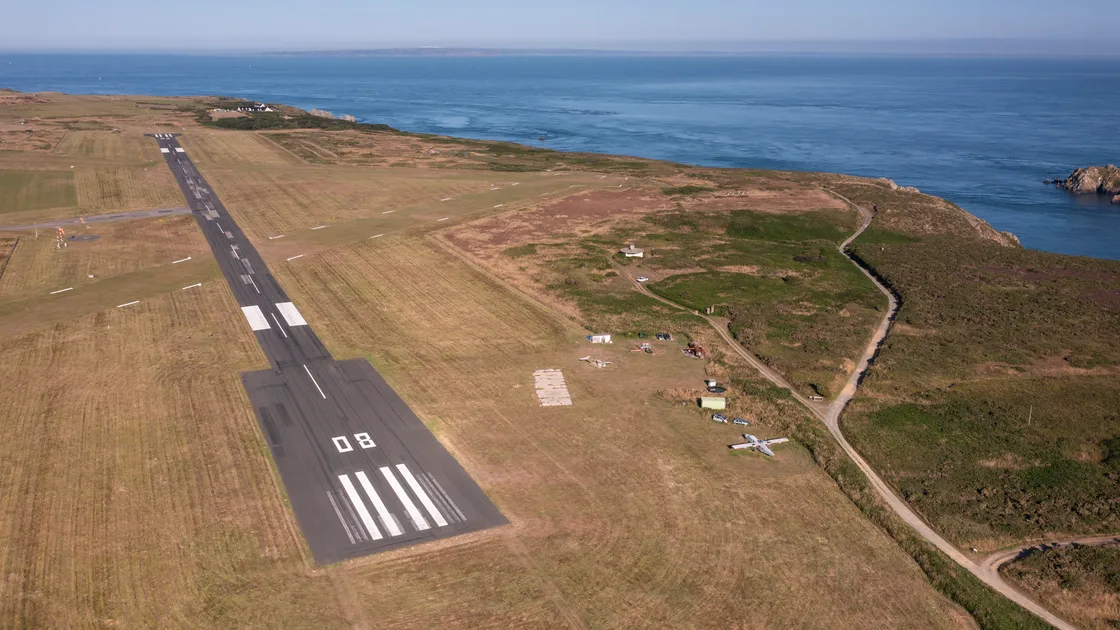
The rehabilitation of the runway at Alderney Airport and its other facilities has been considered several times by the States of Deliberation in the past decade. It is Guernsey’s responsibility, under the 1948 Agreement between the two islands, to maintain an airfield in Alderney.
In April 2025 the pursuit of Option C+, which included a longer runway and a new terminal building and fire station, was dropped by the States of Guernsey after its budget of £24.1m. was overshot by 50%.
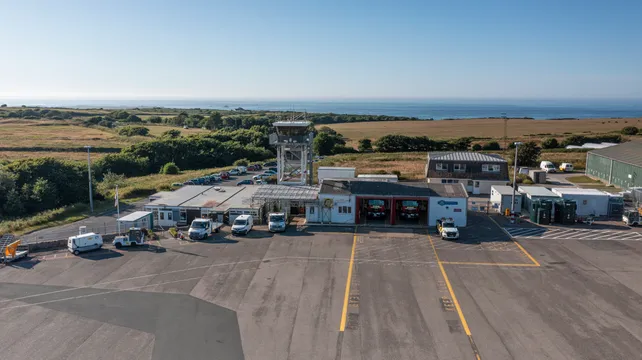
Instead the islands have now looked at a smaller and more affordable scheme offering connectivity using aircraft types popular in other small islands, rather than ATR-72s. The focus is now said to be delivering core connectivity at lowest cost, rather than seeking to maintain the airport as an economic enabler.
In November 2025 Aurigny started its switch away from Dornier aircraft to Twin Otters, being ‘damp-leased’ in partnership with Isles of Scilly Skybus.
The States needs to conclude its tender process by May 2026 and award the construction contract in April 2027, for immediate start on site, in order to complete the project by the end of 2027. If this is not achieved, it is expected that the project could slip by 12 months due to adverse weather.
Design options
Consultants have been looking at options for new designs for Alderney’s runway, looking for alternative and affordable solutions that still meet safety and operational requirements.
Minimum dimensions to ensure regulatory compliance are 877m x 23m, 5m wider than presently. Options for increasing its width and length were ruled out on grounds of cost, and so the States is pursuing a like-for-like replacement in the same position and orientation, slightly re-profiled and with centre-line lighting added.
The runway rehabilitation is a reconstruction rather than a resurfacing project. The runway, and its sub-base, built in the 1960s, will be removed and replaced, and the new sub-base will require resurfacing only when the surface reaches end of life.
A short grass runway will be retained but it is likely that the second will be lost. Any idea of replacing an asphalt runway with a grass option was quickly ruled out on the grounds that it would be frequently unavailable and would require extensive maintenance.
‘Do minimum’ on the runway has been preferred to ‘do nothing’ due to fears that the Civil Aviation Authority would ultimately have to close the runway once conditions deteriorated.
Alderney options
In July 2025, Alderney’s Policy & Finance Committee submitted proposals for two alternative options to undertake the rehabilitation work. These proposals were low cost, and the intent was that they could be undertaken sooner than the current project timelines. The proposals were put forward by Associated Asphalt and Ronez.
Both firms were involved in the previous tender processes but neither submitted a tender.
The States of Guernsey said that an initial technical review demonstrated that both proposals had merit and a clear commitment to finding a cost-effective solution, but they identified several issues that need further consideration.
Neither included detailed design work needed for CAA approval, there was insufficient evidence that issues with the integrity of the sub-based had been resolved, but both offered potential advantages in terms of cost, mobilisation, and local capability.
Elements of the proposals might be able to inform the final delivery strategy, and both firms could be involved in working with the chosen contractor.
Timeline
The project board has explored various ways in which it might be best to go out to an over-heated market for a contractor. Its procurement advisers have also noted that the previous work on the project, which has included going out to market twice, would be a concern for suppliers.
The board is recommending that there should be a process of early contractor engagement, which would allow a preferred bidder to work closely with the States as the project design is finalised, and ensure a collaborative approach to seek to reduce costs of the project.
This approach is particularly recommended because of the significant range in initial cost estimates and complex logistical challenges, and will allow for proactive planning on-site constraints.
Delegated financial authority
There are big concerns about any delays encroaching into the project, and one of them would be if the States of Deliberation was required to sign off on all spending. Significant delays would be likely to put the work back to spring 2028, adding extra pressure on patching the existing runway, which currently costs some £400,000 a year to maintain.
Policy & Resources wants to be granted delegated authority on the project, though it accepts that unlimited authority would place it in a difficult position and would be unlikely to be acceptable on governance grounds, so it would need to be limited. If the project goes over-budget, even nominally, delegated authority would have to fall.
P&R said that it appeared that the States and the public seemed willing to accept a £24m. cost for this project and itself said the level of investment would be considered ‘reasonable’. It intends to proceed on that basis.
Contingency plans need to be worked up if the runway is out of action for any period ranging from days to years.
There is a historic argument that the spend is too much – P&R says the 1948 Agreement could be interpreted as saying that long-term commitment to the runway could be difficult to commit to.



You need to be logged in to comment.