

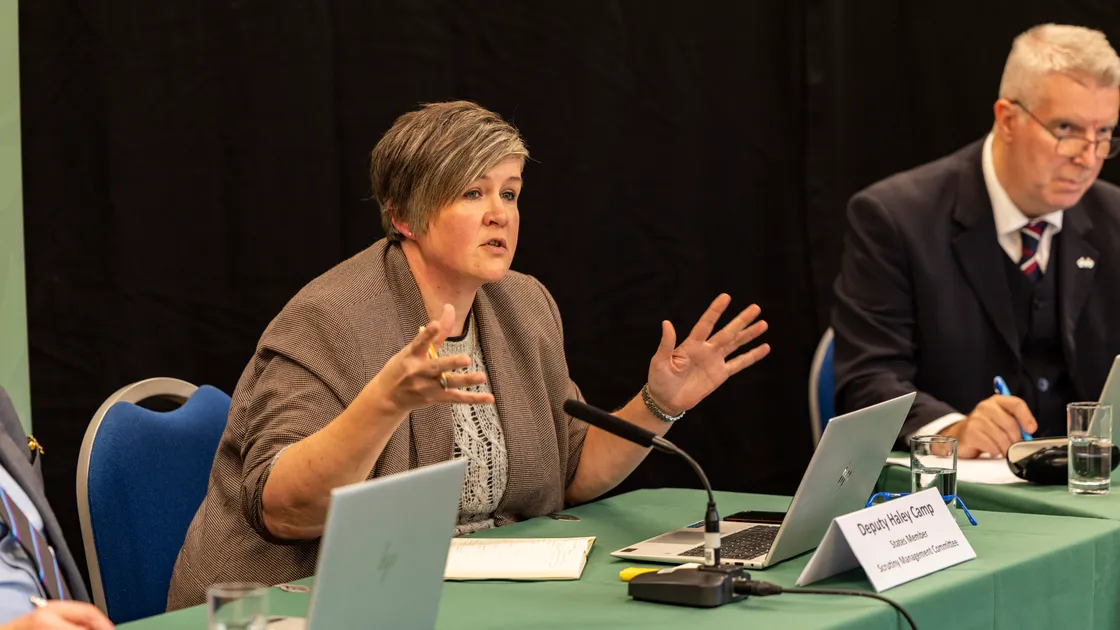
Haley Camp wants to see a zero-based budget review which would require committees to justify every pound they spend as if starting with a blank sheet of paper.
At present, committees typically put together their annual budgets by taking the previous year’s expenditure and adding or subtracting a percentage negotiated with the Policy & Resources Committee.
Deputy Camp has nearly finished preparing an amendment to the Government Work Plan which would direct P&R to lead a radically different approach over the next 18 months.
‘Demonstrably improving financial management mechanisms must be a priority if we are to demonstrate increased transparency in how money is spent,’ she said.
‘The purpose of my amendment is to embed good financial governance and support informed decision-making rather than to mandate immediate or across-the-board change. What it does aim to do is enhance accountability, support sustainable public finances, and strengthen confidence that public resources are being deployed in line with the States’ agreed priorities.’
Deputy Camp was still taking into account P&R’s views on her draft proposal yesterday ahead of today’s mid-afternoon deadline for submitting amendments to the Government Work Plan, which will be debated by the States next week. She indicated that her amendment would also ask the Assembly to instruct P&R to report back in the middle of the political term with the findings of its zero-based spending reviews.
A zero-based approach assumes that each budget period starts with no pre-allocated funds and requires every cost to be justified from scratch.
It would be the most thorough cost control exercise for at least 15 years, when the States set up the Financial Transformation Programme and reduced costs by about £29m. a year.
She said it was a time when ‘improving the social contract between government and the people has never been more critical’ and that required more visible financial discipline from the States.
Deputy Camp believed that a line-by-line investigation of expenditure was particularly necessary ahead of proposals expected later this year to increase personal or company taxation, or a combination of the two, to help deal with a growing ‘black hole’ in States finances which treasury officials recently calculated at £98m. annually.
Some States members see little prospect of securing public support for additional taxation unless it is combined with an extensive programme of efficiency savings.
‘It is important to stress that good financial management cannot be developed piecemeal,’ said Deputy Camp.
‘If government is to commit, it must commit fully or not at all, and have a worked-up plan rather than a disparate set of measures designed to test the waters.’
It is understood that her amendment will be seconded by Deputy Rob Curgenven, although that does not need to be confirmed until it is submitted to the States Greffier by 3pm today.