
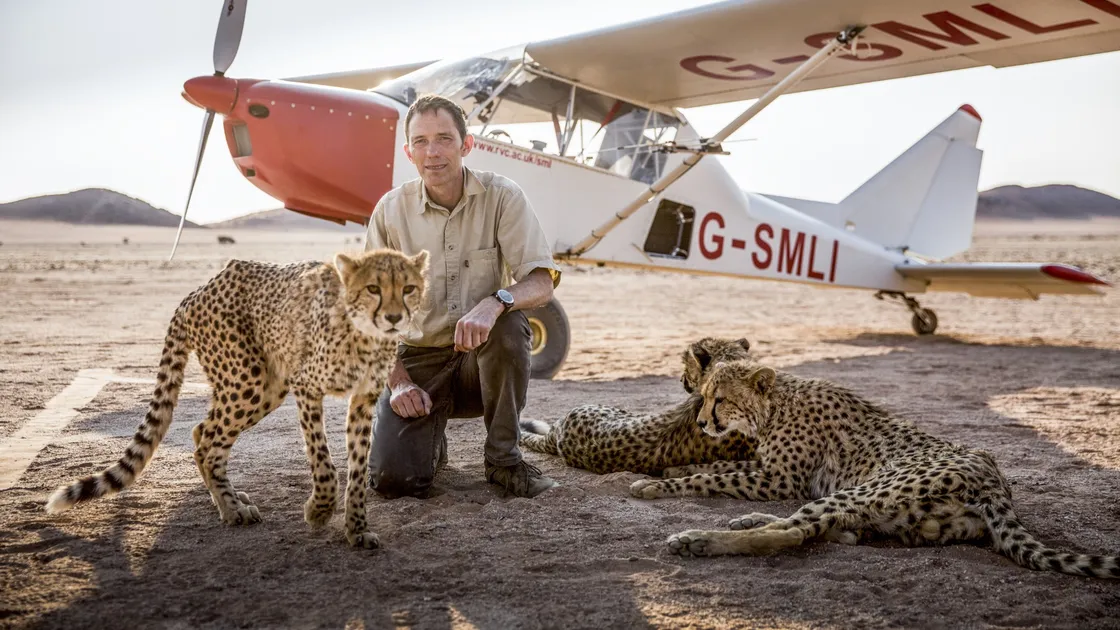
Dr Alan Wilson works as a professor of locomotor biomechanics at the Royal Veterinary College in London, though he has spent much time over the course of his career in Botswana and Namibia, where he tracks and monitors wild animals – an endeavour that has involved his construction of small, fuel-efficient aircraft to track wildlife from the air.
Dr Wilson’s research is focused on locomotion – more specifically, on how animals move in the context of their environment, with their need to both preserve energy and perform at speed. Together with a team, he developed novel sensor systems and GPS wildlife collars, which he helps to build himself. His technological work has featured in BBC documentaries, including BBC Horizon’s The Secret Life Of The Cat and BBC 1’s Big Cats series.
‘I can build gadgets – it’s a nice mixture of skills to have,’ said Dr Wilson, who gave a presentation to members of the Guernsey Aero Club.
His engineering prowess, however, extends to much larger projects than building small sensor gadgets.
‘I’ve been building planes since 2011,’ he said.
‘They’re just very small, light aeroplanes. You need them because helicopters use 50-60 litres of fuel per hour, while my plane will use about 13.’
For Dr Wilson, a typical flying day will involve nine to 10 airborne hours, taking photogrammetry 3D photos with a high-definition laser scanner. The object of his research is to further understand the configuration of the musculoskeletal systems of athletic animals.
He has had a recent focus on the gemsbok – a type of antelope that survives in the sand dunes without ever drinking water, surviving off the hydration they get from minimal vegetation. As far as is known, he is the first to track the animal in such detail.
‘I just love understanding biology and making people excited about science,’ he said.
‘I want the next generation to be enthusiastic about science and to carry on researching and discovering the world. I love living and working in the bush. I go there some four to eight times a year, for two weeks at a time,’ he said.
Dr Wilson has been in the scientific world for decades, graduating from Glasgow University with a degree in veterinary medicine and a BSc in physiology in 1987. He continued on to do a PhD where he studied the mechanical basis of tendon injuries, and, a few years on, joined the Royal Veterinary College.
Just recently, Dr Wilson was chosen to become a fellow of The Royal Society – the world’s oldest scientific academy in continuous existence. Though looking towards retirement, Dr Wilson still maintains his boundless scientific curiosity, and revealed that his next ambition is to build an aircraft and fly with geese.