
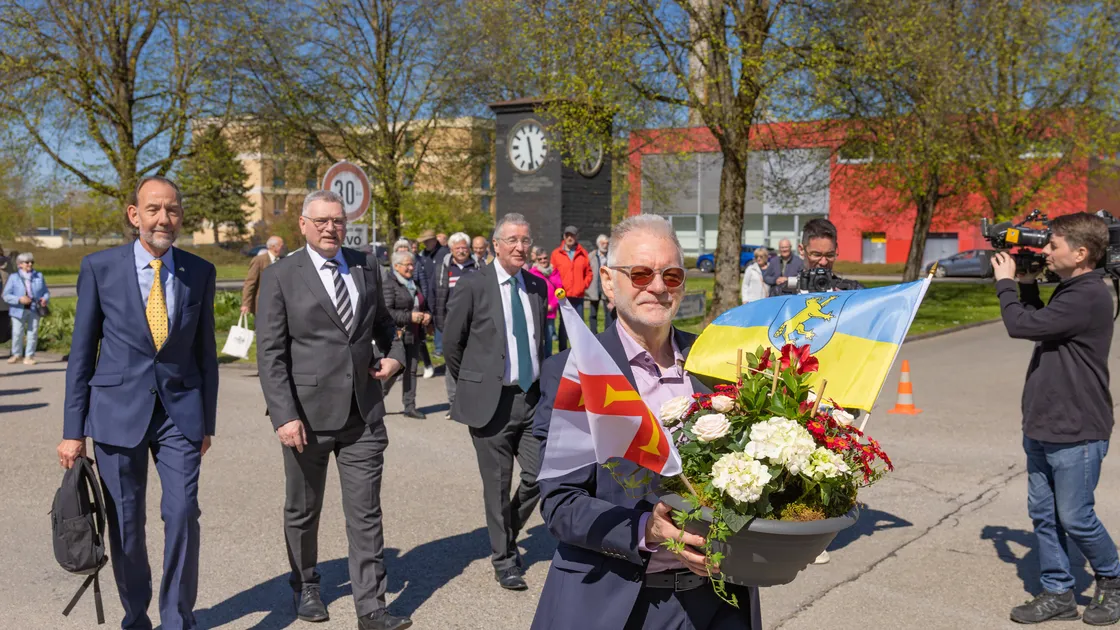
Bailiff Sir Richard McMahon and States external relations lead Steve Falla were in Germany for the ceremonial countersigning of the friendship framework agreement which was signed in the island on the 80th anniversary of Liberation Day last year.
The town’s Lord Mayor Norbert Zeidler had called that occasion ‘a historic moment and one of the most moving of my personal life’ and now, at home, he was similarly delighted, saying that the friendship was ‘anything but a given’.
For many people in Guernsey, the name Biberach had long been associated with suffering and internment. All the more significant, therefore, that a friendship had emerged from this history, he said.
The partnership had been built steadily since 1997, he said.
‘In this context, one must be aware of the profound turning point marked by the signing of the friendship agreement last year, especially for the people of Guernsey. They accepted us – the descendants of the occupiers, the former enemy – as friends,’ Mr Zeidler said, also paying tribute to his predecessor as mayor, Thomas Fettback, who was awarded an OBE by the Queen in 2005 for his services to reconciliation with the island.
Deputy Steve Falla also emphasised the exceptional significance of the agreement.
What had begun as a history of suffering had, over the decades, developed into a powerful symbol of reconciliation, and the framework agreement was a conscious reaffirmation of shared values – peace, understanding and respect, he said.
At a time when these values were once again under pressure around the world, such expressions of international friendship were of particular importance.
‘It is especially moving to sign the friendship framework agreement here today – in a place that meant hardship and suffering for so many from our island community, but which can now bring us together in a spirit of healing and hope,’ Deputy Falla said.
It is hoped that the new agreement will open up opportunities for cultural and educational exchange and for encounters between students, artists, historians and associations.
The aim is not only to keep the shared past alive, but also to convey to future generations the enduring value of friendship and cooperation.
Sarnia Cherie was sung at the signing ceremony.
The visit also took in the commemoration of the liberation of the Lindele camp. Guests gathered on the grounds of the former internment and prisoner‑of‑war camp – now the site of the Police University – before the historic clock tower, the last remaining original structure of the camp, which was liberated by French troops on 23 April 1945.
About 1,000 people from the Channel Islands, predominantly from Guernsey, were interned in the camp from autumn 1942, which saw the development of friendships through meetings in maternity wards or internees working for Biberach families.
Those connections ultimately led to former deportees being invited back to Biberach in 1997.