

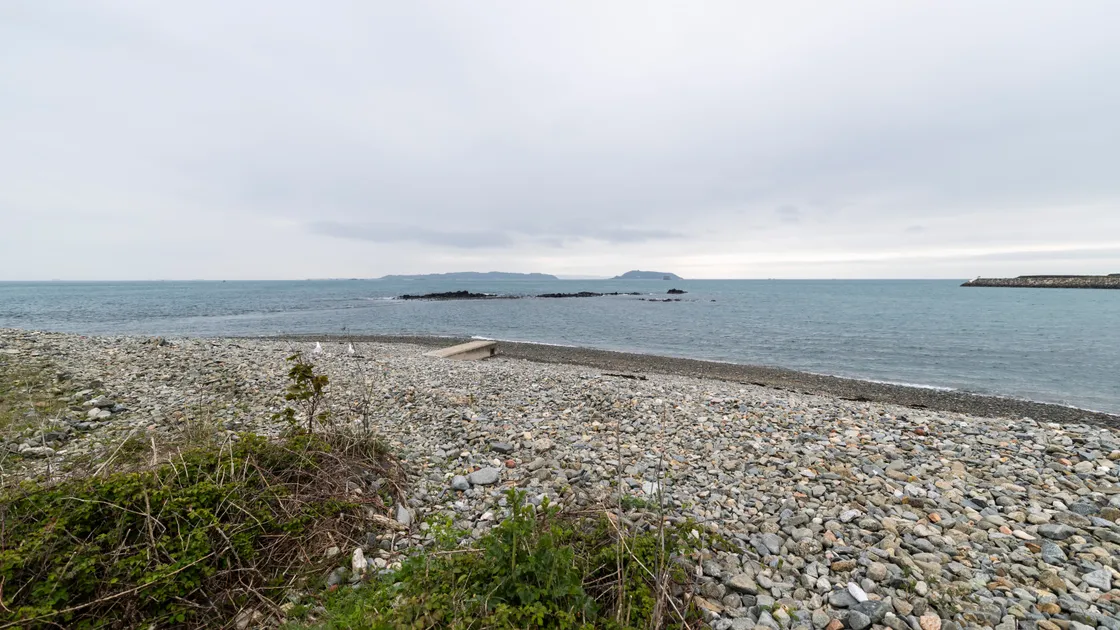
Months after publicly raising concerns about building hundreds of homes and commercial and leisure facilities off the island’s north-west coast, Lee Van Katwyk told the latest Guernsey Press Politics Podcast that he was more optimistic than ever that the land reclamation scheme could be stopped.
He hoped another States debate soon on the disposal of inert waste – a key part of the scheme – would result in preparatory work on the Black Rock scheme being discontinued.
Listen to the full interview with Deputy Lee Van Katwyk on the latest Guernsey Press Politics Podcast
‘Six months ago that [development] was the definite direction of travel but that is suddenly making a U-turn,’ he said.
‘I think that’s the way that we’re heading. We’ve got to look at all the options holistically. Now that we’ve got new information, I think it needs to be brought back to the States and we need that full debate once again.
‘The idea was ill-conceived to begin with. I’m glad that we now see that there’s not that sort of potential possibility there, either for building houses or perhaps even just reclaiming the land.’
Black Rock was approved in principle by the previous Assembly as the island’s next disposal site for inert waste, such as concrete, bricks and stone from demolition and construction, with an estimated minimum 12-year lifespan.
That would create nearly 80 acres of additional useable land at the east end of St Sampson’s Harbour, near the Vale Castle, and the Guernsey Development Agency has got behind initial plans for it to accommodate about 600 homes, a restaurant and bathing pool, a project which it believes could create thousands of jobs, boost the economy and improve the environment.
There was an indication recently of mounting challenges to the scheme when Deputy Mark Helyar, president of the States Trading Supervisory Board, which is responsible for waste disposal, revealed advice from harbour officials that reclamation at Black Rock may increase navigational risk and required more analysis.
Deputy Van Katwyk thought the pieces of a jigsaw were starting to fall into place, which would eventually reveal the Black Rock scheme as pure folly.
‘I think it’s down to my direct communications around it,’ he said.
‘Six months ago, I was talking to different local experts about what was going on there and one thing I found out was there were more issues with what we call the fluvial flow of the Little Russel.
‘We had [consultants] doing this work and we were being told by local experts for free that this isn’t going anywhere under this guise.
‘Then a few months later, we’re being told the [consultants’] report has come back and we are now seeing that some of these things are the case and it’s not going to be a simple land reclamation as we were led to believe.
‘It looks like we are finally listening to local experts, and I believe I had a good part to play in that.’
The GDA said earlier this year that it was on course to present the States with its full vision for the area around St Sampson’s Harbour by the end of 2026. It also claimed that Deputy Van Katwyk’s campaign against the Black Rock scheme was founded on inaccuracies and misunderstanding.