

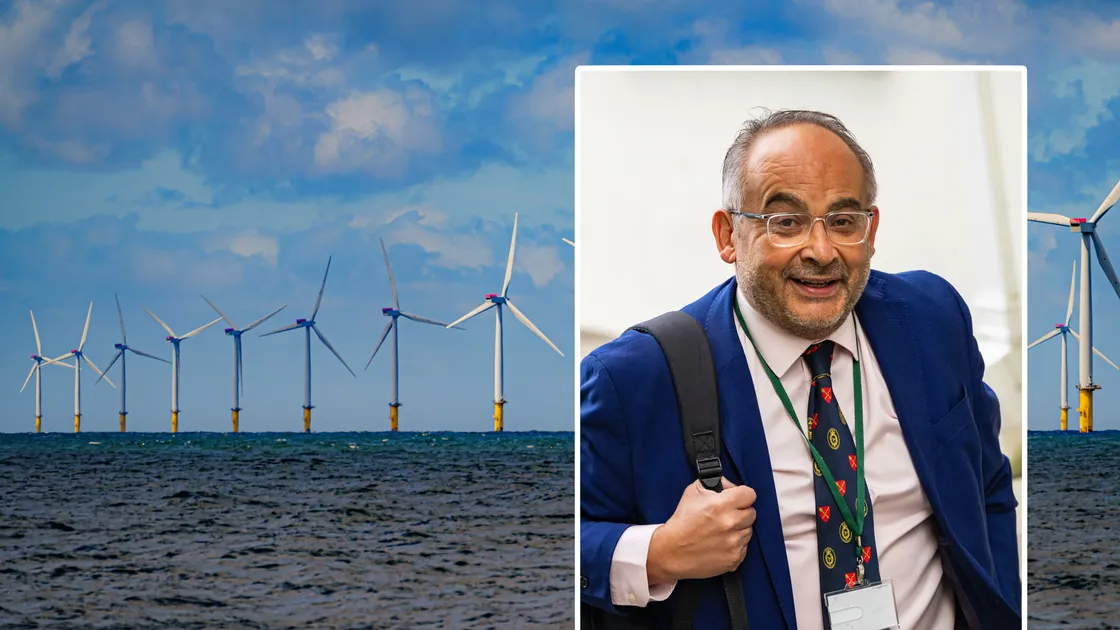
The membership of the board was refreshed when a new States Assembly was elected last summer.
It now consists of Chris Blin, Environment & Infrastructure president Adrian Gabriel and Policy & Resources president Lindsay de Sausmarez.
‘We lost time in the past where we had political distractions or changes within the government. It’s now a really focused project and we want to push it harder,’ said Deputy Blin.
‘It is now a delivery board, rather than a larger committee.
‘Everything remains not only as motivated and driven as it was at the beginning but further so, now that other changes are happening.’
Guernsey’s approach to trying to develop an offshore wind farm has been split into four clear phases.
Phase one explored the viability of offshore wind in Guernsey’s territorial seas and phase two examined the potential value of the project, focusing on the economic value of Guernsey’s seabed.
Since then, the States has approved a policy letter to progress to phases three and four.
The board is now working on phase three, assessing potential export markets for Guernsey’s offshore wind energy, before starting phase four which will consider how a wind farm could access those markets, including grid connections and commercial arrangements.
‘I’ve always made clear that this is a mid-to-long-term and hugely beneficial opportunity. We are talking tens of millions of pounds per year,’ said Deputy Blin.
‘It’s an opportunity which we always felt should have been done many years ago, but we’re doing it now.’
Allocation rounds six and seven of the UK’s Contracts for Difference scheme are designed to secure investment in renewable energy projects.
Deputy Blin said that this year both were over subscribed, whereas last year they were under subscribed, meaning developers didn’t engage with all of the projects.
‘What we’ve discovered is the resilience and belief in independence of energy, especially with an energy war going on right now. People are realising the importance of it,’ he said.
‘Various pieces have moved within the UK government, such as needing legislation. These are the pieces we need to connect what we’re doing possibly to the UK for the transmission of the energy – they were set for the early 2030s, but it’s now more likely to happen in 2027.
‘There are some big, big steps. It doesn’t mean it’s all happening faster and sooner, but we are in a far better position than we’ve ever been before.’
It is believed that the creation of jobs in a new, modern industry would be among the benefits of leasing the seabed for a wind farm.
‘It’s a brilliant opportunity, but it’s not a replacement of GST-plus. It’s got to be seriously seen for what it is and the opportunity to create jobs.
‘There will be about 150 jobs in the maintenance of it. In a world where AI is taking over, we need to ensure we have opportunities there,’ said Deputy Blin.