

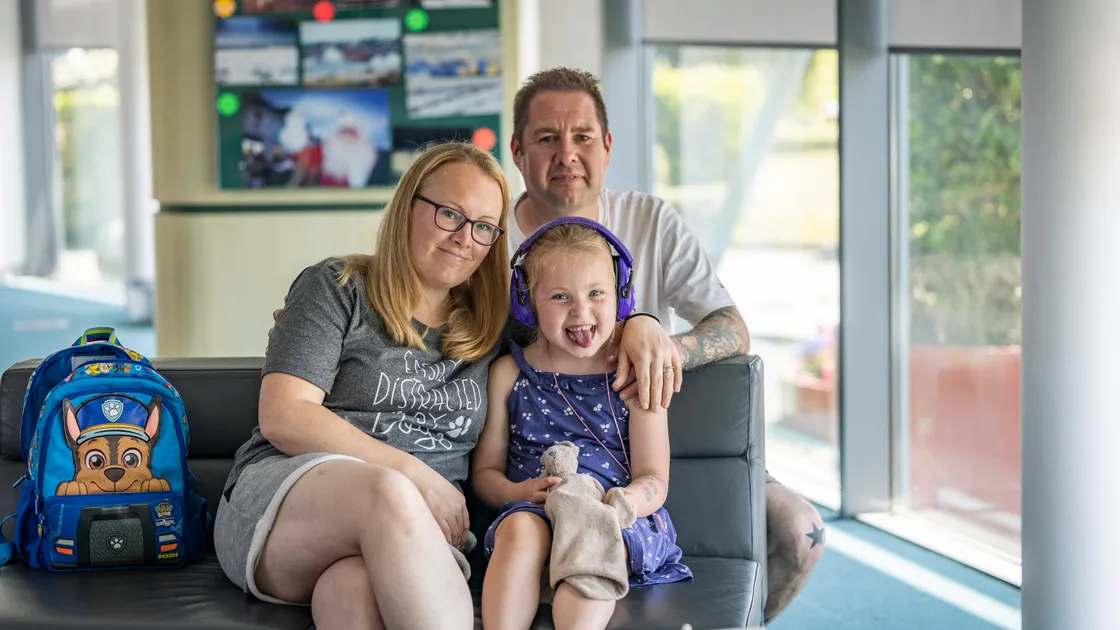
Ady and Chantelle McKane’s daughter was diagnosed with autism at the age of two, and is awaiting an ADHD diagnosis.
Since starting mainstream school at Amherst last September, Alana started to exhibit extreme distressed behaviour, and reached the point where she refused to return. Mr and Mrs McKane said their daughter’s neurodivergent needs were not properly understood, acknowledged or met, and they felt completely let down by an educational system that offers their family no support.
‘Just like you wouldn’t push your child into a fire because it would hurt them, we don’t want to send our child somewhere that’s going to physically, emotionally and socially damage her – we know that it hurts her,’ said Mrs McKane.
The national Special Educational Needs and Disabilities (SEND) framework establishes the legal duties for schools, local authorities, and health services across the UK to ensure that autistic youngsters receive the exact level of help that they need. It has four categories: universal, graduated, targeted and specialist.
Despite needing to be prescribed sedation after one particular after-school meltdown, Alana is categorised in the lowest tier – universal. She would need to be in the specialist category to attend a special education school. But her mum said the assessment to determine her category was not fit for purpose.
‘It’s not a holistic assessment at all,’ said Mrs McKane.
‘It’s not seeing the detrimental effect on her physical, social and emotional wellbeing and that of her family when she returns home. And it’s gender-biased. Girls who are neurodivergent mask heavily. They hold it in, and it is only when they are back at their safe space – home – that they show their distress. So because she “copes” in school, she doesn’t meet the criteria for a specialist placement.
'She’ll have been fine all day, according to her teacher, but on pick-up she bursts into tears, won’t talk to anybody for hours, and trashes the house.
‘We’ve had to take her to the Emergency Department previously, and they’ve had to prescribe sedation for her because she was that agitated. Our other children were in fear of her. They had bite marks, bruises – she would attack them for no reason. But all of this is ignored, because it didn’t happen at school.’
But since stopping school, Alana’s behaviour has calmed significantly.
‘We were having to physically restrain our daughter every day when she was attending school,’ said Mrs McKane.
‘She was unstoppable. She wasn’t manageable and we had no support. But interestingly, these behaviours have really reduced since she stopped going. And we know a lot of other people who are saying the same thing.’
Mr McKane shared the family’s struggles on a public social media page that has so far received more than 80 responses – many from other parents experiencing similar issues. In his post, Mr McKane said ‘it feels like we’re stuck in a system that focuses more on whether a child can appear to cope rather than whether they are actually coping. Schools understandably want to be seen as inclusive, but inclusion shouldn’t mean keeping a child in an environment that is causing them significant distress. What is difficult to ignore is that funding is linked to pupil numbers. When a child moves schools, funding arrangements can be affected, and it’s hard not to wonder whether that plays a role in decisions being made.’
The McKane family do not have the resources to home-school, and said it would not be a beneficial route for Alana. They are keen to get her socialising and back into education as soon as possible, but are urgently calling for change.
They have contacted a number of deputies on the Education, Sport & Culture committee, including Rob Curgenven, who said the States was aware that more needed to be done.
‘I’d like to acknowledge the family and the patience, commitment and resilience they have shown throughout this process,’ he said.
‘It’s important to recognise the challenges they, and many other families, can face when seeking the right support for their children.
‘We’ve seen a significant increase in the number of children with additional learning needs and, as is the case across the UK and elsewhere, education services are working hard to respond to growing demand while ensuring the best possible outcomes for all pupils. I recognise that this can be a source of frustration and concern for children, parents and carers, particularly when they are seeking timely support.’
He said the committee was working with families, schools and support services to ensure every child is properly supported.
Education improvements ‘are still taking effect’
Positive progress is being made to improve the provision for neurodivergent children in Guernsey’s education system, officials have said.
Head of inclusion services Dave Stumpf said Education was committed to ensuring that all children, including those with autism and ADHD, were supported to thrive in school.
‘Guernsey has made significant progress in recent years through a comprehensive programme of reform developed with extensive input from education professionals, health practitioners, specialist services, schools, families and the wider community,’ he said.
‘This has included the introduction of a new Additional Learning Needs Code of Practice, the appointment of a qualified additional learning needs coordinator in every school, and strengthened partnership working with Health & Social Care to improve support and diagnostic pathways.’
He said substantial work had been done to embed a whole-school approach to inclusion and there was now a communication, interaction & autism service base at every secondary school, as well as a primary CIAS base at Forest School.
‘These improvements are still taking effect, and over time more children and young people will benefit from them,’ he said.
‘However, we do recognise that some families continue to face challenges, and we are committed to building on our progress and making further improvements.
‘Demand for the CIAS has increased significantly in recent years and under this increased pressure, Education continues to work closely with partners across health and education to ensure services are better connected and families experience a more coordinated offer.’
He said the child and their family were at the centre of planning, recognising that their experiences across school, home and beyond were interconnected and that behaviours and coping strategies may vary between school and home.
‘Where a child’s needs extend beyond education, support may involve a range of professionals working together across services, including HSC teams. Through this collaborative approach, our priority is to work in partnership with families to ensure that every child receives the right support from the right people at the right time.’
HSC member Deputy Sally Rochester said the coordination of assessment processes for autism and ADHD had been valuable and the team was working hard to enhance the experience and delivery for service users.
‘The committee is keen to digest the outcomes of the UK independent ADHD taskforce report and the ADHD, autism and mental health interim report and work with colleagues to enhance the timely delivery of assessments and, as importantly, the provision of supporting services both before and after diagnosis,’ she said.
‘This does, however, likely require additional resources and funding at a time where HSC is being pressed to reduce costs.
‘We are committed to supporting preventative measures to ensure our community have the best opportunity to be and remain well, productive members of our community and this is one area where we see a significant opportunity to deliver on that objective.’




You need to be logged in to comment.