

Pastoral care in schools is not a one-size fits all endeavour.
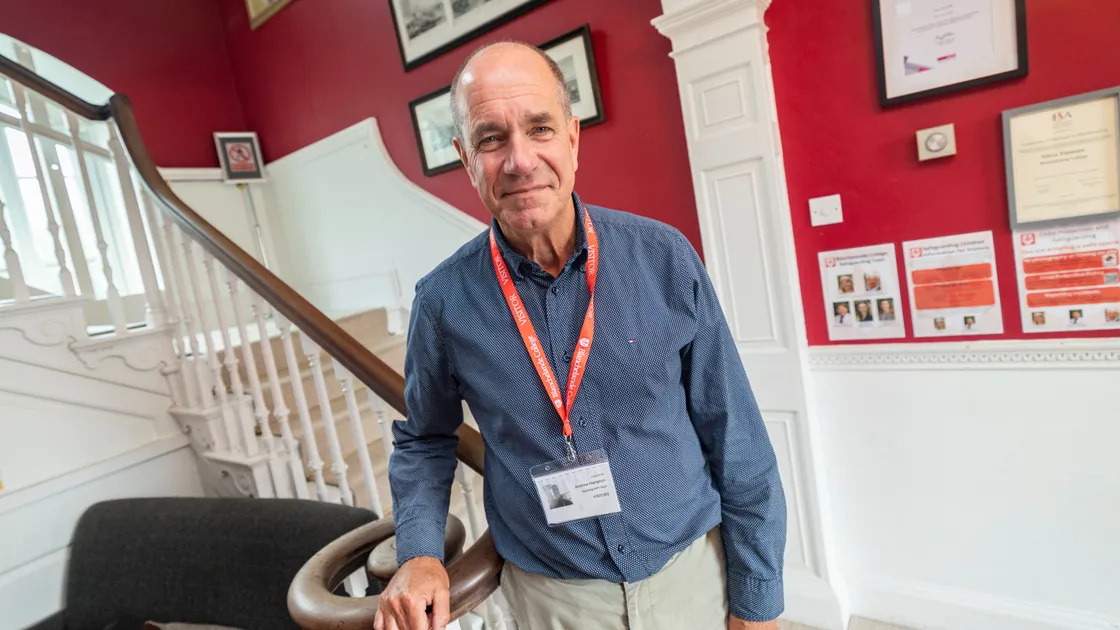
Andrew Hampton, author of Girls on Board and Working with Boys, was brought over by Blanchelande College to train teachers on the two programmes which are aimed at the relational cultures of pupils in schools.
While acknowledging both boys and girls are equals, Mr Hampton’s approaches also highlight the difference between the two sexes.
‘It’s a gendered approach so one programme is called Girls on Board and it’s really focused on girls and their friendships, understanding that friendship is by far the most important thing for girls, and if it’s going wrong, or even if you feel it’s going wrong, it’s utterly devastating. The girls will tell you that when the grown-ups try to get involved and try to fix it, it makes it worse,’ he said.
‘Girls on Board has been adopted in 1,500 schools now across 36 countries over the last nine years, and effectively uses empathy to empower the girls and license them to sort it out for themselves. The grown-ups, whether that’s parents or teachers, are still very much there to support and to listen and to help and step in if things get too bad, like if bullying is actually happening, but otherwise those grown-ups are there to evoke the girls’ empathy.’
One thing the programme shows is that having at least one friend in their school year group is of critical importance for girls.
While Girls on Board highlights isolation as an issue girls face at school, humiliation is the biggest problem for boys, and they will do anything to avoid that.
Working with Boys touches on encouraging behaviours that reduce misogyny while supporting them to be the best version of themselves. The programme aims not just to help boys thrive, to be the best they can be, but to be gentle, kind to each other, compassionate, putting collaboration ahead of competition, and putting a sense of equality ahead of hierarchy.
‘It’s more complex because boys don’t want to talk about humiliation, whereas girls, although it’s painful, will talk about their fear of isolation,’ Mr Hampton said.
‘The main beneficiaries of all of those cultures are the girls, because the girls feel unsafe when the boys are being laddish and misogynistic, and ultimately harmful sexual behaviours occur.
‘But even before that happens, the girls kind of go – all this laddish stuff, it’s uncomfortable to be around it. I don’t think the boys realise how uncomfortable it is for the girls to be around boys behaving in that way, and so it also very much empowers the girls.’
Toxic masculinity has been highlighted in the last couple of years and the course touches on teaching boys that it is not acceptable.
‘I think it’s a sort of a global issue, around masculinity, around men, and we’re still hearing the kind of reverberation of the Me Too movement and a kind of divergence between many, many men completely understanding that the old ways of being, and being sexist, just really need to stop now,’ said Mr Hampton.
‘There is a section of the male population of the world who are doubling down on the “I’m a man and I am inherently superior because I am stronger and therefore that’s all you need to know”, and that group has infiltrated its thinking into younger people.
‘So even at a primary level, boys are kind of making misogynistic remarks as a kind of way of bonding with each other and in a way it’s ridiculously inappropriate. Then in mid-teens we see harmful sexual behaviours arising.
‘So I think it’s a kind of lifelong human problem that we are in the midst of a battle around what masculinity means to people and how we can bring those people who are so violently opposed to being gentle, how we can bring them back into the fold and make them realise that actually happiness lies in collaboration and a sense of equality with the opposite sex.’
Mr Hampton said that while these were gendered approaches, it is important to recognise that the two sexes are equal and that there are many similarities.
‘The challenges are making sure that we understand that while boys and girls, men and women are different, they’re also very much the same and they’re very much equal,’ he said.
‘Sex is a protected characteristic, and by that, we can therefore project the idea that if you’re teaching a girl, she has a protective characteristic as a girl, and you should acknowledge and support her sex in a way that if you try to treat her as if she isn’t a girl, she’s just a pupil, and it doesn’t matter whether she’s a girl or a boy, you’re actually denying her right to be acknowledged as a girl, and obviously the same thing I say is true of boys as well.
‘Equality is incredibly important, but it’s not the same as acknowledging the differences between girls and boys and men and women, because we are different and we have our separate needs.
‘And it’s really important that in our global attempt to embrace feminism and to bring women up, as it were, in the power-based level to men, that we don’t try to say that that means that men and women are the same, they’re not, they’re equal, but they’re not the same.’