
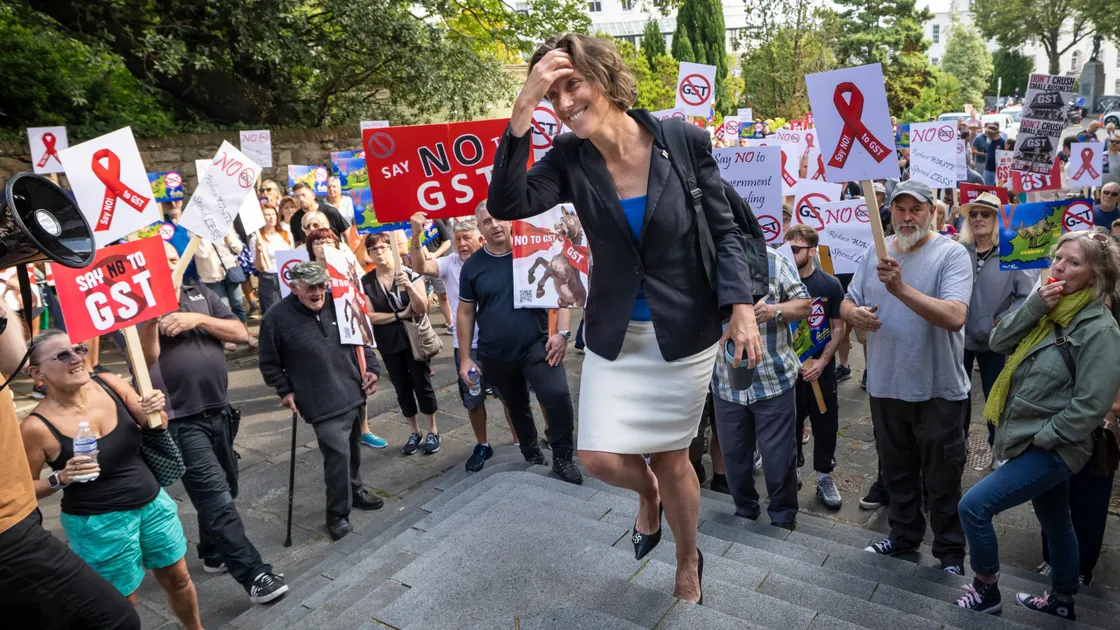
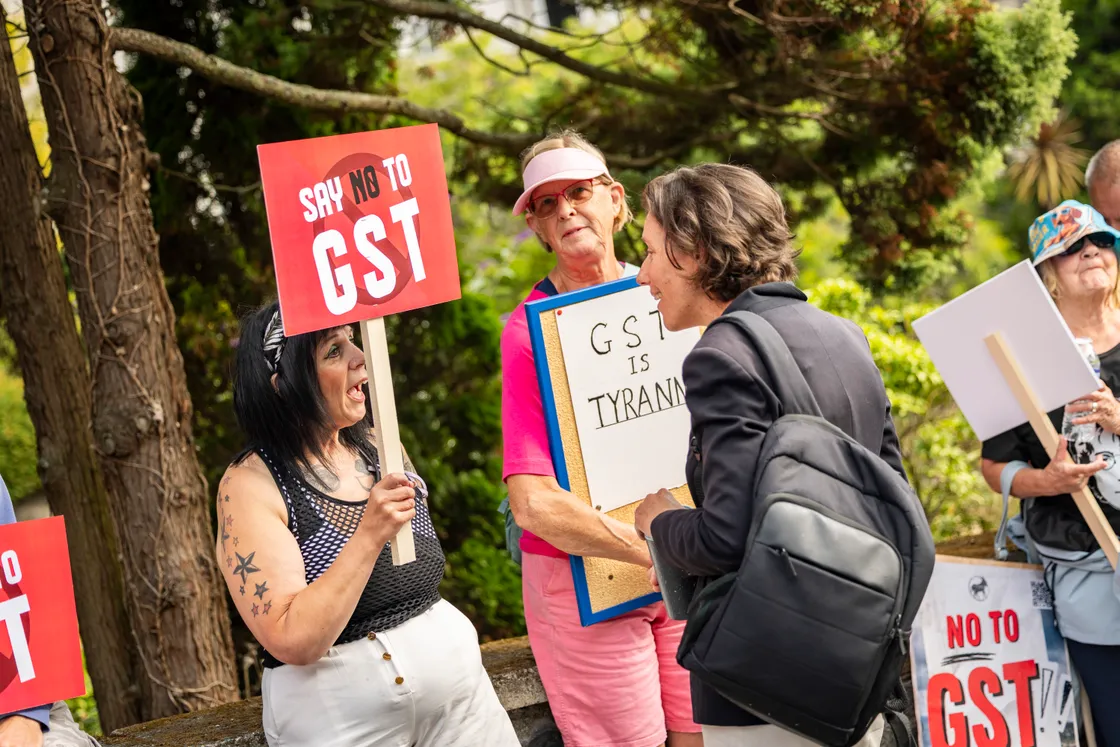
Her comment was highlighted by a protestor outside the chamber with a megaphone interrupting her speech and shouting ‘no to GST’.
Earlier, deputies were greeted by a crowd of more than 200 as they arrived for the July meeting, with some giving speeches on the steps of the States ahead of debate on P&R’s controversial tax package.
Deputy de Sausmarez said the proposals addressed the fact that change was needed to the way in which public services were funded, which was becoming less and less sustainable.
Over the years successive assemblies had realised that there were risks in relying so heavily on taxing income, which had accounted for about three-quarters of the States‘ tax take over the years.
Change was needed and the issue was how to make it efficient, effective and fair, said Deputy de Sausmarez.
‘The more heavily we depend on income taxes alone, the more we place the burden of funding public services on the people who earn their living through employment, self-employment, and enterprise,’ she said.

‘Increasingly, that burden falls on our working-age population, and particularly on younger generations.’
She herself would not support a standalone GST, since she opposed regressive taxes that disproportionately affect people with less money. ‘But these proposals are designed to invert that impact, to help those with less while also raising more revenue overall,’ she said.
She said she made no apology for the proposals raising revenue from corporates, visitors and the island’s wealthier residents in order to shift some of the tax burden from individuals, while funding a significant tax cut for the majority of households.
Among the impact of the changes would be closing the funding gap so that there could be investment in infrastructure, the economy and public services, while reducing over-dependence on income-based taxation.
It would capture contribution from wealthy residents who paid little or no income tax, and ‘address long-standing inequalities or inequities in parts of the social security and transport taxation systems, and make our public finances more stable and sustainable, so that younger and future generations have a real hope of staying in or returning to their island home.’
While many people had objected to the proposed GST, very few – if any – had objected to the proposed reductions in income tax and social security contributions that were a central part of the proposals.
‘These proposals have been deliberately designed to direct the greatest benefit towards lower and middle-income households, rather than higher-income households,’ said Deputy de Sausmarez.
P&R had undertaken to leave no stone unturned in examining the problem.
‘We now have a broader, better balanced, and more workable set of proposals that draws from more sources and softens the landing of necessary tax reform.’
If approved, the proposals would not only address the structural funding gap but broaden the tax base to help protect the island‘s credit rating, she said, and to enable investment in and support of economic growth, housing, and people’s needs and aspirations. ‘We can improve our resilience,’ she said.
‘We can protect those most vulnerable to rising costs, and we can provide meaningful tax reductions for the majority of households, especially those struggling with the cost of living.
‘That is probably the single most significant action we can take to make a positive difference to islanders’ lives.’




You need to be logged in to comment.