
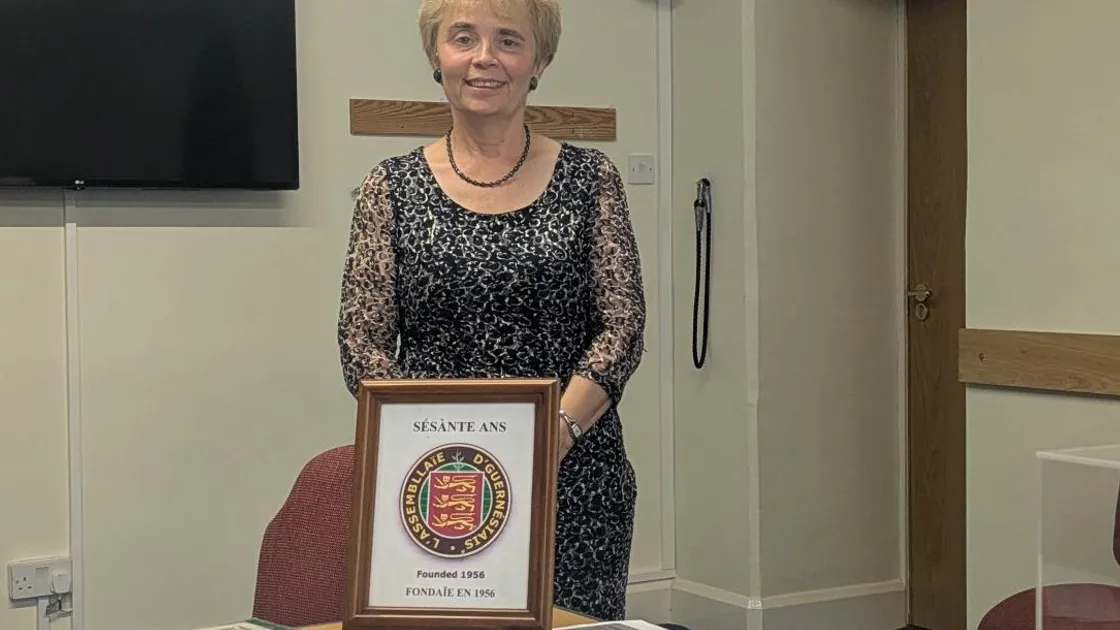
Mari Jones, a French linguistics expert, started to develop a relationship with the local language at university when she was studying how languages develop into each other.
‘I was looking at the development of Latin into French and then the relationships between French and Norman French, and that then eventually led me to the Channel Islands,’ she said.
As a native Welsh speaker from Rhymney Valley, she said the Channel Islands’ languages stood out to her.
‘I’m Welsh, and I’ve always spoken Welsh. It was that idea of a little language living alongside a big language like English,’ she said.
By the end of the 1990s, after joining Cambridge as a lecturer, she had begun learning Guernesiais and had planned her first trip to the island.
‘It was lovely. The people were so kind and gave me a lot of time when I first came over. I made a lot of friends.’
More than 20 years later, Professor Jones has maintained her relationship with the island and her interest in Guernesiais, which she has found echoed within her university community.
‘The university is extremely interested in the work I do. It has promoted me through the ranks to professor,’ she said.
‘I also include it in the courses I teach and I always find my students are fascinated by it too. We look at why it’s spoken, why it’s different, the literature and also how different accents have developed around it.’
Professor Jones has also found people’s fascination with Guernesiais to extend around the globe.
‘People are very engaged.
‘I’ve been invited all over the world. Japan, New Zealand and I was recently in Vienna talking about it.
‘It’s so rich, but also such a small language. And it has an incredible heritage. It’s been such a pleasure to study it.’
Beyond her academic interest in the language, Professor Jones has also become a keen advocate for the survival of Guernesiais.
‘It’s so important to keep it alive,’ she said. ‘It’s somewhat purer than Norman French today, which has been fairly diluted by French. It gives you a unique view of the world that no other language will give you. It gives you an understanding of Guernsey and its literature. It’s also people’s native language here, their family language. And the world would be such a sad place without its linguistic diversity.’
It is in light of her enthusiasm to see the language thrive that she is also a staunch supporter of L’Assembllaie’s work and felt it important to travel to the island for its 70th anniversary.
‘We have to celebrate the role of L’Assembllaie in keeping the language alive.
‘It’s bringing people together to speak it and creating contexts where it is used as the primary language, and that is so important.’