

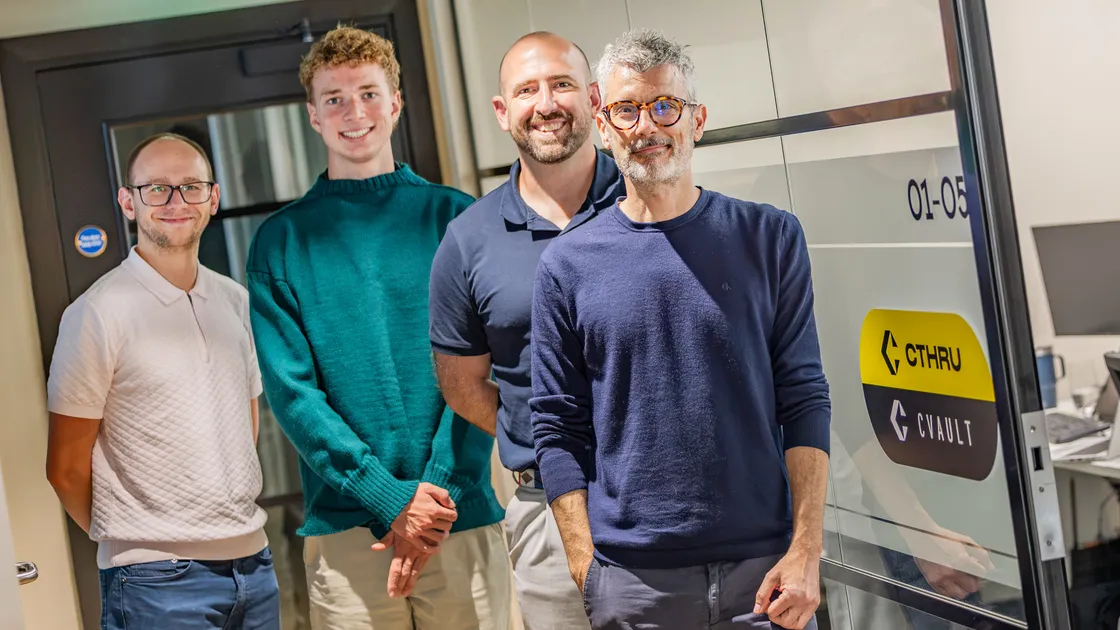
Albert Climent, co-founder and CEO of CVault, was one of the people behind the island’s first Bitcoin summit earlier this year, which brought together industry experts, advisers and regulators to discuss the future potential of finance, in particular how digital assets, such as Bitcoin, are evolving and what that could mean for Guernsey.
Mr Climent is an entrepreneur who has previously worked in emerging markets in several global south countries.
On moving to Guernsey three years ago, he teamed up with islander Jamie Winterburn and between them they identified a gap in the financial services market.
‘Traditional wealth managers and fiduciaries were scared of on-boarding any clients with crypto exposure,’ he said.
‘Their conservative approach to digital assets was contributing to a massive loss of business to the island, of benefit to other jurisdictions perceived as more progressive and commercially attractive.’
The pair set up CThru, a consultancy which acts for regulated intermediaries.
If a company wanted to bring in clients who had a certain amount of Bitcoin, for instance, and was concerned about the risk or provenance, CThru would carry out forensic investigations and prepare a report to assist in satisfying the regulated intermediaries' requirements for enhanced measures, due diligence and enhanced due diligence. This proved to be a success, but led to another issue – where to locate the Bitcoin.
Mr Climent says a ‘superpower’ of the currencies is that it can be held by the owner in any location, but firms taking on clients with massive amounts of the crypto currency wanted a third party to be responsible for it.
There was nothing like that in Guernsey, so Mr Climent, along with Mr Winterburn and with the help of Steve Moore, a local crypto legal expert, founded CVault, which acts as a secure custodian of the digital assets.
It was when finding somewhere to work collaboratively became an issue that they turned to the Digital Greenhouse.
Up to that point, CVault had been run from his home but Mr Climent said he did not want to have to hold meetings with clients in his garage.
‘We gathered at the Digital Greenhouse to gather our thoughts and to use a white board,’ he said. ‘It provided a community aspect as well.’
The company made use of the greenhouse’s meeting rooms and facilities for about four months.
Although when it was founded the Digital Greenhouse was designed to be an incubator for start-up companies, Mr Climent said that in his case CVault ‘did not need any hand-holding’.
He thought it a pity that it was under threat, but said that in order to survive an incubator needed a lot of people with ideas.
‘We need more entrepreneurs in the island. We should be preparing kids to become entrepreneurs.
‘We need people to create ideas.’
Economic Development said yesterday that ‘several exciting companies’ had expressed an interested in taking on the role of the Digital Greenhouse.