

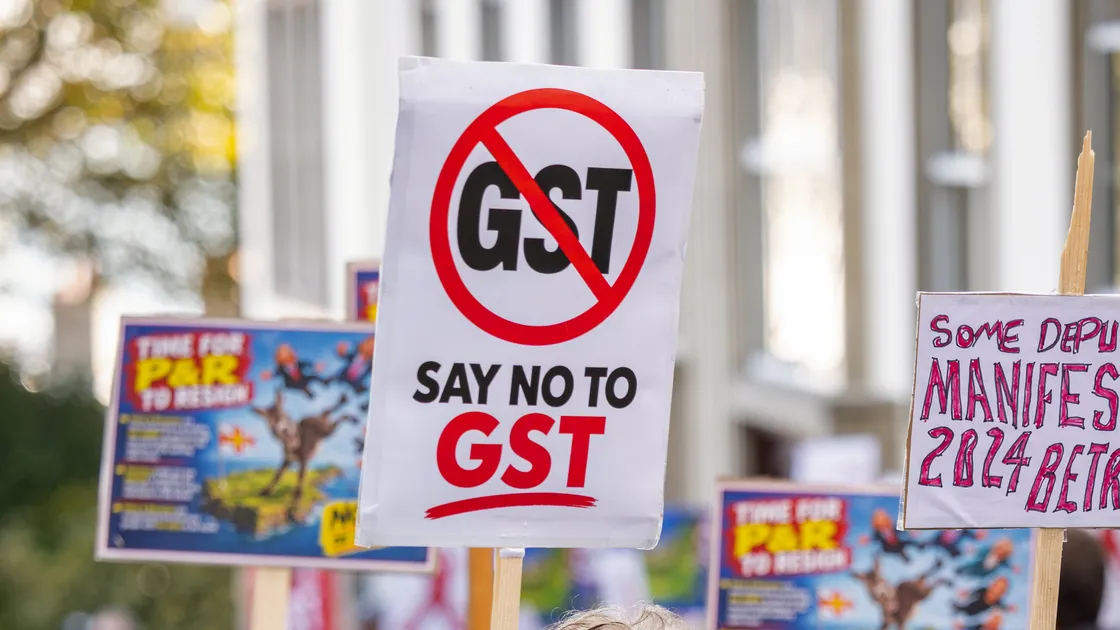
Policy & Resources is now pencilling in 2029 as the start date of GST at 3%, if deputies vote for its wide-ranging reform package at the end of their landmark tax and spending debate.
And an amendment to the senior committee’s package was approved on Thursday which anticipated raising the rate to 4% two years later and 5% two years after that, if the next Assembly’s independent Fiscal Policy Panel backs such changes.
The amendment, proposed by Gavin St Pier on behalf of his party, Forward Guernsey, also anticipated further reductions in income tax and social security contributions to limit or eliminate the additional cost pressures of increasing GST on less affluent households, and making it harder for the States not to maintain the real-terms value of those measures.
In addition, the amendment proposed that the States should be given a vote this time next year on various ideas contained in Forward Guernsey’s manifesto, including an additional tax allowance to encourage young adults to live in the island and tax-free savings accounts to help first-time buyers get on the property ladder.
‘This amendment is designed to grow the economic capacity of the island, helping to deliver wider tax reform and ensure its fairness, particularly for low- and middle-income households, younger earners and those seeking to save to be able to buy their own home,’ said Deputy St Pier.
He argued that increasing GST to a maximum of 5%, while also lifting the measures to limit its impact, would leave States finances about £15m. a year better off without taking more tax overall from lower- and most middle-income families.
Deputy St Pier said that treasury projections showed the hole in States finances growing in the years ahead, even with GST at 3%, and warned that they would still be vulnerable unless there was a continued shift from income-based taxation to consumption-based taxation.
But he also believed that 5% would be ‘the upper limit of a broad-based consumption tax’ and that some goods and services would have to be made exempt if the rate exceeded 5%. His amendment proposed incorporating the 5% maximum in the States’ fiscal policy framework.
The amendment was approved by 21 votes to 16, with three members abstaining, and must still win a final vote at the end of the tax and spending debate before it becomes agreed States policy.
Deputy David Dorrity said his supported the amendment as it ‘establishes a clear pathway for GST from 3% to 5% if it is proven necessary’.
Deputy Andy Sloan described the amendment as ‘an inflationary path to introduce higher taxation’ and claimed that would be the consensus view among economists.
P&R’s treasury lead, Deputy Charles Parkinson, said he was unable to support the amendment because it would be ‘perceived as a glide path to 5% GST’, an outcome he hoped was avoidable.
Lee Van Katwyk disputed claims that the amendment would effectively introduce a 5% ceiling on GST.
‘Realistically, what is going to happen when we’re still struggling for money because we haven’t sorted out our underlying issues?’ he asked.
‘We’re going to move in line with Jersey, then put GST up to 10%, and who knows 10 years down the line it might be 15%.’
Deputy Van Katwyk was one of several members to warn again that cost of living pressures were driving some younger people out of the island and predict that gradually increasing the rate of GST would make that problem worse.





You need to be logged in to comment.