

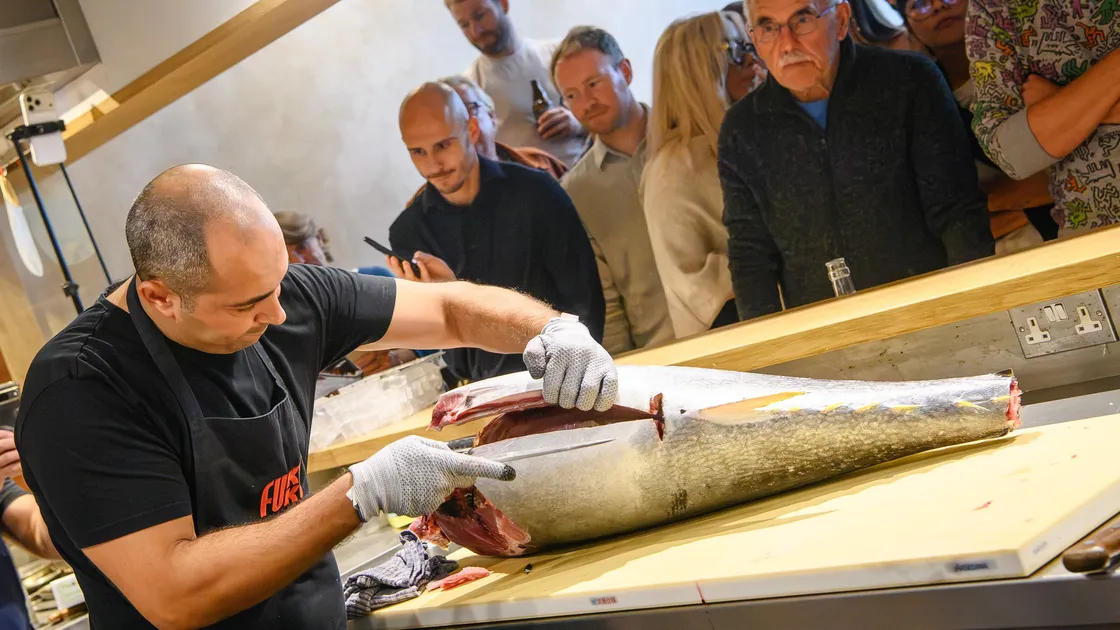
However, catching and landing tuna is currently prohibited in Guernsey, so the fish came from Jersey waters.
Fukku restaurant owner Sam Jarrold organised the event, where customers watched chef Khaled break the fish down while the team prepared some dishes for sampling.
‘We’ve been very keen to get local tuna on the menu, but obviously we’re limited because there are no licences in Guernsey. Fortunately, we were put in touch with a project in Jersey called Regen, which is looking at developing more diversity in farming and food production,’ he said.
‘One of the people involved is also working with the fisheries sector and has been helping tuna fishermen get their product to market and highlight its premium quality.’
Mr Jarrold, Khaled and restaurant manager Mikella met the fishermen a couple of miles off the coast of Jersey last Monday.
After about five hours at sea, they landed a 40kg bluefin and 35kg bluefin and took them into port to register the catch with Jersey officials.
‘The fish were then loaded into body bags packed with ice and transported back to Guernsey that evening,’ he said.
‘We’ve had them dry-aged in our dry-ageing cabinet for six days. That helps draw out moisture, which improves the tenderness of the fish.’
Removing moisture also helps preserve it, so it lasts a little longer.
The event was organised at short notice, but served as an opportunity for people to see how large fish are prepared and have a taste.
The restaurant regularly receives tuna weighing up to 150kg or 200kg from suppliers in the UK, with wild bluefin coming from places such as Spain and Canada.
The rest of the fish would be prepared into blocks and super frozen at minus 60C to retain the texture and quality.
In addition to the event, it served as an example of the important of sourcing local food and reducing food miles and the opportunity for inter-island food trade.
‘It’s opened up a link with Jersey that we didn’t previously have. It isn’t just about tuna. We’ve met farmers over there and there are things Jersey produces that Guernsey doesn’t, and vice versa,’ said Mr Jarrold.
‘If Guernsey’s fishermen receive a licence for bluefin tuna, we’d be in a fantastic position.
‘The fishermen we were with were quite confident that the larger bluefin are actually found in Guernsey waters.’
One former fishmonger, who asked to remain anonymous, said it was a ‘brilliant story’ and it was an example of what was possible.
But he said it is frustrating that local fishermen need to go to Jersey to access bluefin tuna.
‘We’ve had opportunities to pursue licences here in Guernsey for years, but it feels as though not enough has been done,’ he said.
‘I met with Sea Fisheries around four years ago and was told applications would be made and that local fishermen could potentially be at the front of the queue for licences. Yet here we are, with Sam having to travel to Jersey, catch a couple of fish there and bring them back to Guernsey.’
He said the wider fishing industry is facing significant challenges, with crab and lobster stocks under pressure, scallops impacted by octopus and traditional species such as brill, turbot, monkfish and Dover sole becoming much less abundant.
‘At the same time, we’ve seen the emergence of what could be an important new fishery in bluefin tuna.
‘There now appear to be significant numbers of tuna around the islands, yet local fishermen are unable to benefit from that,’ he said.
‘We once had a thriving local fishing industry based on a wide variety of species, but many of those traditional fisheries are not what they once were.
‘Meanwhile, bluefin tuna represents a major opportunity, yet it’s one we’re currently unable to take advantage of.’