

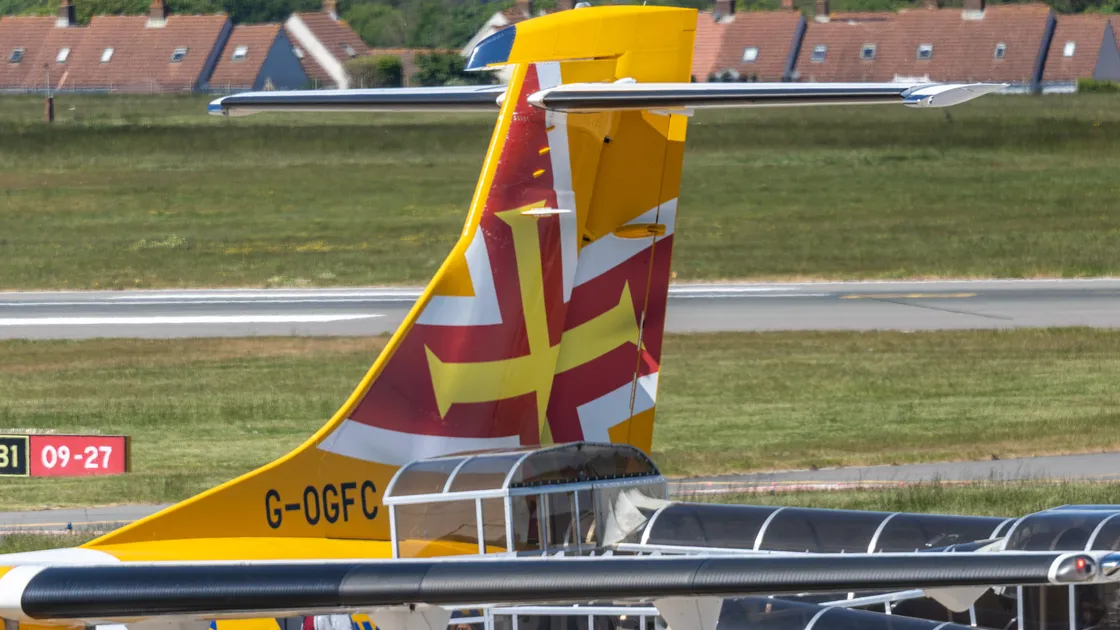
AURIGNY has told deputies that it can eliminate its trading losses next year through its own efforts – and the £5m. of losses that it will not be able to shift are largely ones imposed on it by the States itself.
In a briefing to deputies this week, the States-owned airline set out a plan to cut its full-year loss from £9.7m. in 2026 to £5.7m. in 2027, a reduction of about 40%, chiefly by handing back its sixth aircraft.
It argued that, stripped of external shocks and costs outside its control — particularly fuel and the States-subsidised British Airways Heathrow service – the underlying business is already at or above break-even.
The briefing was both a defence of a bruising year and a pointed message to politicians – decide once and for all what you want your airline to do, and fund that choice, before judging Aurigny on its losses.
A record year and a heavy loss, at the same time
Aurigny carried 512,267 passengers between January and September, up 19% year-on-year, and had its busiest-ever summer.
Reliability also recovered after a run of poor years – 86% of flights arriving within 15 minutes of schedule. Its average fares were around 10% lower in real terms than 2025.
But despite all that it still expects to lose £9.7m. for the year.
As Aurigny itself said: ‘We carried more passengers, more reliably, at lower fares, and we made a £9.7m. loss. The two facts belong together.’
The airline said four pressures drove the loss, each one, it argued, largely beyond its control.
There was £2m. a year in fixed costs in respect of the sixth ATR72-600 taken on after Blue Islands collapsed in November 2025. It used standby capacity over the winter.
A £1.4m. rise in fuel costs, about £1m. of it from record jet-fuel prices sparked by the war in Iran and its repercussions. Aurigny was among small carriers making national headlines for cutting back on flights between April and June. Although it ‘trimmed’ 450 flights over that period and raised a fuel levy, it said the full costs were not passed on to customers.
There was an 8% fall in UK air fares as demand weakened as the Iran conflict began. Aurigny said it acted to match capacity to demand rather than flying empty seats, and also had to use some tactical discounts.
And the loss of around 49,000 subsidised BA Heathrow seats from April, which the airline has claimed cut its Gatwick yields by about 12% and London City passengers by 43%. It had to respond with promotional pricing to hold passengers and had to continue to protect its Gatwick slots.
It also paid the States £11.7m. in the first nine months of the year – in respect of airport charges, social security, tax and interest, which was up 17% on last year.
If it could strip out fuel costs, the Heathrow impact and other one-off items, then the business would have done better than breaking even this year, it said.
‘We controlled what we could control’
Aurigny said it had delivered the strategy its shareholder approved – protecting lifeline routes, simplifying to a single main fleet type and squeezing more from each aircraft.
With no Dorniers or Embraer jets in the fleet any more, Aurigny was operating only ATR72-600s and ‘damp leasing’ its Twin Otters on the Alderney route.
Fewer than 1% of its Gatwick flights were cancelled over the summer, and its average delay in August services was the third-best performance of 29 UK airlines.
Almost three-quarters of its flights were on lifeline routes, including Jersey for the first time and its move on to Southampton to replace Blue Islands, where it carried more than 350,000 passengers – up 38% on last year.
Total overheads per passenger fell 14% in real terms, fuel hedging saved an estimated £1.3m., and trimming around 450 flights between April and June avoided £0.69m. in costs.
It flew 38% more flights per employee than in 2019, with staff costs per passenger down 18% in real terms.
It also made the case that it is keeping Guernsey exceptionally well connected, claiming the island has more London flights per head of population than Jersey, Edinburgh, the Isle of Man or any comparable region.
How the 2027 loss will be reduced
The central move is returning the leased sixth aircraft at the end of its lease in March 2027, saving about £2m. a year – described as the single biggest saving in the plan – while keeping 97% of this year’s flights with five aircraft.
Other savings come from ending short-term wet-leasing, rationalising the network and a lower-cost Alderney operation, alongside longer Guernsey Airport opening hours in summer 2027.
But Aurigny was explicit that most of what could blow the plan off course is external: fuel prices, softer demand, and – pointedly – the subsidised Heathrow service, warning that any further subsidised route entry ‘would worsen the result’.
Risks to the savings plan could include more volatility in the price of fuel, demand softening across the network, changes to the States air policy framework, and, of course, Heathrow.
Why it won’t go below five aircraft
The airline mounted a pre-emptive defence of keeping five aircraft, calling it ‘the floor’. Removing another would save around £2m. but leave no standby cover for lifeline routes.
It argued the non-lifeline routes – a third of its passengers and revenue – are flown mainly in the middle of the day using aircraft and crews the lifeline peaks already require, and contribute towards fixed costs that would otherwise, it said, fall on lifeline fares or the taxpayer.
Alderney – right call made but service not yet right
On Alderney, Aurigny defended switching from Dornier aircraft to Twin Otters – modelled to save £1.1m. a year, 44% of the subsidy – as the right decision forced by the States’ request to cut the public service obligation from a maximum of £2.5m. to £1.5m., when the two Dorniers cost £3m. a year to run.
But it conceded the service ‘is not yet right’. While technical reliability had improved markedly, with cancellations for non-weather reasons down to 1.5% from 4.6% a year earlier, it acknowledged that recent disruption in March and this month was caused by crew-availability problems at operator Skybus.
A second rebuilt Twin Otter dedicated to Aurigny is due ‘within two weeks’, and the airline said it was taking more direct control of crew recruitment and planning.
The decision Aurigny wants from the States
Underlying the whole briefing was a demand for political clarity.
Aurigny quoted the States Trading Supervisory Board’s own statement to the Assembly in April back at deputies in the briefing – that it ‘cannot be expected to be both a fully commercial carrier and a social utility, and judged as both at once, without that conscious choice being made’.
The timetable is tight.
The 2027 States Budget debate, including Aurigny’s loss provisions, starts next week.
The Air Policy Framework expires at the end of 2026, with Economic Development due to bring forward a new approach to air connectivity, while the STSB and Aurigny work up a future operating model and longer-term funding proposals.