

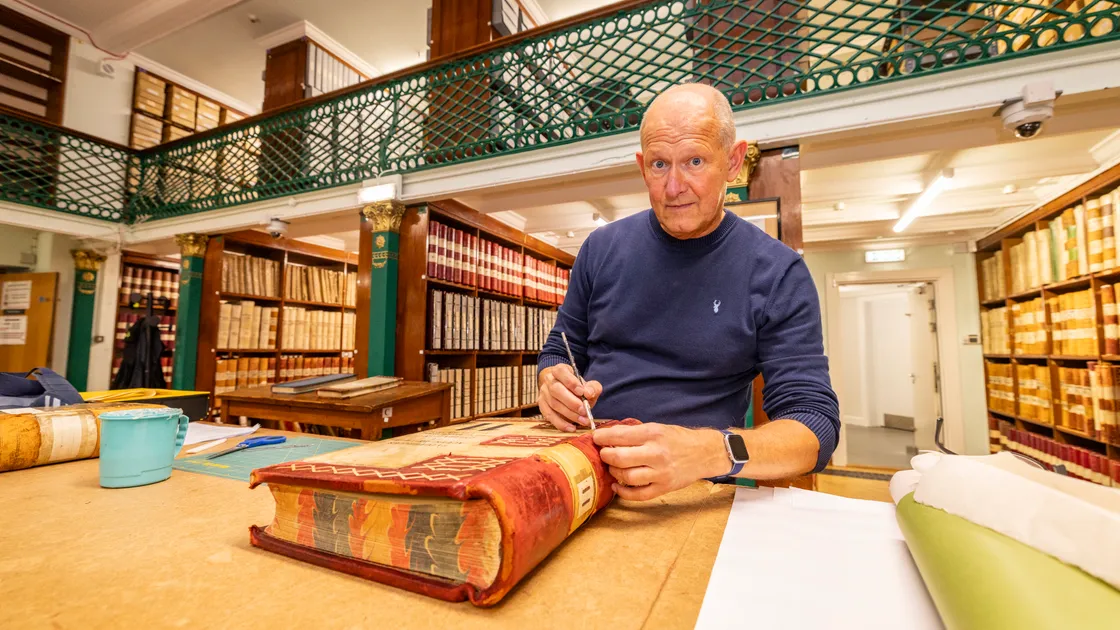
From centuries-old court records and handwritten marriage registers to crumbling copies of the Guernsey Press, bookbinder Andy Graves has spent about 35 years preserving the island’s paper trail.
The 63-year-old, from Sycamore Bookbinding in Nottinghamshire, boards the ferry to Guernsey six times a year, bringing his tools and traditional craftsmanship to repair and restore documents that tell the story of island life.
On his latest visit, he was hard at work in the Royal Court’s Strongroom, surrounded by shelves of historic records, carefully repairing worn leather bindings and strengthening fragile pages.
‘I’m really only refurbishing things that can’t go off the island,’ he said.
‘These are public records, they’re in use most days. I’m tidying them up, basically, so they’re not going to get worse.’
The Greffe holds birth and death records dating back to 1840, conveyances from 1567, and charters dating back to the 14th century, including one from the reign of Henry VIII.
Head of registration David Jehan said the handwritten registers remained an important resource for islanders.
‘We’ve got people in there daily conducting family tree research, genealogical research,’ he said.
‘They’re turning the pages, and obviously over time you get wear and tear. We’ve got to look after it because it’s the only record that we hold for the island.’
Mr Graves works through a rolling programme of repairs, identifying books requiring attention and gradually restoring them during his visits.
Some are bound in vellum or calfskin, with elaborate stitching and brass fittings, while damaged pages are repaired using specialist Japanese paper.
‘These would have cost to reproduce now, you’re talking hundreds and hundreds of pounds,’ he said, examining one particularly elaborate cover.
‘Where they’ve split, I’m trying to put a repair in, and maintain them before they get too bad.’
But his work is not confined to preserving the past.
Every year, local marriage returns are collected and bound into permanent registers, ensuring today’s records are preserved for future generations.
And Mr Graves has also been tackling a substantial collection of historic Guernsey Press newspapers, carefully dismantling old bound volumes to make them easier to digitise.
‘I’ve just brought back 12 years’ worth,’ he said.
‘Because the newspaper’s quite acidic, they’re all tearing and falling apart. The project at the moment is to take them out of the bindings and turn them back into individual newspapers.’
Having spent three months working through the latest batch of daily papers, he has already collected another 11 years’ worth.
His work comes as more of the island’s historic records become accessible online.
In April 2025, a major digitisation project involving the Greffe, Priaulx Library and Island Archives made 210,000 pages of archival documents available through family history website Findmypast, while the original records continue to be preserved.
For Mr Graves, every project brings a different challenge.
‘I enjoy the variety of it,’ he said.
He entered the trade at 16, after a school careers adviser suggested his talents for woodwork, metalwork and art would be better suited to a practical profession than a desk job.
He went on to complete a five-year apprenticeship in Nottingham and has remained in the trade ever since.
‘Every day is different,’ he said.
‘It can be just a new bind. It can be a full restoration. You never know what’s coming through the door.’
And it has come with a lot of responsibility, with highly valuable and delicate pieces under his care.
His work has ranged from restoring treasured family cookbooks and rare maps to repairing first-edition Tolkien books and creating replica passports for television productions.
One recent project involved a book valued at £30,000 which required a complete restoration.
Mr Graves also works on historic records in Sark and Alderney, as well as rare editions of The Book of Sark, originally produced by artist William Toplis.
He recalled restoring one particularly special copy that had been given to a Guernsey tailor in payment for a suit after the artist was unable to settle his bill. The book had remained in the family for generations.
Such projects, he said, were about far more than repairing paper and leather.
‘You don’t get rich doing this, but you get a lot of satisfaction.’