

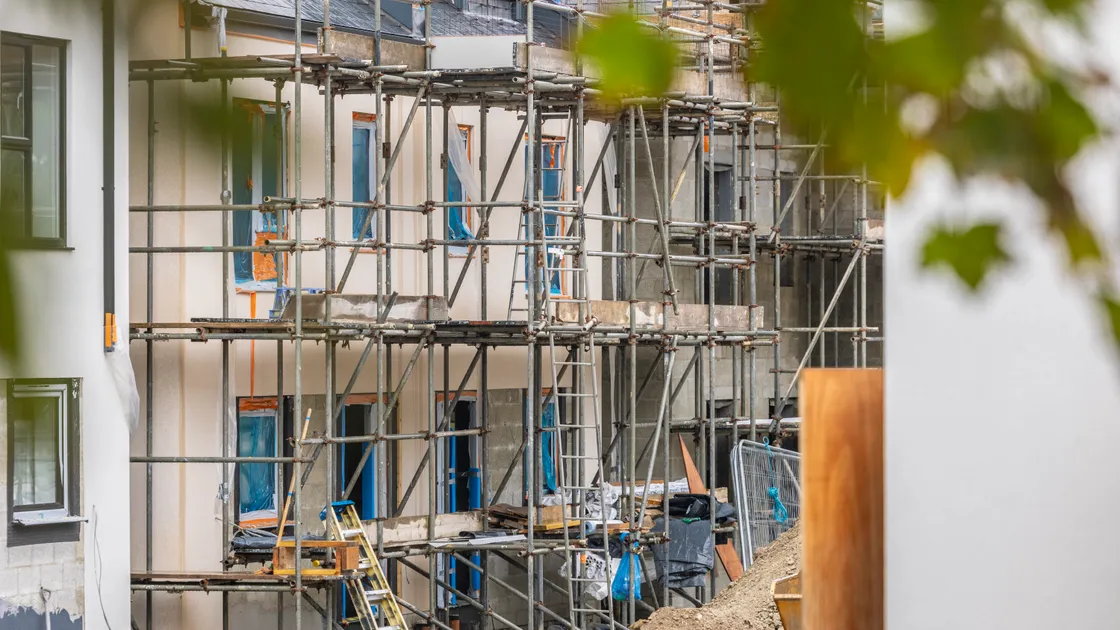
The Guernsey Building Trades Employers’ Association was responding to the planning service’s latest two quarterly monitoring reports.
But while many new homes are now in progress, last year just 62 were added to the housing stock, the lowest number since 2016. That was 10 fewer than in 2024 and continues a decline in net additions from 155 in 2021.
That is compared to the States’ housing indicator’s call for about 300 new homes a year, including 135 affordable properties.
Overall, though, builders are encouraged. A GBTEA spokesman said the group would continue to be engaged with the States in identifying and removing blockers to enable developments to continue to progress through planning and into construction.
He said that one such blocker that has been removed as a result was the GP11 policy, which called for a proportion of all new accommodation developed to be classified as affordable homes for rent or shared ownership and its removal had undoubtedly contributed to the building ‘boom’.
The report also showed that affordable housing stock has increased by a net of only one home in three years – none were added last year or in 2023.
Meanwhile, there are just over 1,200 homes in the pipeline having received planning permission, although many of these – 1,100 – are in the private market and only 154 are affordable. The number of private homes is about three times the two-year requirement set out in the report, while the affordable homes figure falls short of the 243 to 296 needed.
Approvals for new developments for the first two quarters of the year saw 74 new homes approved in the first three months and 44 in the second, the latter below the three-year quarterly average of 69.
Of that 44, 37 were conversions and that included four schemes turning offices into flats. The largest approval was for 12 dwellings at Eton House in Rue du Pre, St Peter Port.
The Island Development Plan was adopted in 2016, and in that, 15 sites were set aside for housing.
To date, 220 homes have been approved, while a total of about 780 homes at Belgrave Vinery, Franc Fief and the Saltpans have no planning permission.
The GBTEA spokesman said that it was encouraging that approval had been given for homes and that progress was being made on planned developments. ‘But it will be several years before people are moving into new homes on these sites. In the meantime, we must focus on small to medium developments on suitable sites.’
These sites could be financed, designed and constructed relatively quickly within existing processes and local capability, he said, and that would help address the immediate housing needs.
The Development & Planning Authority will propose nine new sites to be designated a priority for affordable housing in the States later this month.
The Housing Committee is looking to supplement affordable housing being developed by the Guernsey Housing Association with its own programme, said committee president Steve Williams.
‘We also want to see an active private development sector, which is why we’ve been working with developers of the larger sites to help understand the issues they face and, where possible, try to remove some barriers,’ he said.
‘What we can’t currently do is force developers to bring forward housing on their sites. Larger housing sites present challenges in being brought forward, and there are a range of factors that influence when development takes place such as access to finance, construction costs, construction industry capacity, landowner expectations and planning permission.’
Housing was also working with the DPA to bring forward priority affordable housing allocation sites ahead of the November States meeting.
‘One of the benefits of these sites is that it will allow the committee to crack on with some readily developable land for affordable housing without treading on the toes of the private market,’ said Deputy Williams.
‘These sites don’t face the same challenges as many of the States-owned development sites, which are important but have much longer timelines for a variety of valid reasons.’



You need to be logged in to comment.