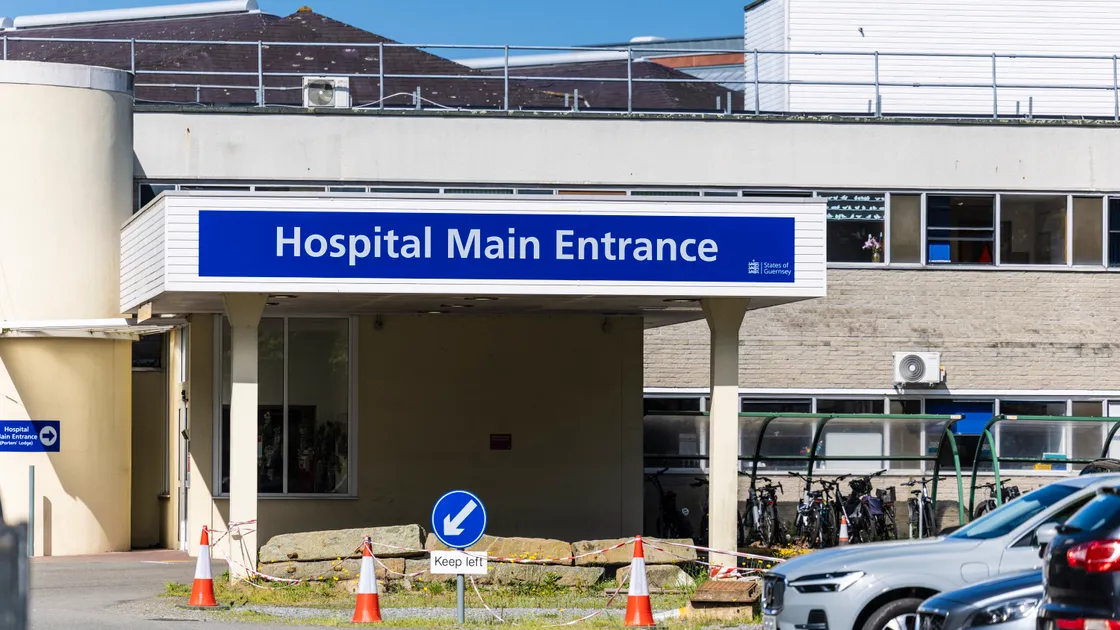
In his first update statement the new president of HSC, Deputy George Oswald, made a very big promise. He pledged that his committee would develop a plan for a sustainable health and care system, suitable for Guernsey’s scale and resources, by the end of this political term.
What did he mean by the word ‘sustainable’? Probably several things but it was clear that top of the list was financial sustainability. Indeed the HSC president made clear one of the biggest reasons why the way healthcare is delivered in Guernsey needs an overhaul is that otherwise his department will need an extra £6-8m. a year, on top of any inflationary uplift.
How can that be prevented? Or to use Deputy Oswald’s exact term, mitigated. Obviously he wasn’t in a position to give any details yet, but he suggested there would be a three-pronged approach.
Firstly a look at what is provided. Secondly consideration of who should provide it. Thirdly who should pay for what – in other words what part of the healthcare tab is picked up by the taxpayer and what part by the patients themselves. All of these are potentially controversial policy considerations. In particular the first and the last.
So my response to this ambitious public announcement is simply ‘Good luck’. And I mean that in both the straight and the slightly ironic sense of the phrase.
The straight sense because it’s something that clearly badly needs to be done. So full marks to HSC for stepping up to the plate. I genuinely wish them well.
The ironic sense because as someone who spent more than 14 years on previous health committees I know how incredibly difficult such reforms are going to be to deliver.
Let’s look at the three suggested approaches separately. Firstly how much healthcare should be made available to Guernsey people?
It is going to be nigh on impossible to prevent healthcare provision from continuing to grow – let alone actually managing to reduce it. Two reasons for that.
Firstly every year there is so much more than could be provided as healthcare develops and new treatments and procedures become available. Secondly the changing age profile of our community is going to greatly drive demand.
Of course, in theory, neither factor means an increase in healthcare provision is inevitable. The States and HSC could simply say to the population ‘We don’t care how much need there is, or the fact that such care pathways and treatments are available elsewhere, we are strapped for cash, so they’re not going to be available in Guernsey’. Good luck with that – ironic sense.
So it is pretty much inevitable that the quantum of healthcare delivered in Guernsey, and for Guernsey people in UK tertiary centres, is only going to grow. The only question is by how much. So let’s look at HSC’s other two suggested approaches.
Firstly consideration of how, and by who, such care should be provided. I definitely think there is some mileage here. While safety and quality are both crucially important there may well be some services which can be delivered by GPs instead of specialists. Or nurses, or pharmacists, instead of doctors. So definitely worth pursuing but I somehow doubt it is going to do the heavy lifting.
Which brings us to the most contentious consideration of all. Who foots the bill for all of this healthcare?
I expect the message from the review will be that Guernsey’s unusual, low, and fragile, tax structure means it can’t continue to be funded by general revenue to the proportion it is now. Fine. Understood. But the only other alternative is for patients to pick up the slack themselves. Whether that is through expensive health insurance, or simply being billed for more of the healthcare they receive, it is going to prove to be hugely controversial.
In many ways it is going to be made harder by the fact that we are starting from where we are. Once a population has a sense of entitlement, built up over many years, taking things away from them always brings forth howls of anger. Far more so than if the government had never provided those things in the first place.
One small example. I suspect that one of the very long list of reforms the HSC will look at over the next three years will be whether to continue to provide all pensioners with free prescription medicine, no matter what their income may be.
If the prescription system was being introduced for the first time now, and HSC said, for example, pensioners on less than £50,000 income will get their medicines free, but those on higher incomes will pay the standard charge, I suspect it would probably come across as quite reasonable.
By contrast if they try to bring in such a system retrospectively so that old Mr and Mrs Le Cheminant suddenly have to start paying for their drugs, when they’ve been getting them free for the last 15 years, then cue outrage. (I suppose I should declare an interest in such considerations myself).
Of course there are many other areas of potential patient charges which would be even more contentious. For example, unless you go private, a stay in the PEH is currently free. So I guess HSC could bring in a daily food and lodging charge. They have already said this will be looked at, together with the possibility of charging those who can afford it for operations.
Please understand that I am not suggesting these happen. Indeed personally I would view them as a huge backwards step. Didn’t we bring in additional social security payments precisely so we could stop charging people for operations?
That said, what I am saying is that if HSC really wants to slow down the juggernaut of healthcare expenditure, to the extent that it becomes sustainable and affordable to the public purse, they really are going to have to think the unthinkable. They’ve said to the States and the island that they are up for that. I greatly respect that and probably understand more than most just how hard it is going to be. But it is a task which unquestionably needs doing. So I hope that public opinion will cut them some slack, rather than resorting too quickly to knee-jerk opposition to whatever they come up with.
I say it one more time: ‘I really do wish them the very best of luck.’