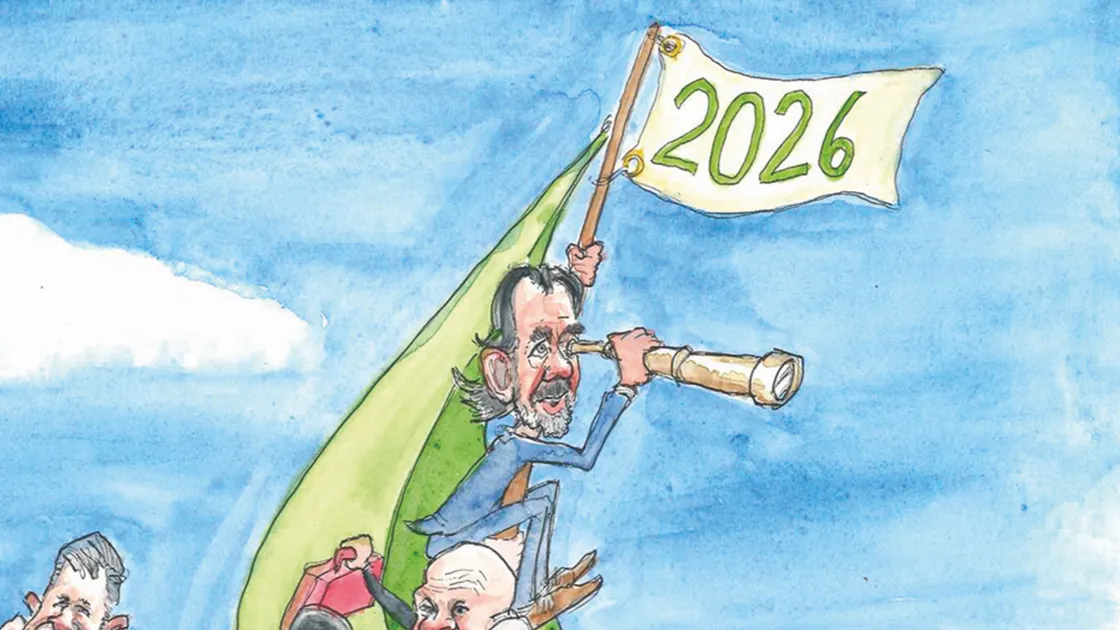
Whole forests have probably been felled in the States’ prolific production of voluminous work plans and service plans and business plans and strategic plans. The last States alone – after declaring on day one ‘enough of plans… action now’ – went on to produce Government Work Plans totalling just over 1,000 pages and containing more words than the longest book in the Harry Potter series, the mammoth Order of the Phoenix, which was also about how magic can turn far-fetched storylines into implausible results.
The 2020-25 States would almost certainly have acted the same way and made the same decisions, and achieved no more and no less, regardless of the 300,000 words in those plans or even if it had no plans at all.
Almost every States has been the same since the turn of the century, perhaps longer, as the emphasis seems gradually to have shifted from doing things to thinking, talking and strategising about them.
I recall once visiting a senior civil servant to share my concerns about this and finding virtually an entire wall of her office decorated with an elaborate scheme of boxes, circles and arrows apparently showing the relationships and conflicts between innumerable plans then under development, which she talked me through with immense enthusiasm but incomprehensibly.
I left in despair, seeing that the production and maintenance of this suite of plans had become more important than the actions and results they purported but largely failed to deliver.
The exception among recent States was elected in 2012. Horrified at the prospect of vast amounts of officials’ time and the money to pay for it being thrown at another round of plans of doubtful utility, the Assembly put them to one side, frustrated but realistic that it just wasn’t going to be presented with the kind of slimmed down, simplified game plan it would have preferred. That term proceeded without an equivalent of the States Strategic Plan it inherited or the Government Work Plan of later years. That wasn’t ideal – the States and its committees should publish what they want to achieve and be held to account against those commitments.
But the Assembly without a grandiose, rhetorical plan turned out to be the most constructive and productive of recent times. It would be a stretch to claim cause and effect, but the evidence I have seen locally, and from various other places where I’ve looked into policy planning, tells me that sweeping, lengthy, ambitious work plans are much less useful in government than most politicians hope and many officials believe. The lesson is not to abandon plans altogether, but to put tight constraints on the hours spent writing them, keep them extremely short and focused, and recognise that the conditions of government make them less significant than they usually are in business and always more likely to be blown off course by events, dear boy, events.
Encouragingly, the current Policy & Resources Committee seems to have learned some of these lessons.
Its draft Government Work Plan, which will be debated next week when the Assembly returns from its winter break, is still too long, at nearly 40 pages, but does at least concentrate on a small number of priorities. Developing the plan has seemingly not consumed a small army of civil servants, and its objectives are understated and unpretentious compared to the ludicrous bravado of at least some previous versions.
The plan could lose some focus if too many additional commitments are added by a growing list of amendments various deputies are expected to lodge by tomorrow’s deadline.
But this is a relatively small risk and P&R must balance it against the political cost of reflexively fighting every amendment out of excessive pride for its own work and then, having needlessly upped the ante, losing.
The bigger danger to sensible policy planning in this political term is what follows next week’s debate. Previously, even senior committees sceptical of over-planning have allowed the States’ work plan to become bloated and ineffective by giving into, or in the worst cases encouraging, the bureaucratic machine’s propensity for process, procrastination and perfection.
They then succumb to what I summarised many years ago as not wanting to do anything until they can do everything and therefore doing nothing.
This, presumably, is why P&R is asking the States to scrap the requirement for annual debates on the Government Work Plan and lay down no specific reporting requirements for policy planning in the future. It wants to remove the fuel which has driven the bureaucratic machine, but its critics believe it is fleeing accountability.
The States debate on the plan, and the amendments to add new commitments to it, will throw an early spotlight on perhaps the biggest issue of politics in 2026 – economic growth, or the lack of it, and all that flows from that.
States members have limited information about the island’s economic performance, and about the labour market and population changes and much else, because of the ongoing failure of systems which are meant to supply the raw numbers for a small and capable data team to crunch.
Quite why deputies are tolerating this fiasco without kicking up merry hell is beyond me. It implies casual indifference to the need for contemporary evidence when making policy.
Anyway, the latest figures which are available tell us that there was virtually no real-terms economic growth in Guernsey between 2019 and 2023.
After adjusting for inflation and population growth, Guernsey’s economy was smaller in 2023 than it was in 2017, 2018 and 2019. Published data on wages are 18 months out of date, but we know that in real terms average earnings declined by 2.8% in the year to June 2022 and by roughly another 0.5% by June 2024.
This all matters enormously. Declining living standards is arguably the single greatest issue of our time, fuelling not only financial hardship in households but discontent, extremism, and mistrust in the concept of democracy. This is a national, indeed international crisis with complex causes and no easy solutions.
In the draft Government Work Plan, P&R is asking the Assembly to agree five so-called super priorities which it expressly states will deliver sustainable economic growth. This may be wishful thinking, but some deputies read it as insufficiently ambitious.
They wanted to see the words ‘economic growth’ in the list of super priorities or some additional sentences linking each super priority to economic growth.
The cynic in me thinks that of course nothing smacks of having cracked the elusive recipe for economic growth more than altering a few words in a document which will have not the slightest effect on the size of the economy by the end of the political term in 2029.
‘Trust only movement,’ said an eminent Austrian psychologist 100 years ago. ‘Life happens at the level of events, not of words.’
The point is that stimulating economic growth is going to be supremely difficult. The largest economies in Europe are barely growing despite the huge power of their governments to pull demand- and supply-side levers.
The idea that Guernsey’s leaders, with many fewer levers to pull, could put another 2-3% on economic growth if they had just a bit more willpower, or slightly different wording in the Government Work Plan, is for the birds.
Events, not words. Only actions – changes on the ground, like different investment decisions, supply-side reforms, amending laws and improving productivity – might, and it is only might, stimulate higher rates of economic growth.
Sadly, there is no Harry Potter-like magic which can be sprinkled to bring about economic growth, and no rewriting or editing of the Government Work Plan is going to change that.
It is these economic realities, and how States members and States committees choose to debate and respond to them, which more than anything will shape the Assembly and politics locally this year.
For an A3 colour copy of Ross Le Brun’s artwork, see his Dad Makes Stuff Facebook page or message or call him on 07781 113562. An A3 print is £40, with £10 of that going to the Guernsey Motor Neurone charity.