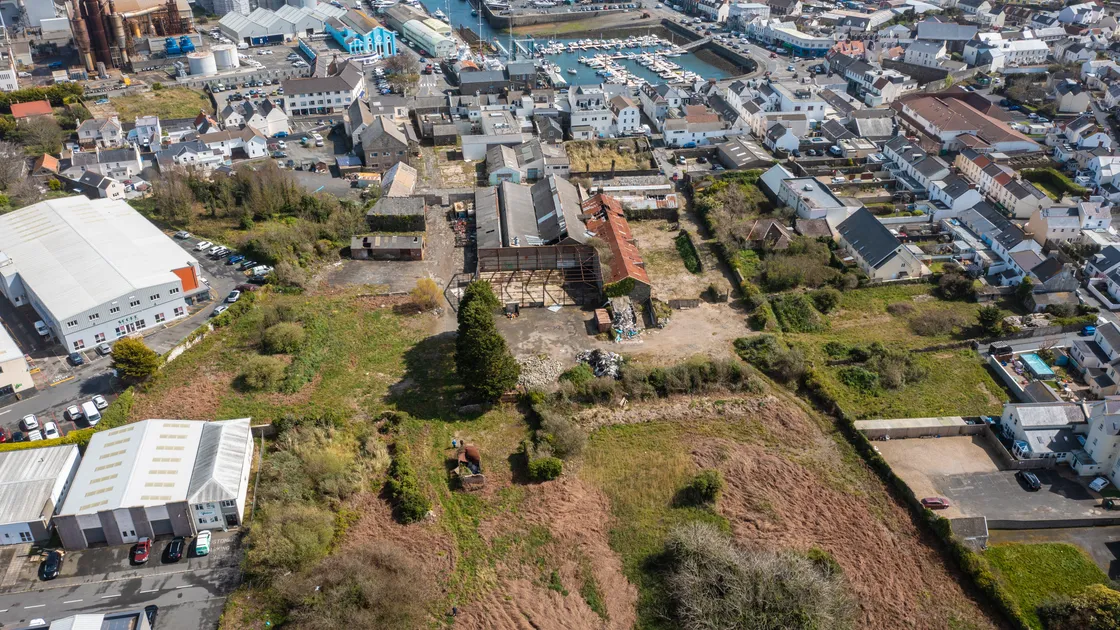
For too many years all of the development which has taken place in the north of Guernsey has meant the same thing. Additional pressure on the existing infrastructure, and a loss of green spaces and public amenity.
While it would be madness to create a uniform suburban environment across the island, by spreading development evenly like butter across a slice of toast, it’s no wonder many Vale and St Sampson’s residents feel hard done by. They simply feel their quality of life is being slowly eroded.
It doesn’t have to be this way. New development, particularly done at scale, can be the solution rather than the problem. It can be the conduit to providing much needed new infrastructure, taking pressure off the old. And it can actually provide public access to significant new green spaces.
Where is this ramble leading? Well there are a number of large sites in the north which are currently zoned for housing. If they all (or even most of them) come off, it will represent the biggest change in the physical characteristic of this part of Guernsey since the reclaiming of the Braye du Valle. So it is vital to get it right.
This was fully appreciated by the previous States who engaged Savills to do some master planning of the area. They appreciated that the opportunity existed to make the whole so much more than the sum of its parts. That was a good start but undeniably the States purchase of Leale’s Yard takes the opportunities to do much more than simply build houses to a whole new level.
We now have three of the biggest sites, all pretty much adjacent, under public or quasi-public control. Leale’s Yard is owned by the States while the former Kenilworth Vinery site and the ‘data park’ belong to the GHA, which is grant-funded, and therefore liaises closely with the States on new developments.
This creates many great possibilities, so it was music to my ears to hear P&R say they were effectively treating all three as one site. That is the right approach. Hopefully they will also take into account some of the privately-owned sites nearby when considering what infrastructure to install.
So what can be done? Well I am no expert, but surely one option is a new road to take the pressure off the congested junction between Braye Road and Route Militaire? Then, with the boom in cycling and e-biking, cycle lanes are surely a no-brainer, not to mention pedestrian routes.
But it is not all about transport. I know that part of the outline plan for the Kenilworth site was the creation of what would effectively be a new northern public park, consisting of a major water feature surrounded by green space. Obviously with all three sites now being regarded as a new super-site, then an even more ambitious approach can be taken to creating new, public, green spaces. Done right, development could enhance rather than erode the quality of life for those living in the area.
All that being said, there’s no doubt that one of the biggest benefits of these developments will be that they will also yield up many hundreds of much needed new homes. Guernsey’s housing shortage has been a blight on our community in so many ways. From making it difficult for our young people to achieve their own homes, to holding back our economy, and these sites could make an enormous difference. But once again it has to be done right.
Vic Slade, the head the GHA, is spot on when she says that there needs to be a real mix of tenures created on the publicly-controlled ‘super-site’, including some private market properties, and some affordable housing. There are three main reasons for that.
The first is funding the project. It is quite common these days for social housing projects in the UK to include some private housing to help the finances stack up. We’ve even started doing it in Guernsey. Both the key worker site at the Oberlands and the affordable housing project at the Mallard include elements of private housing which will be sold.
The second reason is the demand. While the States Strategic Housing Indicator shows the requirement to increase the proportion of affordable housing to private housing, there is still a need for both, and therefore both should be addressed.
Finally there are the social reasons. It simply leads to a better sense of community to have all sorts of tenures cheek by jowl rather than having very large estates consisting solely of, for example, social rented properties.
So I would expect to see this pivotal new development deliver lots of social rented homes for those who need them, lots of partial equity homes to help our young people onto the property ladder, lots of units suitable for older people wanting to downsize, a lot of new private properties to help ease that overheated market, and maybe a few key worker homes thrown in. All of that on top of creating vital new transport infrastructure and significant tranches of new public amenity land.
I have said it will represent the biggest transformation of the north of our island since the Braye was reclaimed, and so it is vital to get it right. But it also needs to be driven forward in a timely manner, the benefits are too important to dawdle, and after all Doyle didn’t hang around.
I am aware that I have spoken at length about the possible transformation of the northern parishes without mentioning once the ambitious plans of the GDA. Are they are beautiful vision, a nightmare, or a pipe dream?
Other questions also spring to mind. Will the public get behind them or resist them? And even if they receive public acclaim will they prove affordable?
Well we should get our first hint of the answers to those questions pretty soon. Why so? Well the clock is well and truly ticking on the requirement for the States to choose a new inert waste disposal site, and their preferred option will speak volumes.
At the moment the island’s inert waste is being stockpiled at Longue Hougue, but planning permission to do that is time limited. In theory that permission could be extended but there is still only so much material that site can take, and anyway stockpiling involves double handling, which is expensive.
So the pressure is well and truly on to identify the next inert waste tipping site. Particularly so if (as seems likely) the choice is to carry out another land reclamation project. That’s because it takes quite a long time to prepare such sites with the creation of rock-armoured bunds.
What has all of this got to do with the GDA? Well the prime candidates have to be Longue Hougue South and Black Rock. If the States chooses Black Rock it will be a strong hint, but not a guarantee, that the GDA’s master plan will enjoy a tail wind over the years ahead.
Which is the better site? Well if we were only talking about the best place to dispose of our inert waste then I would tend to favour Longue Hougue South. That is because I think it would provide more years of capacity for about the same price. Certainly that was the assessment a few years back.
Also if the area further out to sea is ever used for any sort of commercial ports provision, then reclamation here may well prove to have been useful.
At the same time I can’t help baulking slightly at the Black Rock plans. While I am not as concerned as Deputy Van Katwyk seems to be, as a ‘Bordeaux boy’ myself I don’t really relish the prospect of a large housing estate underneath the Vale Castle, at the entrance to St Sampson’s Harbour. Personally I find it the least attractive element of the GDA’s master plan.
That said, if the reclamation here achieves the twin benefits that the agency claims it will, then I am willing to try to overcome my objections. Firstly they are suggesting that Black Rock will provide the northern jumping off point for a new entrance to a much expanded port. Secondly they suggest that this part of the project could be the cash cow that helps to fund their other plans.
So what are those plans?
Well very much like the STSB plans a few years back they want to take all of the heavy commercial shipping out of the harbour (as it now stands) to allow it to take on far more of a leisure ambience.
From my understanding one of the main stumbling blocks might be how to discharge the heavy oil used by the Vale power station. Again I am no expert but I am told this couldn’t be done via a discharge buoy in the same way that other fuels could be brought ashore. So completing the GDA vision may well become mixed up with the other commercial port planning that P&R is promising as part of the Government Work Plan.
Then another eye-catching proposal is to build a new road across the harbour to cater for through traffic. While the idea of building a bridge to take the pressure off the Bridge is not a new one, it would be pretty transformational. But before it could be done, Marine & General would need to be moved. Again that is part of the master plan but the mere fact that the whole scheme relies on a series of interdependent elements must make its delivery more difficult to achieve.
Should it be achieved? That is subjective and people will have different views, but in my opinion – yes, if practical. I have already ‘fessed up my dislike of the planned new housing estate, on the shoreline, under the Vale Castle, but taken as a whole the GDA’s master plan includes far more that is positive than negative.
When my grandad worked at St Sampson’s Harbour it was still a busy granite exporting port. Those days have long gone. The time must be ripe to now look to move the other heavy commercial shipping out of the harbour and transform it into something charming.