There are times when a single thread of the Guernsey political narrative takes a stranglehold so tight as to deny the slightest whiff of oxygen to any issues not directly or indirectly related to it and thereby dictates the mood of government itself, not least when it gathers collectively in the States Assembly. So it is with the Agilisys debacle that has so grievously wounded government efficacy and public finances. Those wounds are slow to heal. Even worse, they have begun to fester. Among their malodorous suppurations can be found a mixture of blame-seeking, revenge-taking, excuse-making, breast-beating and holier-than-thou self-exonerating which, sad to say and politics being politics, was probably as inevitable as it has been regrettable.
The two hallmarks of the Agilisys experience – stunning ineptitude and ruinous waste of money – served as both a catalyst for virtually every word that was to be spoken over the three days of last week’s States meeting and as the lens through which every member subconsciously viewed the meeting’s disparate agenda items.
The meeting began with an update from the P&R president. In the questions to her that followed, members queued up to register their views on the Agilisys affair. Just in case we hadn’t noticed, members were indignant, even outraged, that such a disaster could happen. They demanded assurances that steps had been taken to ensure that it couldn’t happen again and that those to blame would be brought to account. On the latter point, in response to Deputy Ozanne, Deputy de Sausmarez gave the strongest possible pledge that the identity of the culprits would be made known to members. Unless I missed it, her promise did not mention the public being informed. Was that omission innocent or canny?
Deputy Matthews has developed a talent for asking those cringeworthy ‘Does the president agree with me’ questions to which there is usually only one answer. Did the president agree that it was important to improve the monitoring of expensive IT projects in order to avoid a repeat calamity? I leave it to readers to ponder whether the P&R president could conceivably have answered ‘No’.
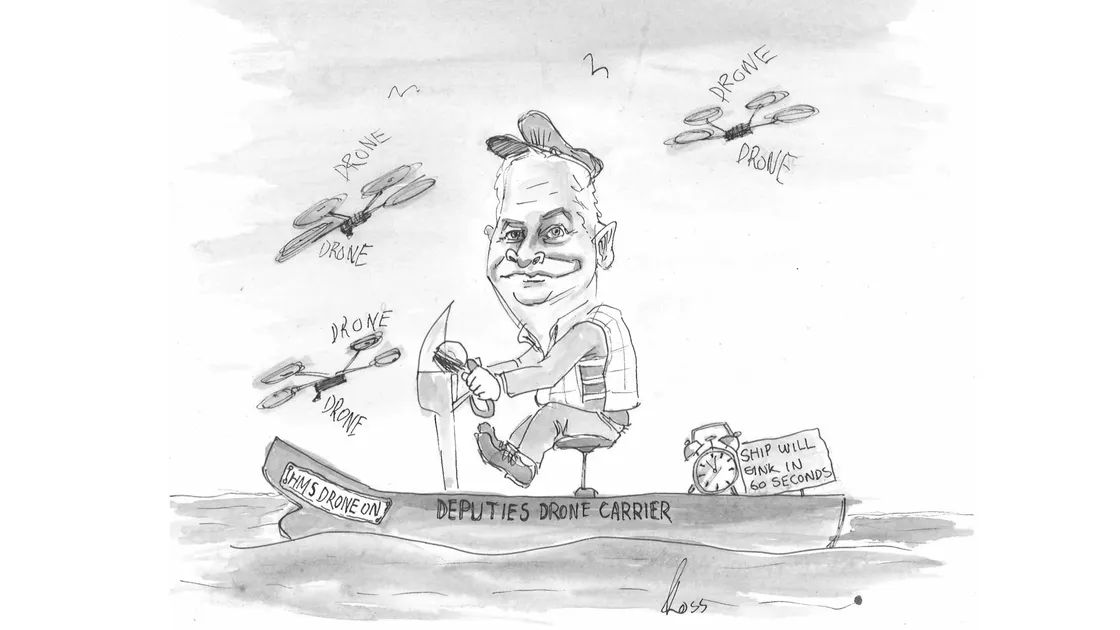
Deputy Niles had his customary losing battle with the challenge to ask a question within the allotted time. I suspect decisions in the Niles household are not made in haste. He did, however, manage to point out that the £42m. damage to public finances caused by the Agylisis cock-up was the Guernsey equivalent to the £42bn with which the UK government could have built two aircraft carriers. This interesting observation prompted me to wonder why anyone would spend more than the price of a haircut on building aircraft carriers that these days can be rendered inoperable by a drone controlled by a 10-year-old having mischievous fun during a break from school homework.
Deputy de Sausmarez had similar time-keeping problems when giving her answers, being frequently timed-out by the Bailiff, who invariably shows admirable levels of patience with those who regard 60 seconds for a question and 90 seconds for an answer as aspirational targets rather than non-negotiable limits. Our diligent P&R president has yet to embrace my enthusiasm for the notion that less is more when speaking in the Assembly, but I haven’t given up hope.
Deputy Sloan gave his first update as president of the Scrutiny Management Committee. I have to be especially careful, even circumspect, in commenting on his speeches. He is softly spoken and needs the help of a microphone to reach those not blessed with the sharpest of hearing. Somewhere between his lips and the microphone, something doesn’t work well.
From what I could understand, the effect of his statement, intentional or not, was to plant in the minds of members the thought that government in general and P&R in particular would perform better if he and his committee were in charge. He never said it but somehow it hung in the air as a scent to be sniffed.
Deputy Matthews asked him another of those ‘Does he agree with me’ questions to which Deputy Sloan replied, refreshingly, that he didn’t. I cheered quietly to myself. By way of contrast, he could scarcely have declined to agree when Deputy Camp, a loyal member of his committee, invited him to agree the importance of evidence-based data. Even I, outside the political bubble as I am, know that data is the oil with which Deputy Sloan lights his lamp each day, so I may be forgiven for suspecting that this question might have been just a teeny-weeny bit convenient to the committee’s desired narrative.
Deputy Kazantseva-Miller asked how the committee, in pursuance of its role to hold government to account, proposed that it should itself be held to account. ‘Ah! Quis custodiet ipsos custodes?’ was Deputy Sloan’s brief theatrical response, delivered in Latin with a fluency and flourish that Juvenal himself could not have bettered. Who guards the guards? The Assembly, unfamiliar with exposure to spontaneous, dazzling erudition like this, was stunned into an awkward silence.
When debate of the Government Work Plan eventually began, it soon became clear that the fundamental misconception of the plan held by several purveyors of social media was shared by some of the Assembly’s most blinkered, clunky-minded members. To listen to them, the GWP was a P&R plan, or even worse a de Sausmarez/St Pier plan, or even worse than that the personal plan of Deputy de Sausmarez herself. It’s sad to reflect that no matter how often and how painstakingly the GWP is accurately presented as a government plan, and therefore as a plan formed and owned collectively by Assembly members, those who harbour the misconception will forever remain as the dupes of it. As for those members who declined to contribute to the formation of the plan, I begrudge them the right to a view of it.
Amendments, mostly constructive in nature, came and went, as did the speeches for and against them. In speech after speech, Economic Development president Deputy Kazantseva-Miller registered her concern. I cannot record any of her speeches which did not strongly feature the word ‘concerned’ preceded by the words ‘I am’. For all I know, she was right to be worried, but I was left thinking that if concern were a valuable international trading commodity, her prolific, one-woman production line of the stuff would have Guernsey out of the red in next to no time. I guess she won’t be auditioning for the role of Pollyanna in the Assembly’s Christmas pantomime.
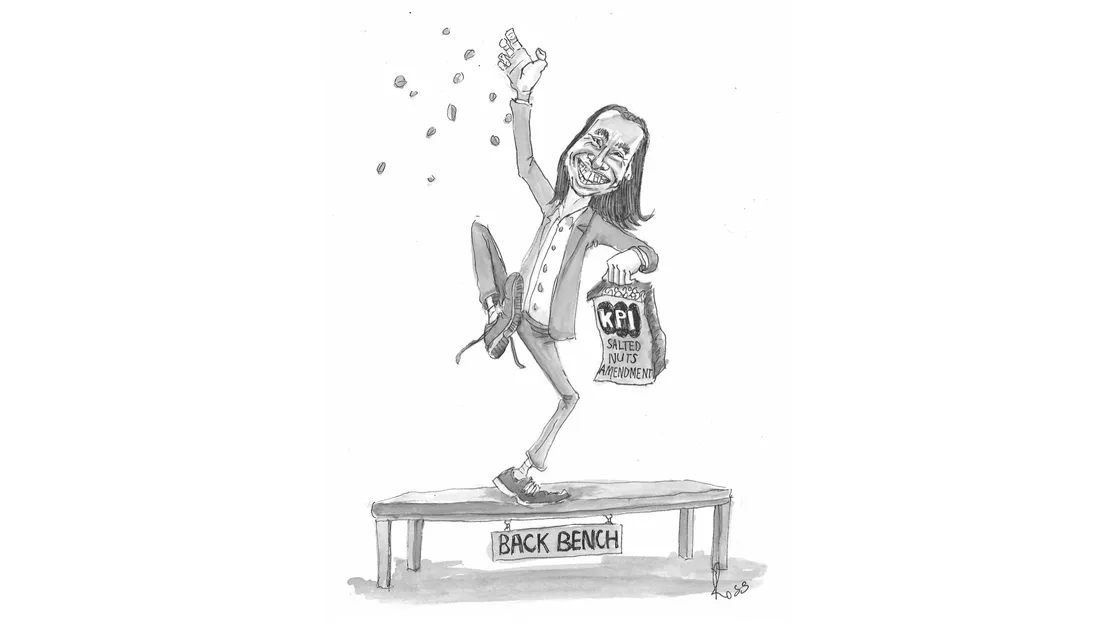
Deputy Goy proposed an amendment which revealed his obsession with KPIs – key performance indicators. Whereas I managed to live and prosper for seven decades before I even heard mention of them, let alone used them, he seems to regard them as the sine qua non of life itself.
His seeming addiction to these devices and to the management-speak gobbledygook which surrounds them, includes the attribution of magical powers to them. He claimed that with them, none of Guernsey’s failures would have occurred and a prosperous, blemish-free future would be guaranteed. I thought, crikey, armed with these KPIs we might even win the Muratti now and again.
Deputy Goy referred to Singapore as an inspirational example of a government sprinkled heavily with KPI stardust. He had looked up all Singapore government departments, and they all had them. I was curious, so I looked for them, too. I focused on their Ministry of Home Affairs because one area where Singapore is so clearly distinctive is in its routine use of the death penalty for convicted murderers, drug-traffickers and the like. The number of judicial killings was up last year to its highest level for more than 20 years, so I wondered if KPIs had played a role. I failed to find a single KPI in the Singapore prison service, nor could I get much information out of the department. They wouldn’t even tell me how many executioners they have on the payroll which meant that I couldn’t measure their productivity. So much for transparency, the buzzword in our current Assembly.
I did manage to learn that executions are by hanging, using the affectionately-named ‘long drop’ method, presumably in preference to the ‘jiggling up and down’ method. Hangings are always carried out early on Friday mornings, in good time to allow the staff to pack up for a jolly weekend ahead. They take place in Changi prison, not far from where I used to swim in the sea as a young boy in the early 1950s. The most recent session was held a few weeks ago and featured a double hanging; two for the price of one eh! A KPI perhaps? History has it that one long-term chief executioner dispatched over 850 criminals during his 50 years of service. I wonder if he ever met his KPIs?
Time to lighten the mood. Here are some snippets.
There was frequent mention of a road map to recovery. I’m not easily scared but the prospect of any government setting out on a road map renders me a quivering wreck. It’s a term designed to offer the beguiling assurance that government knows where it’s going, but in truth neither those using it nor those listening to it have the faintest notion of what is meant by it. You’ve only got to look around you these days to know that if the Assembly minibus tried to follow Traffic’s very own road map, it would finish up driving endlessly round and round the Weighbridge roundabout, unable to leave it in any direction.
At one stage, Deputy Inder invited the Assembly to imagine him naked during his time as a former member of Education Sport & Culture. I admit I get cross with members occasionally, but in my book they don’t deserve to be faced with something quite so distressing as this. Fortunately, Deputy Montague soon provided a welcome reminder that ESC is now in competent, sensible hands in contrast to the ham-fisted, maniacal grip of its ideologically-driven predecessors who bequeathed the current committee a ruinously expensive and inefficient system of secondary and post-16 education, a legacy that is now being tackled as best it can.
Which reminds me. I would mention that Deputy Montague is by some distance the star speaker in the new Assembly, but I won’t in case it generates jealousy of him. Beside him on the top bench, Deputy Helyar is another effective speaker, albeit of a contrasting style. In my view he and the Assembly have benefited from the change of political company he keeps in this term as compared to the previous.
Deputy Montague’s buoyant, articulate and structured speech also provided a brutal and embarrassing contrast to an ill-tempered, rambling rant delivered by Deputy Goy. He bitterly blamed Deputies de Sausmarez and St Pier personally for the failure of his pet Amendment 4. As Deputy Ozanne was quick to point out, he was misleading himself. She was right.
The failure arose because Deputies Goy and Curgenven had jointly made such an abjectly inept case for an amendment whose blatant populism was matched only by its utter vacuity that they had only persuaded 10 members to support it. And bless their cotton socks, and with the best will in the world, most of those 10 members could not describe themselves as the sharpest tools in the parliamentary box. It left me with the thought that Deputy Goy is a bad loser who is cringingly unaware of how unattractive that status is.
Deputy Inder spent most of the three days in a cross mood. He detected conspiracies of secrecy everywhere in government. At one stage he came close to calling all principal committee presidents out as cowards for not voting his way. ‘What are you all frightened of?’ he yelled.
As for those who are eventually found responsible for the Agilisys scandal, he wanted them named, shamed, sacked and goodness knows what else. I think I might give him the email address of the Changi jail manager. A public execution outside Coco might go down well.
At least Deputy Inder attended all three days, which is more than I can say of too many of his parliamentary colleagues. Only 30 of the 38 Guernsey deputies made it to the final vote on the Fiscal Policy Framework around 4.45pm on Friday afternoon. Not very impressive, eh? Especially since they’d had six weeks since the previous meeting during which to make their arrangements. My hero Cicero had words for it. O tempora, O mores! See, Deputy Sloan isn’t the only one who speaks Latin.