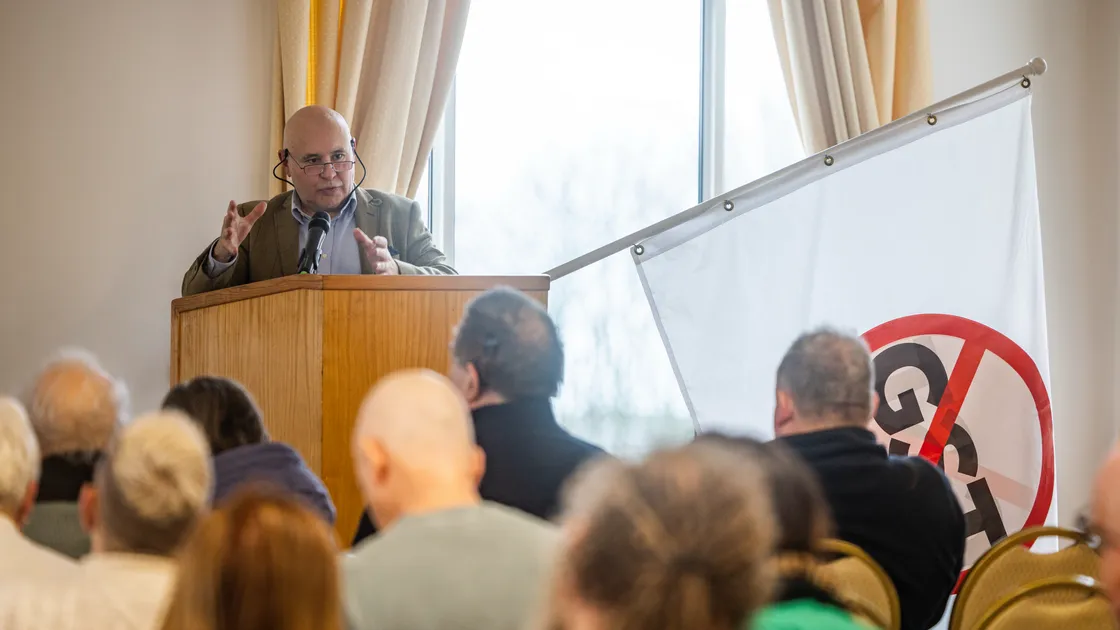
On Sunday afternoon I went up to the Cotils for the anti-GST meeting, led by former – and hopefully forever former – deputy Carl Meerveld. On the panel beside him sat Deputy McKenna and other sitting politicians who were very clearly there not as spectators but as political ballast. This was meant to be a serious intervention in the debate, not a fringe gathering and not a social grumble, and it had real weight behind it.
And for a short while it justified that weight.
Meerveld was absolutely right about where we are, speaking about a government that has allowed spending to grow faster than the economy that feeds it, year after year, until the gap becomes structural rather than cyclical. He spoke about reserves built up by earlier generations which are now treated less like a constitutional safeguard and more like a convenient smoothing mechanism, and he spoke about arithmetic rather than ideology, which is where this debate should properly sit. On that central point he was not wrong.
He was also right that GST does not solve that imbalance, because it does not shrink the state or re-engineer the relationship between the size of government and the productive capacity of the island, it merely provides another stream of income to sustain the current trajectory. That may buy time, but it does not constitute reform.
Unfortunately, instead of landing that argument cleanly and opening the room to scrutiny, he took us on a long and winding tour, and 10 disciplined minutes which would have sharpened the case became something far longer and slowly dulled it. You could feel the room begin to shift as engagement gave way to restlessness, and a sharp critique gradually lost its edge under the weight of repetition.
Then Deputy McKenna took the microphone and things began to unravel properly.
Rather than responding directly to questions from the floor, he delivered a long and rousing political speech that bore only a passing resemblance to what had actually been asked, energetic and heartfelt and entirely on brand, yet unfocused. The microphone became a platform rather than a tool for dialogue, and other deputies on the panel, who had turned up to demonstrate that opposition to GST crosses personalities and factions, were left largely silent. There was no firm chairing and no clear structure, and no real sense that anyone was steering proceedings with discipline.
Gradually the meeting became discombobulated, with points made, remade and half-answered while questions drifted and the air thickened with frustration, until into that drift stepped the chief minister, who did what experienced politicians do in a room that has lost coherence, and imposed order.
The irony could not have been scripted more neatly, because the entire thrust of the afternoon was that the States lacks financial discipline, that over the past decade tens of millions have been committed to projects that drifted, ballooned or under-delivered, that capital schemes have returned repeatedly for additional funding, that systems have cost far more than first presented, and that spending has developed a momentum of its own, and yet the event making that case could not keep itself tightly organised for a single afternoon.
Still, dismissing the room as mere theatre would be a mistake, because beneath the chaos was something serious. And for me the best thing to come out of the meeting was seeing Gordon there, still very much alive, still campaigning for a better Guernsey and still prepared to stand up and have his say, and long may that continue. In an island that sometimes forgets its institutional memory, persistence like that matters.
There is a profound lack of trust running through this debate, and it does not arise from ignorance of economics.
Over the last decade we have watched substantial sums allocated to projects that expanded well beyond their original framing, we have seen plans re-costed, timelines extended and budgets re-profiled, and we have seen initiatives presented with confidence only to return for further injections of cash. Even where the intentions were defensible, the financial grip has not always been evident, and spending has crept upwards almost by habit while the economy, by contrast, has not kept pace.
Now we are told that GST-plus is required to stabilise the position.
Let us be honest about what that means, because on the government’s own figures GST will not fund better services or transform healthcare or finance grand ambition, and will not even fully close the existing 'business as usual' black hole, it will merely reduce the rate at which reserves are depleted.
That is not structural reform, it is a sticking plaster.
We are being asked to introduce a permanent, broad-based consumption tax not to improve the island but to slow deterioration, and we are asked to do so in the absence of any binding commitment that the underlying driver of the problem, the steady growth of government expenditure beyond economic growth, will be restrained.
Anti-GST campaigners are frequently challenged to produce a fully-costed alternative, which is a convenient deflection because they do not have access to Treasury modelling or civil service teams running 10-year projections, or the data that sits inside government. All deputies in this island are independents, there is no party research machine and there are no shadow departments, and government holds the numbers and therefore government carries the burden of proof.
If GST-plus is to be credible, it must be accompanied by something far more important than distribution charts and modelling assumptions, it must be accompanied by a clear and enforceable commitment that spending growth will not continue to outstrip the growth of the economy, because without that GST is not reform but reinforcement.
This is the heart of the unease that filled Les Cotils hall, and it is not ignorance of demographics and it is not denial of arithmetic. People understand that health costs rise with age and that pensions do not pay for themselves, what they struggle to accept is the idea of handing more money to a States that has yet to convincingly demonstrate fiscal discipline.
Before introducing a permanent new tax, government must first prove that it can manage within the productive capacity of the island, that it has learned from projects that ballooned and budgets that drifted, and that the era of automatic expansion is over.
Until then GST-plus will look less like courageous reform and more like revenue support for a system that has not yet earned renewed trust.
That was the real mood in the room on Sunday, beneath the speeches and the chaos and the theatrical moments, and a simple question hung in the air.
Why give more money to a States that cannot yet prove it is fiscally responsible?