Being half-Dutch, half-Ecuadorian, I’ve always had an interest in what’s going on in many other places in the world. I first became fascinated by this specific topic when I received the famous I Am Malala autobiography on my 11th birthday.
This sparked a specific interest in the Taliban and how they affect not just Pakistani women, but the women of neighbouring countries. When I was given the opportunity to do this TEDx talk, I wanted to spread awareness and educate more girls about what’s going on in the world and what might be on headlines on the news for just five minutes, or not at all. I wanted to educate as many people as I could, just like Malala did.
My title, ‘Freedom without a face’, may seem like a riddle, but for some it’s a reality. Picture your family photographs. Now picture them with a woman blacked out. Their smiles, their voices and their futures removed.
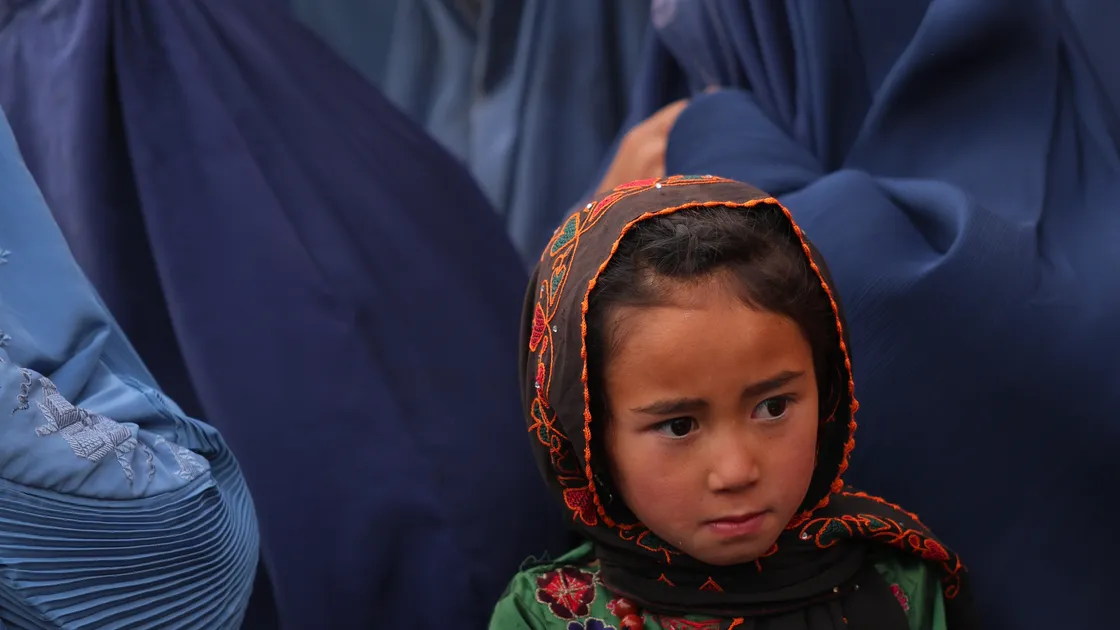
This absence may seem like a metaphor, but it’s what many Afghan women have to live with. It’s their reality. They’re invisible in public, invisible in law and invisible in history, unless we choose to see them.
Before 2021, when the Taliban regained control of Afghanistan, the lives of millions of women changed. Schools had to close their doors to girls, women were removed from their jobs and their presence in public spaces began to disappear. Invisibility doesn’t just happen. It’s forced and created, and in Afghanistan it has become policy.
Now, behind these policies are real girls with real dreams, just like you, me, our mothers, our daughters and our sisters.
Let’s imagine a 16-year-old girl. Let’s call her Zara. Before 2021, she would wake up early, put on her uniform, make breakfast and go out in an excited hurry to get to school. A friend, Malika, would pick her up along with some others, and they would gossip about anything and everything, just as you do.
They would talk about how excited they were to start the new year and what subjects they enjoyed the most. Perhaps it was biology. Maybe it could have been chemistry. Or maybe she even had environmental science. Perhaps she wanted to be a lawyer or a doctor, or maybe even a teacher, as she looked up to her own teacher. But either way, she loved to learn.
Then one morning, after her usual routine, she approached the school gates and found a piece of paper bolted to the door, a government seal, and just like that her future was suspended until further notice. No longer could she be that lawyer who fights for justice, the doctor who saves lives or the teacher who inspires.
Zara’s story isn’t unique. It’s one that thousands of women can relate to. Hearing these stories, it’s easy to see it as a rare exception, and it’s also easy to see what’s being taken away from her. What’s hardest to see is what invisibility does to someone when they grow up inside it.
Just imagine growing up where your absence is expected, where your dreams aren’t crushed violently but silently, through a strict routine. When invisibility becomes normal, it can shape how a person sees herself, not as someone who is denied the opportunity, but someone who was never meant to have it in the first place.
This is one of the most damaging forms of control, and the cost of invisibility doesn’t stop with women. When Afghan women are erased, the focus is often on what they lose: their education, their independence and their voices. But what the focus isn’t often on is what Afghanistan itself loses.
A country without educated women loses doctors who can understand their female patients on a deeper level, teachers who can teach the next generation, journalists who tell the whole story and leaders who can represent half the population. When girls are removed from classrooms, their futures shrink and their careers disappear entirely before they had a chance to start. Progress doesn’t just slow down, it becomes impossible to restart.
Here in Guernsey, we’re free to dream, to walk the streets and imagine if these freedoms were taken away from you. Zara’s story is a reminder that voice and opportunity are precious. Silence anywhere allows injustice to thrive everywhere.
But caring doesn’t have to stop at feeling sad. There are many ways we can help, even here in Guernsey. I’m sure many of you know the story of Malala and her charity, the Malala Fund, along with the Afghan Women’s Project, working tirelessly to give girls education. Small actions like spreading awareness, giving donations and sharing their stories can make a huge difference.
This may seem overwhelming, but change is possible. We may be far away, but our voices, our choices and our support matter. Invisibility doesn’t have to be permanent.
Hearing stories like Suraya Matthews, a woman who was threatened with acid attacks if she continued to go to school, shows us that when women are seen, their stories are told and remembered, and change becomes possible, even in environments where they can’t.
Afghan women resist invisibility by learning in secret, sharing and helping, and sharing their stories. Invisibility isn’t fixed overnight, but visibility creates space for hope. This reminds those who have tried to erase women in any way that they have not and will not succeed.
There are many stories we can educate ourselves about, women like Zara. And I would like to leave you with a quote from A Thousand Splendid Suns. In the book, Khaled Hosseini writes, ‘Like a compass needle that points north, a man’s accusing finger will always find a woman.’
However, in Afghanistan, this isn’t just fiction. It’s a pattern, a system designed by the controlling men of the Taliban to remove women from public life.
The problem isn’t that we know these stories. It’s that we have been taught to see it as distant, as literature, as headlines, as something that happens somewhere else.
But invisibility can only work if no one pays attention. Zara didn’t choose to disappear. She disappeared because the world allowed her to be unseen.
So my final question to you is: what are we willing to do to ensure that no woman is left unseen?