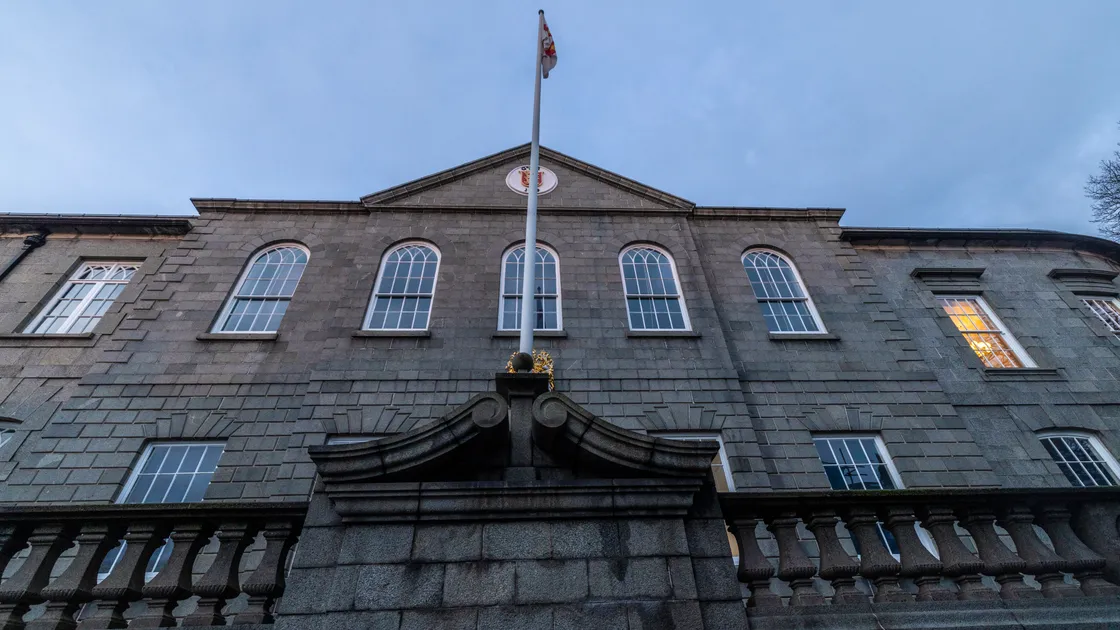
Those of our forebears who designed and built the Royal Court House which houses inter alia the Assembly’s debating chamber, were a tough lot who minded the pounds and pennies, or to be more accurate, the francs and sous.
If in those days, two and a quarter centuries in the past, Guernsey ever experienced the extremes of cold and hot weather that have become almost routine nowadays, those who met as a government would have been expected to turn up and just get on with it. Times may have changed.
I remember a winter meeting during the 2016-20 political term when it was so cold that the Bailiff permitted the wearing of overcoats and scarves. I thought at the time what a bunch of namby-pambies we were, being able to personally recall a distant but undiminished memory of having to meet the call of nature in a mid-winter Berlin forest at -15C. Now that really was cold.

As a Castel deputy, I had a seat in the Assembly which offered a view of the entire floor of the chamber and shall never forget one particular sight the likes of which are rarely seen other than on a film set. As shivering members entered the chamber after lunch, there, before my very eyes, was the BBC’s most recognisable pantomime villain in the form of the Gestapo’s Herr Otto Flick from the sitcom ‘Allo ‘Allo!, complete with full-length, black leather trench coat, black hat and gloves. For that memorable cameo alone, Deputy Meerveld deserved to be re-elected in 2020, let alone for all that anti-GST stuff, and his non-election in the 2025 general election has left an empty hole in the pit from which I dig up precious fuel for my parliamentary sketches.
The image came back to me when the States of Deliberation met to debate the States Accounts for 2025.
It was very warm in the chamber, and the Bailiff promptly invited members to remove their ‘outer garments’ if they wished. Oh dear! What followed was not a pretty sight.
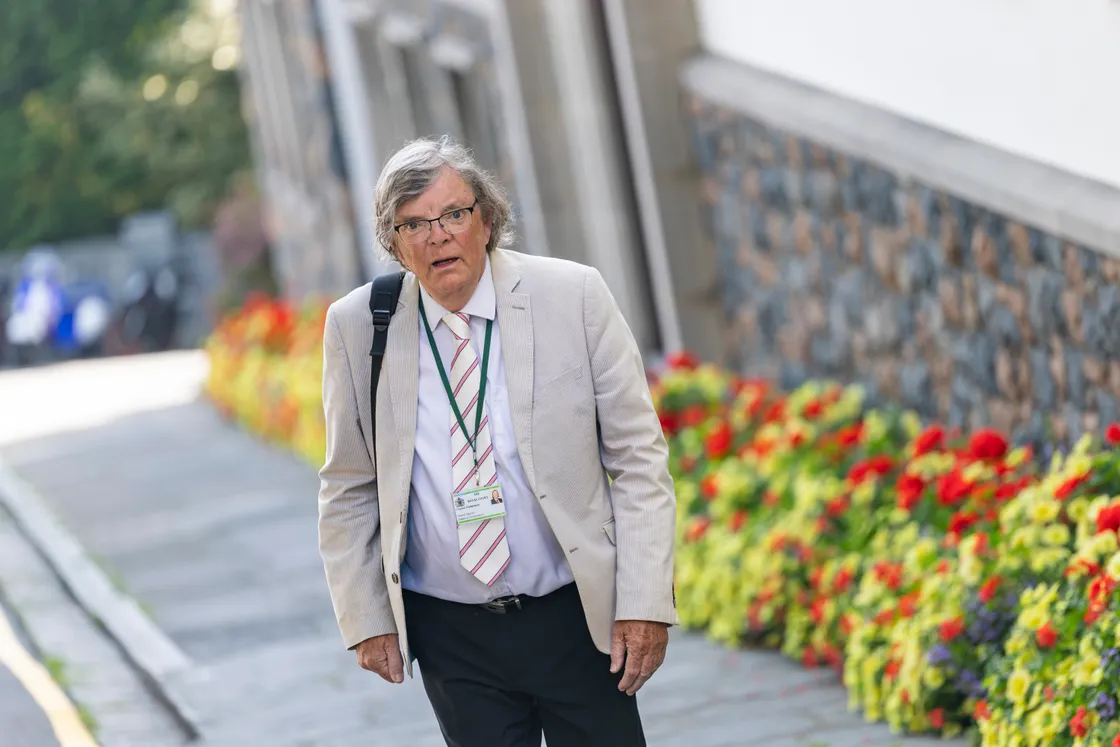
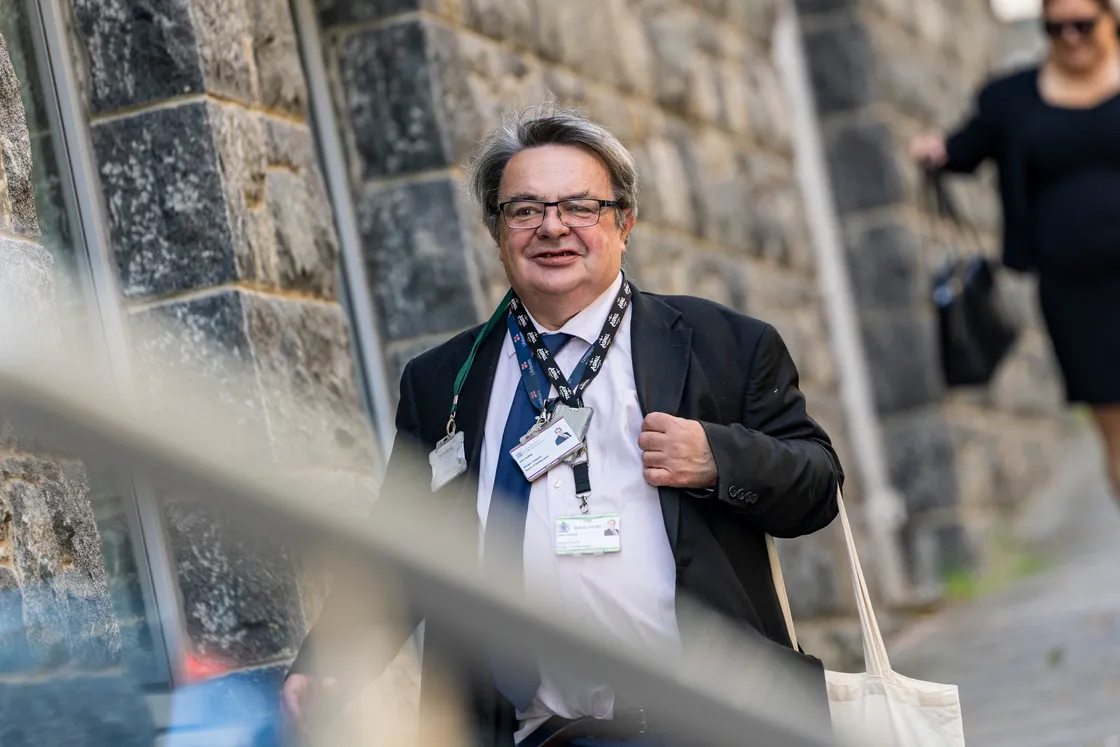
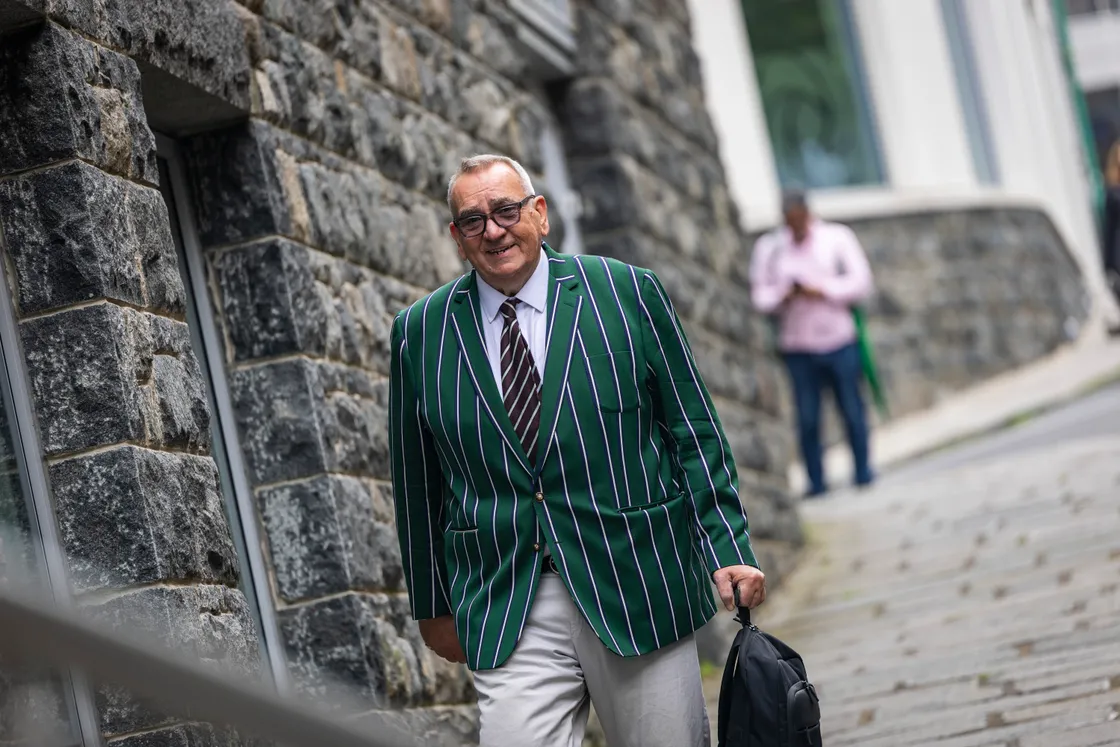
I am about to write something that will reveal how old-fashioned I am. What’s that? You knew that already. I can’t imagine how. Anyway, here goes. I think the current Assembly’s male deputies are a scruffy lot. Not all of them, of course. Not even the majority. But enough to prompt a comment. I don’t expect them all to wear stuff from Savile Row, but do some of them need to look as if they’ve just raided the Salvation Army discarded clothing bins? At least they could stop pretending they are typical secondary schoolboys and learn how to tuck their shirts into their trousers and how to wear a tie.
‘Does it matter?’ I hear some ask. Yes, it does. Or it ought to. The presiding officers, law officers, States’ Greffier and HM Sheriff all take the trouble to dress appropriately out of respect for the occasion and so should all members as a visible sign that they acknowledge – and do not take for granted – their privileged role as our elected representatives. There is no excuse for any members to look as if they’ve just arrived for a game of darts at the Ship & Crown.
And female standards of dress in the Assembly? Even I wouldn’t dare go there!
Having identified scruffiness as one characteristic of the new Assembly, I’m tempted to share my thoughts on how else the character of our new government can be assessed one year after its election. After all, there wasn’t much business material for a parliamentary sketch writer in last month’s States meetings, so there’s space for a bit of mischievous leg-pulling. The identity of who owns the pulled legs will remain with me. As we soldiers used to say, ‘no names, no pack drill’. But their colleagues will recognise them. It’s even possible that some will recognise themselves and feel the tug.
Let’s start with a positive.
Assembly membership
Stronger or weaker? Marginally stronger is my subjective opinion. Of the 21 successful candidates who are either first-timers or returning after an absence, at least eight have already demonstrated that they are a clear asset and bring specific, useful and relevant talents to our government. I’m still making my mind up about six of the newcomers who have begun promisingly, while only seven of them seem to have been exposed as a something of a waste of space, just like some of the election casualties whom they have replaced. P&R includes the four poll-toppers and a promising newcomer who between them offer a usefully diverse range of talents, and all principal committees and authorities are led by competent deputies, even though I disagree with some of their favourite policies, strongly so in some cases.
But there are disappointments.
Decisive indecision
First off is a feature inherited from the previous Assembly membership. Like a bored but timid kitten presented with a ball of wool, several members toyed and pawed distractedly and nervously with the need for decisiveness before proudly embracing the convenient delusion that being decisive is the practice of deciding not to make decisions. It’s the same old story this time: ‘let’s wait until we know this or that; let’s wait until we have consulted the public for the umpteenth time; even let’s wait until we’ve held a referendum; let’s wait until we’ve appointed a new him or her; let’s wait for yet another third-party comment; or let’s wait until it’s too late’. Among old and new members and previously rejected members now recalled, too many are content to serve as ‘agents procrastinateurs’. For some, it has reached the stage where it has become their political trademark.
Paralysis by scrutiny
Mention of trademark reminds me of a further but related characteristic of far too many members for whom the role of States deputy has shrunk to being nothing more than a generously salaried opportunity to do very little while giving the impression of intense activity on our behalf. Let’s call them ‘Shrivellers’ in line with their shrivelled approach to political service which has them queuing up to scrutinise and question the doers, but when it comes to what my dear grandmother used to term ‘getting off their bums’ and getting something done, they are nowhere to be seen or heard. Paralysis by scrutiny comes to mind. We need more doers than scrutineers, methinks. Even more irritating, some of the scrutiny has become performative and declamatory in its conduct. I admire scrutiny carried out with cool, analytical objectivity, but will always call out arm-waving, look-at-me grandstanding that belongs better at the Performing Arts Centre.
And here’s a further thought on the role of scrutiny, prompted by the latest public meeting of its formal embodiment, the Scrutiny Management Committee. We look to this committee to provide objective, forensic analysis and questioning of our government, and not to use its public sessions as a stage on which to theatrically promote its individual members’ personal political agendas. A casual visitor to the Castel douzaine rooms who stumbled upon last week’s public scrutiny of P&R could easily have concluded that they had gate-crashed an audition for a Gadoc production of Kafka’s The Trial. I can forgive the blatant playing to the gallery, irritatingly puerile as it was. Much more seriously, though, it has left me doubting that the SMC, as currently constituted, is up to a task that demands political objectivity and independence of mind.
Is there anybody there?
By way of stark contrast to the attention-grabbers, there are deputies from whom we seldom hear a word or even a hint of what they are thinking or doing. If they were on sale at Aladdin’s Cave, they would come in a box labelled ‘battery not included’. Don’t get me wrong, I have never confused noise with effectiveness, but I think zen-like inscrutability and observance of a Trappist vow of silence are not a great fit for a politician. For all I know they are beavering away to good effect in their respective States committees, so let’s give them the benefit of the doubt. For the time being.
The prima donna tendency
The first year of the current political term has featured seven early resignations from committee membership. While four of those departures can be ascribed to necessary adjustments to unforeseen circumstances, three of them hint at the presence of a small and hopefully unrepresentative ‘Quitters Tendency’. States committee work can be tough going at times and is not for the fastidious or the egotistical hissy-fitters.
Niggle
Few would dispute that the previous Assembly was, post-Covid, an inharmonious place where the conduct of government for the good of the Bailiwick too often took second place to the playing out of personal grudges, rivalries and dislikes. For the outside watcher, it didn’t make for pleasant or encouraging viewing and listening. In fact it was hugely dispiriting. Robust disagreement is, of course, a necessary, even welcome, feature of democratic government, but political venom is invariably a poisonous injection into the political body for which effective antidotes are hard to find.
The new Assembly is not free of niggle, some of it brought in by contaminated returning members, some of it freshly imported, but as yet the niggle is felt as a moderate breeze that comes and goes rather than as the constant, stiff headwind that the Assembly had to battle during the last political term. So far, so much better. But it is early days, and a small number of members have already offered hints of tense relations ahead.
Enough gossip. I now turn to the business conducted at June’s States meeting.
The States accounts were first up for debate. Deputy Parkinson, as Treasury lead, opened. He’s a canny old fox and deployed a simple diversionary tactic to send members off into relatively easy territory. It’s known as getting your retaliation in first. He suggested that if the States Revenue Services were a school, they would be put under special measures. His ruse worked. Members’ ears pricked up. Some began falling over themselves to flagellate – in one case with a disturbing degree of lip-licking pleasure – the predictable whipping boys and girls of our Revenue Services.
As I listened, I thought, beware what you wish for. Mixing metaphors with politics and schools is a dodgy business. Imagine a classroom where a teacher is taking a class through lesson six of the algebra curriculum. Half the class are scrolling through their WhatsApp messages on their smartphones. One third are tapping away on their laptops. Two students are chatting in one corner at the back of the classroom, while a late arrival enters the room and takes their seat whilst the teacher is in full flow. Three students, bless their cotton socks, are actually listening to the teacher and making eye-contact with him. And the teacher, knowing this is the norm, thinks to himself ‘if this were a political debating chamber, the public would be demanding a general election’.
It’s as if he could picture the scene that I witnessed that Tuesday morning in the Assembly. Of the 12 persons seated at the top bench, only three bothered to look at Deputy Strachan when she was the first to respond to Deputy Parkinson’s opening of the debate. Two of the three were the Lt-Governor and the Bailiff. But miracle of miracles, Deputy Strachan’s thoughtful and interesting speech about investment opportunities via a sovereign wealth fund stimulated first one pair of ears to prick up and eyes to look up from laptops, then a few others until Deputy Strachan had the attention of all. She knows a thing or two about investment funds; and, just as important, knows how to talk about it intelligently to an audience that for the most part doesn’t – but pretends it does.
It is hard to dislike the amiable Deputy Vermeulen, but amiability does little to lessen his ability to embarrass himself. He was quickly onto his pet subject of Aurigny bashing. He began by informing members that such was his keen interest in Aurigny’s accounts, that he had ‘raced to page 33’ of them. Was I alone in finding the image of Deputy Vermeulen moving at speed in any direction somewhat elusive? His argument was not helped by his bizarre criticism that the company’s accounts were not ‘opaque’, a criticism made when blissfully unaware that the word opaque means the exact opposite to what he obviously thought it to be. Excruciatingly, he repeated his mistake in his final punchline. Altruistically keen as I am to help him understand the meaning of opaque, I point out that there is a clear definition of opaqueness close by in the form of the Economic Development Committee’s bizarre arrangement with British Airways. The terms of this cosy deal are the epitome of opaqueness. Only the select few are permitted to know what subsidy we, as taxpayers, are paying to British Airways to compete with our very own Aurigny via a lump sum and reduced airport fees, in return for a once-a-day return flight to and from Heathrow’s cacotopian version of hell on earth, Terminal 5.
Which reminds me. Who is allowed to know the true cost of subsidising BA to undermine our lifeline-providing Aurigny? Presumably members of Economic Development. And P&R probably. And the States Trading Supervisory Board. And some law officers. And numerous civil servants. Does the agreement formally name the entitled elite? If not, why exclude those paying for it – you and me?
The States meeting for the next two days provided rich material for those writing seriously adult reviews that are best left to colleagues who do that sort of stuff well. As for me, one of my critics recently pointed out that much of what I write is ‘inane drivel’. Of course it is. It’s what you get when the editor is daft enough to give column space to a pensioner with lunatic tendencies.
At this distance, I recall two relatively inconsequential reminders that came to me. The first is that Deputy Gollop remains one of the very few members capable of making a fluent, articulate speech without notes and whilst looking around him in the hope of engaging with fellow members. Bless him. The second is of Deputy Sloan’s fluency in the spoken Latin word. His ‘Quad erat demonstrandum’ rolled off his tongue as if from a native of Rome.
For the rest, I must confess that even I was taken aback to learn that so many historic resolutions of the States remain dormant, even comatose. Several members were variously cross, bemused and accusatory of others about the situation, but not sufficiently cross, bemused or accusatory to stir them into offering a solution via an amendment or requete to P&R’s policy letter.
What was it my grandmother used to say about getting off their bums?