DURING the Occupation, around 220 Channel Islanders were deported to Nazi prisons, labour camps and concentration camps on the continent for acts of protest, defiance and resistance. The stories of each of these people are recorded in detail on the Frank Falla Archive website, complete with all identified archival material to provide evidence of what happened to them. These can be read on www.frankfallaarchive.org, where many island families have also contributed family stories about their loved ones, sometimes reaching out from Canada, Australia, America and the UK, to where the descendants of victims of Nazism moved after the war.
This summer I have visited six of the former camps in Germany, all now referred to as Gedenkstatte or memorials: Bergen-Belsen, Buchenwald, Dachau, Mittelbau-Dora, Neuengamme and Sandbostel. None of the stories of Channel Islanders are told in the museums at the sites today because British citizens were a tiny minority among the tens or hundreds of thousands at each camp. A photo of one of the Jersey 21, Frankie Le Villio, is, however, one of 20 shown in images of the liberation of Sandbostel. To give an idea of the tiny number of British citizens at these types of sites, just 27 Britons (compared to 14,609 French citizens) are documented at Dachau out of a total of 206,000 prisoners who passed through the camp. Precisely because their stories are rarely told, it is important to talk about them today now that the information has been carefully researched and placed online.
The sites where islanders were once held are very different today to how they looked in 1945. The past 80 years have wrought many changes caused by phases of reuse, decay, demolition, reconstruction and restoration.
At Bergen-Belsen, where Harold Le Druillenec from Jersey had to drag dead bodies into pits, the site today comprises many long, raised mass graves, as well many memorials. There are just a few original foundations of buildings, but the barrack blocks were famously burnt to the ground by liberating British forces in May 1945.
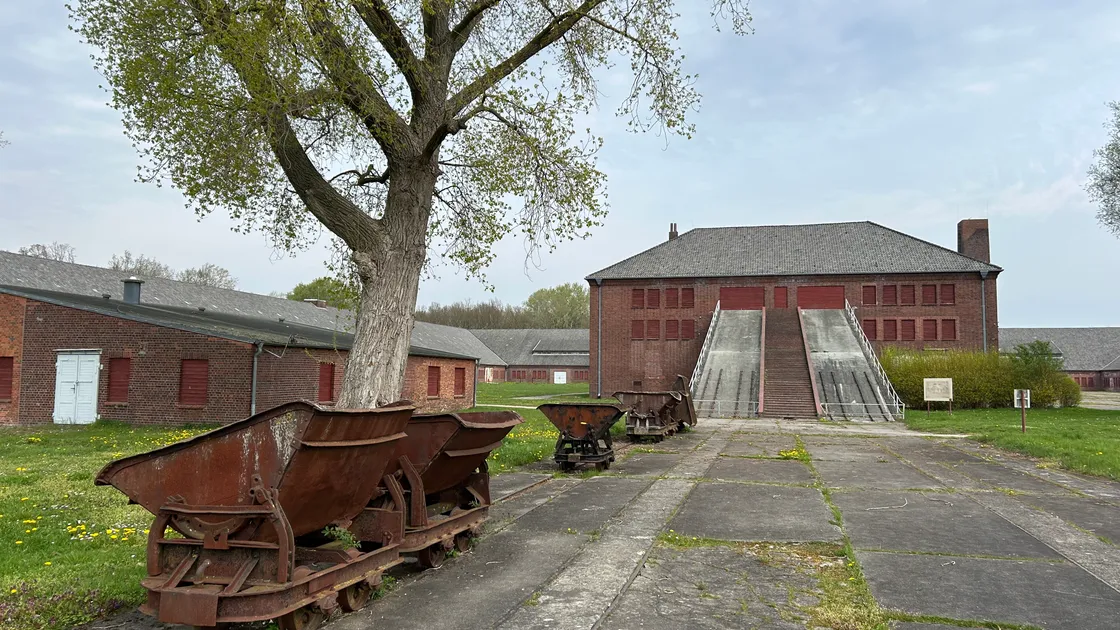
Le Druillenec’s fellow islander in Neuengamme was young Frankie Le Villio, who was not in Belsen with him as once believed but was instead sent to Sandbostel POW camp with thousands of other prisoners from Neuengamme in the last weeks of the war. There he was rescued by British POWs who brought him into their compound. Today, Sandbostel comprises a row of wooden barracks in various stages of collapse and decay, giving the visitor an inkling of what the site once looked like. Such survival of wooden barrack blocks is very unusual, and they still stand in Sandbostel because of multiple phases of post-war use, including as an internment camp, a prison, a refugee camp and even an industrial estate.
Such reuse of former camps has been the norm. Neuengamme, where Le Druillenec, Le Villio and James Houillebecq (all Jerseymen) were sent, was reused as an internment camp for Nazis after the war. A prison was later built on the camp grounds; it was removed in 2005 and the rest of the site handed over to Neuengamme memorial in 2006. Visitors today can visit the brickworks where prisoners laboured.
As the only survivor of the three islanders in Neuengamme, Le Druillenec later wrote that ‘all inmates wore the typical blue and white striped uniform, suffered the same deprivations in food and personal comforts, lived with their only permitted possession – a dessert spoon – and laboured to the death for the ultimate benefit of the Greater Reich.’
Dachau, where Guernsey policeman Kingston Bailey was held, was a camp for political opponents and resisters, among others; Jews made up around only one in four of all prisoners. Bailey wrote about the violence in the camp in his published memoir Dachau. Albert Durand, a Catholic priest from Jersey who was working in France, was also held in Dachau for six months. He spent most of his time in block 24, in a section reserved for priests. He later wrote: ‘The regime was as bad as it has been said. Just enough food to hold oneself together, no hygiene, no medicine.’
At Dachau today, all barracks were torn down in the mid-1960s after the camp ceased to be used as a refugee camp for ethnic Germans expelled from formerly-occupied countries to the east. Today, large Catholic, Protestant and Jewish memorials predominate at one end of the site, and a Carmelite convent can be reached via one of the former watch towers.
Mittelbau-Dora today comprises a deceptively beautiful landscape in which can be found many foundations of buildings from the camp. Visitors can still access the vast tunnels in which prisoners lived and worked while building V1 and V2 rockets. Jerseyman Joe Miere, who died in 2006, was the sole source of memory of Peter Bruce Johnson, deported from Jersey to – as he later wrote – this camp, although no record has yet been found of anyone with that name and the link to Mittelbau-Dora must remain tentative.
Buchenwald concentration camp held nine islanders (four Guernseymen and five Jerseymen) at various points. More survives here than at Dachau; fragments of objects can be seen on the ground on the foundations of many former buildings. While eight islanders were in Buchenwald for acts of resistance, only one Jersey resident – John Max Finkelstein – was put in the camp for being Jewish; he was removed from Laufen soon after his deportation from Jersey in February 1943.
Visiting all of these sites today is a moving experience, even though so much has changed since 1945. Memorials and museums now stand in the place of many camp buildings, and tourists have replaced prisoners in the camp grounds.
Although no traces of islanders exist, only the echoes of their voices in post-war testimonies, as well as camp and prison records, remain for us to view on the Frank Falla Archive website.
Dr Gilly Carr OBE is professor of conflict archaeology and Holocaust heritage at the University of Cambridge, where she is also a fellow of St Catharine’s College. She is a member of the UK delegation of the International Holocaust Remembrance Alliance and a member of the Academic Advisory Board of the UK Holocaust Memorial. Her ninth book, The Futures Of Holocaust Heritage, will be published by Cambridge University Press in 2027. Seven of her previous books are on aspects of the German Occupation of the Channel Islands.