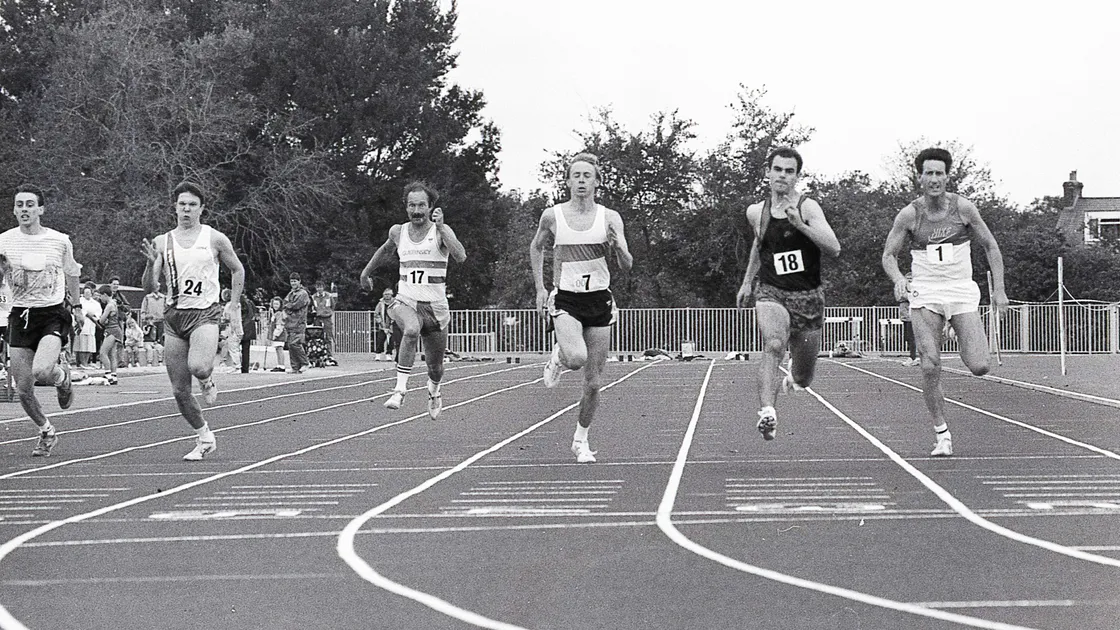
John Allen died recently aged 76 but was, among other things, a president of the old GIAAC, a pivotal figure in the birth of Footes Lane’s synthetic track, and a successful long-term sprinter, whose Guernsey 100m record set on grass took almost exactly 34 years to topple.
In an obituary on their website, Guernsey Athletics highlighted how Allen’s athletics career included competing on the Cambridge Park grass track in the 1960s, Osmond Priaulx cinder surface of the ‘70s and ‘80s and the more modern Footes Lane in the mid ‘90s.
‘John was one of the few athletes that competed seriously on these three “homes” of Guernsey athletics and in this time acted as coach, mentor and training partner to a string of local sprinters,’ the club wrote in the obituary.
Allen rose to prominence by taking silver at the 1967 Hampshire County Schools Championships, posting 10.1sec. over 100 yards to match that era’s outright club record.
However, as he was focusing on his A-level exams, he turned down the opportunity of representing Hampshire at the English National Schools Championships.
It was during an inter-island match against Jersey on 1 September 1969 that he produced that blue-riband record that would stand for well over three decades.
On the grass at Cambridge Park, he became the first Guernsey athlete to officially run 11sec. flat for 100m, which was matched but not beaten until 2003.
He was also selected to represent Guernsey on their Commonwealth Games debut at Edinburgh 1970, though unfortunately he was forced out of the event through injury.
‘Track and field athletics within the island had undergone a fallow period in the early 1970s but John was at front and centre of its resurgence and was always the man to beat over the shorter sprints,’ Guernsey Athletics wrote.
‘Other sprinters came and went, but John maintained a high competitive level through to his veteran years.
‘His long-striding, elegant style appeared more that of a quarter-miler, but it was at the shorter sprints he excelled.’
He also acted as track and field captain, in that role spearheading the GIAAC team that took part in the Southern League from the mid ‘80s to the mid ‘90s.
He also moved into the role of club president, in which he was instrumental in setting up a fund and involving a network of people that ultimately resulted in the synthetic track at Footes Lane being completed in 1993.
That September, aged 43, and 26 years after his breakthrough, he raced in the opening Island Championships on the freshly-built track and still placed third over 100m in 11.8sec.
Darren Le Tissier took the win ahead of Sean Duquemin, both being young athletes he trained with at the time and the former still heavily involved with coaching.
However, in another missed representative opportunity, Allen looked beyond the Island Games despite their overlap with the later years of his career.
‘John preferred to target events within the British system and he let younger athletes focus on the Games while his attention drifted towards the emerging veteran track and field championship events,’ Guernsey Athletics added.
‘John had a dry wit and could convey quite a lot with a weary look, wry smile or raised eyebrow.
‘He once advised a fellow competitor with a typically wry, “Don’t think veteran athletics will be easy. You’ll find yourself lining up against the same people that have been beating you through your senior years”.’
His 100m record finally fell on 31 August 2003, when Ryan de Haaff and Dale Garland both stormed to outstanding times of 10.8sec.
By then Allen had moved to Germany, where he remained until his death.
Long-term athletics stalwart Geoff King, who currently organises the All Terrain Challenge, was among those paying tribute on social media and did not understate Allen’s impact.
‘Without John there is fair chance the club would have folded,’ he said.
‘Many people, myself included, have great memories and a lot to thank him for.’
Olympic marathoner Lee Merrien also gave great praise to the late athlete.
‘He certainly played a huge part in the sport as an athlete, coach and club president and helped transform the facilities we now enjoy.’
Versatile athlete Jay Ap Sion (nee Peet), who like Merrien has nine golds and 14 total Island Games medals, described him as a ‘key figure in supporting and coaching myself and many other sprinters through the ‘80s and ‘90s’.
‘He was totally dedicated and rarely missed a training session.’