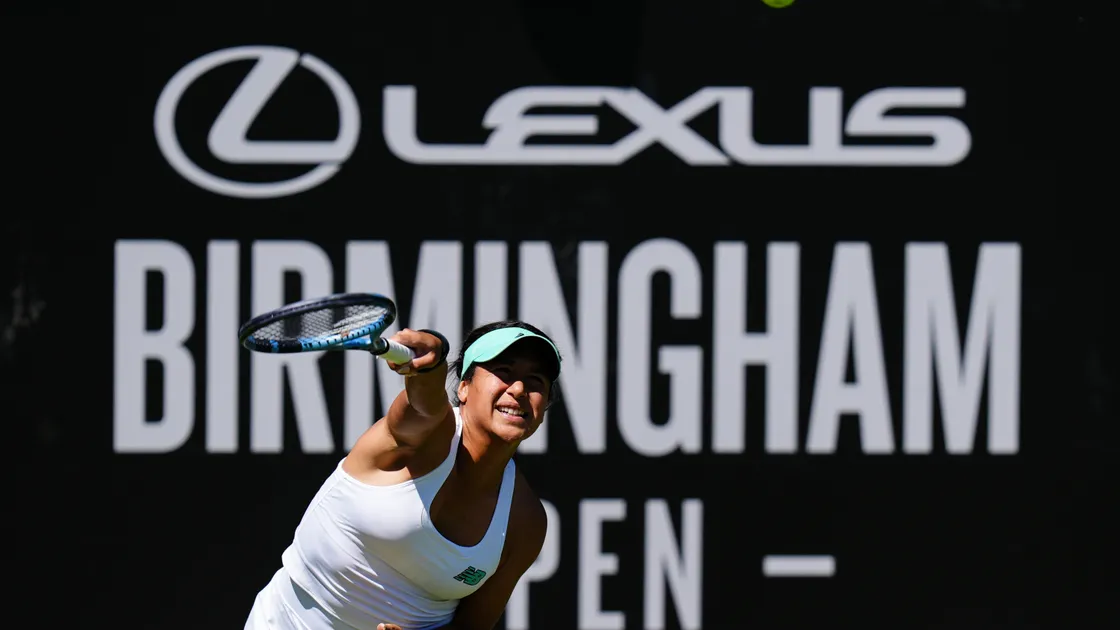
Now aged 34, the former British number one has spent 18 years touring the world as a professional, winning numerous titles in both singles and doubles including the Wimbledon mixed pairs in 2016.
In the current climate, it is not unusual for tennis players of both sexes to play into their late 30s or early 40s.
However, Watson has suffered injury problems over the past 18 months resulting in a prolonged spell out of the game, during which her world ranking has plummeted.
At this year’s Wimbledon, where she competed in the ladies’ and mixed doubles events, having failed to qualify for the singles, Watson said that although she has learned to manage the glute hamstring tendon which kept her sidelined for seven months, the problem was ‘chronic’.
‘I take it week by week,’ is how Watson now describes the situation she finds herself in
‘I’m in a tough position. I’m ranked God knows what – I don’t even want to look, as that would depress me. That’s how I’ve got to think about it.
‘You try to be positive. You want to keep playing. I want to keep playing because I’ve loved it. You want to be back at Wimbledon next year. But I have to be realistic.
‘Physically, I feel good. I still feel the injury but I’m managing it well. That’s what it has come to though. You can’t look long-term when you’re like that. You just have to go tournament by tournament, match by match, and see what happens.’
One of the common misconceptions about the professional tennis tour is that it is one big well-paid party taking in some of the most attractive places on the planet.
The reality, for all but a few of the highest ranked and best-known players, is something altogether different.
Practice, play, airport, hotel and repeat – that is the conveyor belt routine for the majority of players who, once the expenses incurred by travel, accommodation and coaching have been taken care of, usually struggle to break even.
All too often the hotel is actually a flea-ridden motel or a sofa at a friend’s flat.
Injury is a constant spectre. You play more than you should in order to earn prize money and improve that all-important world ranking. Your body, no matter how fit you are, eventually fails. No play equals no points. Your ranking drops. When you are fit again you struggle to gain automatic entry into tournaments because your world ranking is so low.
Watson isn’t at the stage where she is sleeping on friends’ sofas but, right now, the rest of that scenario is ringing horribly true.
In March 2025 the Sarnian was competing in Mexico when she felt a niggle in her left leg.
Long story short, the niggle blew up into a full-blown injury affecting her tendon, resulting in a seven-month break from the sport.
Watson’s ranking subsequently fell off the scale. Instead of playing singles at this year’s Grand Slam events, she has found herself seeking wild cards into some of the less salubrious tournaments on the tennis calendar in places you would miss if you drove through them in anything other than bottom gear.
‘It’s absolutely depressing, there’s no other way of describing it,’ says Watson, breaking into a laugh which demonstrates she hasn’t lost her sense of humour.
‘You play those other weeks so that you can play weeks like Wimbledon. It’s not fun. I mean there are some tournaments that are, but the situation you’re in isn’t. It’s a real grind.’
Does it ever get to the point where she thinks ‘What am I doing here?’.
‘Oh my God, all the time. All the time. But that’s part of it. In this sport you’ve just got to be so resilient week in, week out.
‘I have so much respect for all the players because I know what everybody goes through on a weekly basis and the mental challenges that come with it.
‘Every tennis player is going to be absolutely fine in life, because life will be a breeze compared to what tennis is.’
So what does Watson do to quell the demons when the grind threatens to get too much?
‘I’m quite an emotional person,’ she admits. ‘I get very high and very low. When I’m low I just reach out to friends and family. At the time it feels like the last thing I want to do, but I have to do it.
‘And I have to try and get myself out there. You know, go to dinner and do fun things outside of training or playing.
‘Tennis has been my entire life, but sometimes you just have to put the rackets down and do something else. Something that will clear your head… or your head would just explode.’