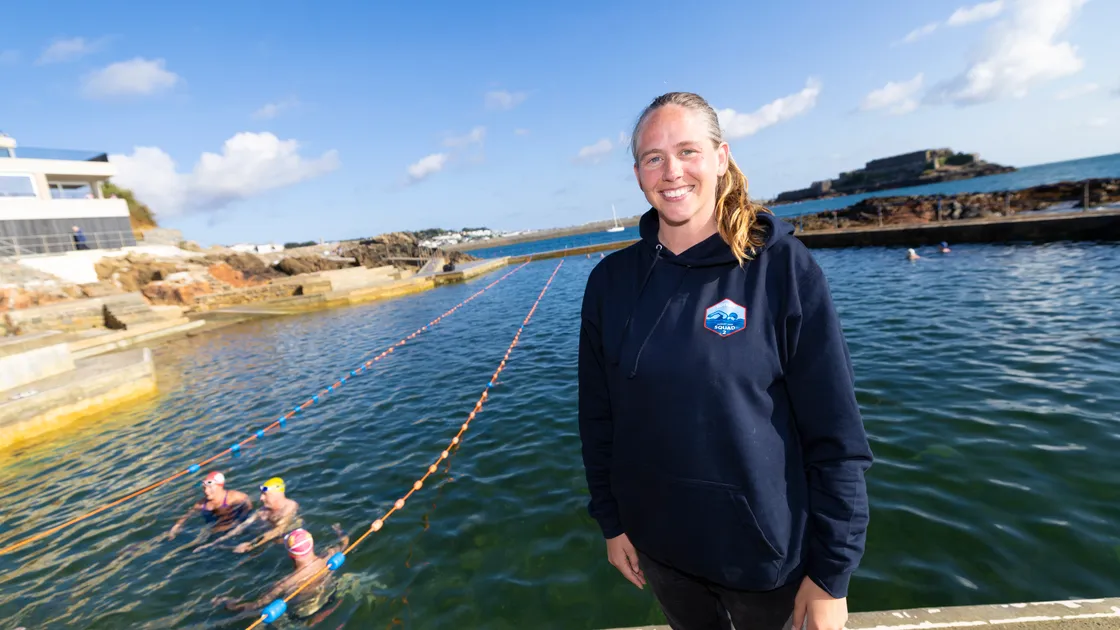
Now the holder of multiple marathon swimming world records, Chloe McCardel has built a career around finding out just how far she can push herself – although she believes success in open water has far more to do with the mind than physical prowess.
‘It’s actually very little about physique,’ she said, during her first visit to Guernsey.
‘Open-water swimming like this is not about being the fastest or the most perfect technique. It’s really about that mindset of just pushing through. You’ve got to have some technique, yes, but the mentality is first, because if your head’s not in the right space, you’re going to have to abort a swim – no matter how strong or fast a swimmer you are.’
Chloe completed her first English Channel crossing in September 2009. Twelve years later, on 13 October 2021, she completed her 44th crossing, breaking the world record for the highest number of crossings, previously held by British swimmer Alison Streeter.
Chloe’s crossing from England to France took 10 hours and one minute – and earned her the title she still holds today.
But she had already proved herself capable of considerably longer efforts.
In 2015, Chloe completed three consecutive crossings of the English Channel in 36 hours and 12 minutes, becoming one of a small number of swimmers to have achieved a non-stop triple crossing.
A year earlier, she swam 124.4km from Eleuthera Island to Nassau in the Bahamas in 41 hours and 21 minutes – breaking the record for the longest unassisted ocean swim without a wetsuit.
It is a remarkable progression for someone whose introduction to swimming came later than most Australian children.
‘I was 11,’ she said.
‘My primary school sent us all off to swim lessons for the first time ever as part of school lessons, and I didn’t know how to swim and I was so embarrassed. I went home that night, and asked my mum to please put me in private swim lessons.’
Once she had learned to swim 50 metres, she wanted to make it 100.
‘I loved it so much. I got obsessed,’ she said.
‘I was always hungry to go a bit further, to get my strokes more refined, go a bit faster. From a young teenager, I’ve always wanted to, not necessarily win everything, but wanted to improve and push my own boundaries.’
Eventually, pushing those boundaries meant breaking free from enclosed pools.
‘An extension of pushing my own boundaries is literally getting into the open water and seeing how far I can go,’ she said.
‘And the English Channel, I believe, is arguably the pinnacle of marathon swimming. I wanted to keep pushing, pushing, pushing, and I ideally wanted to be the best in the world at marathon swimming. That was my goal.’
Completing the triple crossing was a milestone. By that stage she had accumulated 13 English Channel crossings and suddenly realised another target was within sight.
‘I was like, “You know what? It’s only about a third of the way to the world record. I could just keep going.”’
Chloe said individual English Channel crossings eventually became familiar enough that she could treat them much like training sessions.
The prospect of swimming two or three crossings consecutively, however, was very different.
‘The magnitude is huge,’ she said.
‘The pressure that I was putting on myself – not external pressure, just myself – was huge. When you commit and focus to a goal, and your purpose is so strong, you can get really in the zone. That makes seeing it through easier and going through the pain and the challenge, the mental stress, easier because you’re so set on this trajectory.’
One technique she used during the most difficult moments was deliberately practising gratitude.
With marathon swims stretching well beyond 10 or 20 hours, Chloe said there is plenty of opportunity for the mind to drift, and for negativity to seep in.
‘You’ve got time to control your thoughts,’ she said.
‘With marathon swimming, you’ve got to be in charge of them, and not let your thoughts run away from you.’
During periods when she was extremely cold, tired and wanted to stop, Chloe would think about her support crew and the people in Australia who had helped her reach the starting line.
‘I would thank them all. It kind of helped me reset my head space,’ she said.
‘There are techniques that people can learn to help them through hard spots – everyone’s going to go through them. You don’t always know when it’s going to happen or for how long. And you can’t necessarily control what’s going on around you, but you do have an opportunity to control or reframe where your head’s at.’
Even reaching the finish was not always the dramatic celebratory moment people might imagine.
‘People think it’s going to be like elation and joy, but for me – I’m just so exhausted,’ she laughed.
‘I’m like, “Is it really over? Can I stop now? Someone give me verbal permission to stop”.’
But following the exhaustion, once recuperated, something more lasting follows.
‘It’s a deep sense of fulfilment because if you have a purpose that’s really big, and then you achieve that, there’s a kind of peace in that you’ve reached that goal.’
Chloe’s pursuit of the English Channel record ended in 2021, but her involvement in marathon swimming did not.
She has moved increasingly into coaching and organising, and says she has helped more than 160 people tackle the English Channel as solo or relay swimmers.
‘I’m on my second life, it’s not just me swimming anymore,’ she said.
‘It’s the connections and the community of me coaching people and me getting joy and fulfilment when they reach their dreams.’
Chloe said women, particularly middle-aged or older, are the driving force in Britain’s open-water swimming scene.
‘They’re the highest representative group,’ she said.
‘Swimming’s such a support. The water itself is so supportive, that it’s really accessible to people. I’ve heard anecdotally from people with joint pain, disabilities or injuries, that water gives them freedom that they don’t have on land. Open-water swimming generally is a beautiful community. I would say there’s a lot of reciprocal support.’
It was that community which brought her to Guernsey as organiser of Odyssey Squad 2’s planned 101km relay from Alderney to Swanage.
After a mechanical failure with the safety boat and worsening conditions forced them to cancel the open-water crossing in late August, the eight intended swimmers instead regrouped at La Vallette bathing pools, where Chloe and the event’s sports official joined them to complete a sunset-to-sunrise 100km relay in pairs in August.
Seven months after giving birth to her first child, Chloe suddenly found herself back in the water.
‘I was just meant to be here organising the team, not swimming,’ she said.
‘I just had a baby, I have no fitness. So I’m swimming and everything’s hurting.’
Between early-hour stints, she tried to sleep on a thin mattress over the wet concrete.
‘It all went very quiet down here around 3am, when everyone was getting really tired,’ she said.
‘I did not want to get up for my second swim. But when the sun rose, it was like a rebirth. Everyone kind of just emerged out of their little night-time shells. I was swimming when the sun was rising and it was just such a joy.’
After a career spent swimming in waters around the world, Chloe said La Vallette made an impression.
‘It’s beautiful that you have access to this 365 days of the year,’ she said.
‘I’m just walking around amazed by everything. The lighting on the castle overnight is stunning. We were spoiled with the most incredible backdrop – it’s like being in the Med. Like I’m on a Greek island or something. And everyone’s been so welcoming. I feel like part of the community.’
For a swimmer whose career was once defined by records, distances and hours in the water, it is now the people around it which appear to matter most.
‘Swimming gives so much,’ she said. ‘It’s really special.’