

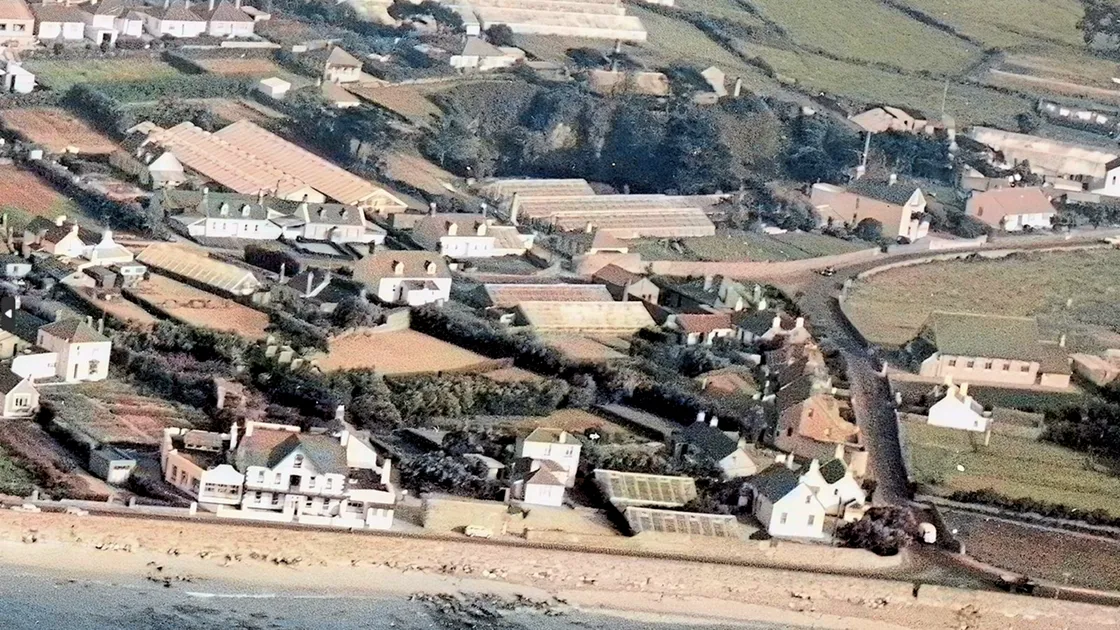
A seaside scene in the mid-1950s.
It looks familiar enough but, yet, it is so, so different to the same place 70 years on.
What do we see that is familiar in this wonderfully colourised aerial shot, owned by Mike Deane?
Not a lot, in truth.
Working from right to left, there is the old Cobo Mission Hall. It had already been there 50 years and well into the 21st century is still going strong, this year celebrating its 120th anniversary.
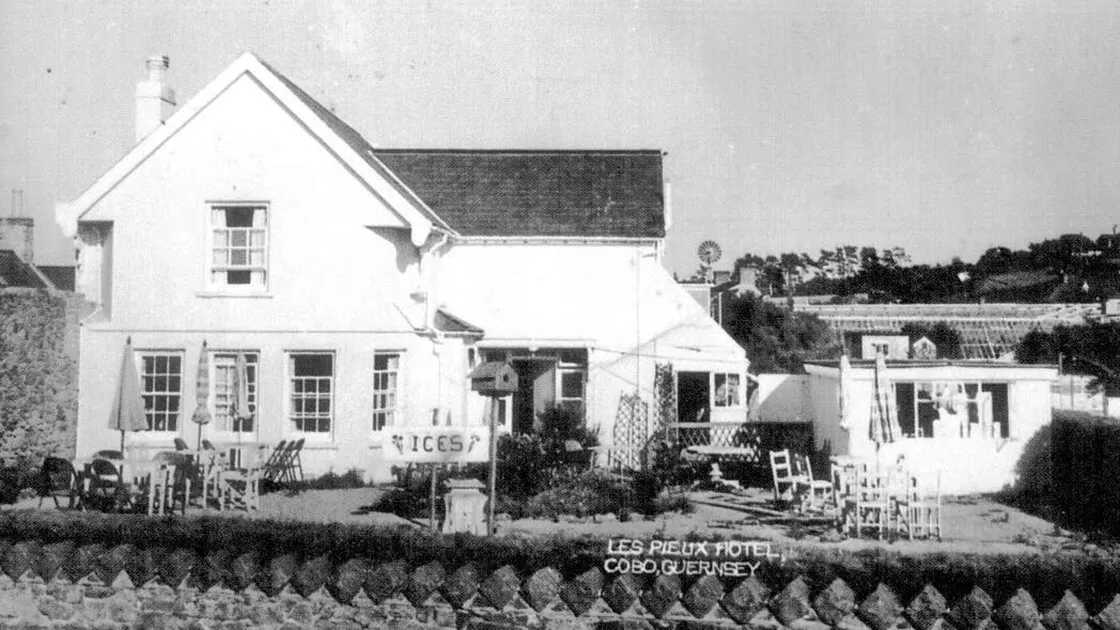
Front centre is the unmistakable presence of the Rockmount, then very much a hotel, as was, a hundred yards or so north, Les Pieux, built in 1885.
Further left, making the corner, is clearly Cobo Post Office and, far left, just in shot, is the now-gone Hotel Les Carteret.
There too, but not so obvious, is the Maryland petrol station and, the now lesser-seen, Curr’s Rocks, sticking their granite-hardened noses through the waves in front of the Rockmount.
More on those rocks later.
Now… what’s missing?
First and foremost – no Cobo Bay Hotel, still an empty field and five years or so away from being built by Jack Norman.
No supermarket either, no coastal boat park, no doctors’ surgery.
This is the era of Bert Curr’s Rockmount bars and hotel, the Delaneys' corner shop, Harry Duquemin’s post office, the Le Tissiers’ growing concern and Maryland Radio.
Nobody, quite yet, had caught onto the idea that by knocking down all the glass and making some alterations to the island’s development strategy and you could make way for literally hundreds of new coastal homes, all relatively easily accessed onto the coast road.
One man who easily recalls this Cobo of his youth is Brian Le Prevost, a man long associated with the area through sport – cricket and air rifle shooting – and now church elder at the Mission Hall, which is just about one thing that has not changed too much in seven decades.
At this time, Brian lived with his parents and siblings at Montpellier, a big family house on the lower reaches of Cobo Road leading to Les Pins and then up to Saumarez Park.
Born in the early years of the Occupation, he is best primed to recall the development of the area and tells a quaint story of the now-passed Roy Le Sauvage, who was a pupil at the wartime schoolrooms in the Rockmount and often went to school on the train.
Yes, you read it right.
Young Roy, with no shoes to speak of, would jump on the German forces’ coastal train at Grandes Rocques and when it had reached the back entrance of the Rockmount, running south along Bouverie Road, he would jump off and toddle into the Rockmount for his day’s schooling.
‘There used to be a very wide footpath along Bouverie and that is where the train ran,’ recalled Brian, who fondly pores over the mid-50s photograph and makes reference to the long-gone people who lived in the then relatively few houses in the area.
Brian points to the mass of glasshouses which were under the control of the Le Tissier brothers, John (Jack), Percy and Clarence, as well as those of the late Rex Guilbert.
His eyes switch to the Le Feugre lane where a then-empty field later became the home of the Cobo Air Rifle Club, a place where he spent many an hour shooting pellets at indoor targets.
He would serve Cobo ARC as shooter and, for some years, as president.
These days his spare hours are concentrated over at the Mission Hall which opened its doors for the first time on Easter Monday 1905, 120 years ago, a year after the then Lt-Governor had laid the foundation stone.
The Mission Hall has changed very little in 120 years, the only outward alteration being the addition of a small schoolroom at the rear.
Then, and still in the mid-50s, the Mission Hall had few neighbours on its flank.
Bill Norman had yet to build the string of bungalows which stretched a couple of hundred yards east and up one flank of the Cobo Road.
Fast forward to 2025 and virtually every inch of that southern side of lower Cobo Road has buildings on it and the very last free space, next to the Mission, has plans for future development.
The image also rekindles many a childhood memory of my own, living a couple of hundred yards away from the Rockmount at 2, Bouverie Cottages in Le Feugre.

Our back garden was a gravel yard and when the Le Tissiers’ vast vinery was pulled down in the early 1960s, it became a new huge children’s playground to explore.
By the time the family left Le Feugre in 1968, plans were under way for utilising the whole of that vinery site for housing, a NatWest branch and doctors’ surgery replacing Dr Heard’s former practice at Albecq.
At the time of the photo Bouverie Road, which runs parallel to the coast road, was totally bereft of housing on its eastern flank.
Within a decade the empty fields would be a line of fine bungalows and gardens.
And to emphasise the way planners are prepared to squeeze in ever more housing, one of those bungalows was relatively recently demolished and been replaced by three houses.
Opposite were a stretch of old 19th-century fishermen’s cottages – Cobo Cottages – where, decades earlier lived one of Guernsey’s earliest sporting superstars – the cyclist John Le Tocq, who tragically died after falling off his penny farthing.
In the 50s and 60s, you would find the Brown, Mechem, Mauger and Timms families.
Off Bouverie branches Le Feugre, a short lane that, as the climb towards Home Farm and Saumarez Park begins, becomes Ruette de la Tour.
In 1955 that hill was only recently beginning to see development, but one bungalow that enjoyed a fine elevated view of Cobo and Grandes Rocques’ rocky grandeur, was the home of future Jurat Tony Spensley.
The Spensleys could look out of their front and back doors at empty fields but before the 60s were out, the Terramar and Tropicana holiday lets had filled a big gap to the south. Another green space gone.
It would, of course, not stop there and while people like me can nostalgically look back at a Cobo ‘village’ in quieter, horticultural times where people had more room to breathe, the island planners were probably right to capitalise on what this coastal area offered.
Cobo could accommodate vast development because it had easy access to a coast road which would take your car either north or south, while Route de Carteret and Route de Cobo opened up access to the east, including Town.
It made sense.
Much-needed housing has swamped the ‘village’ which already had its own post office and pub, and would soon have a surgery, bank, hairdresser, laundromat and supermarket.
All in all, a fine spot to live with a beach that has seen many subtle changes these past 70 years, not least the regular disappearance of the aforementioned Curr’s Rocks which offered the children of the 50s and 60s a source of much fun, but more often than not now are covered totally by sand.
They had everything a child could ask for. The perfect height for kids to safely jump off into the water, sandy channels to make dams and, in total, not so large that you could not swim around.
But how did they get their name and why have they largely gone?
Who better to ask than a Curr, in this case Jennie Dorey (nee Curr) who spent many years of her childhood living in the Rockmount with her siblings and father, Len Curr, who held the licence just as his father (Walter) and brother (Bert) would.
‘As children we used to dive off those rocks. They were named after grandpa,’ recalls Jennie. Her grandpa was a man who could not stand the wind which so often propelled the salt and sea into his hotel.
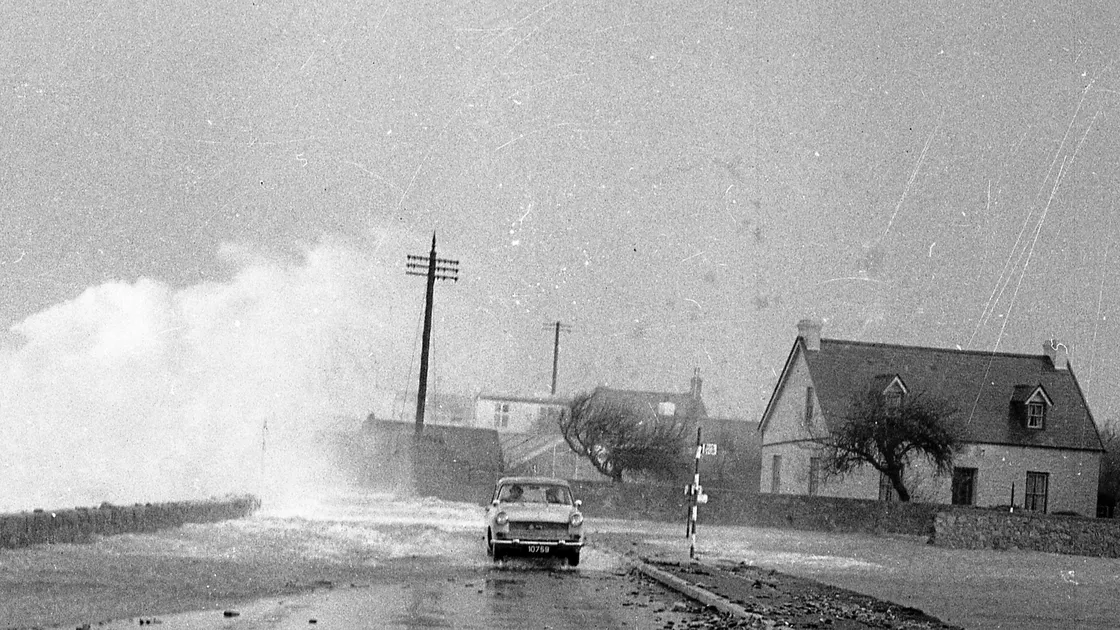
‘I have a photo of him standing on the rocks and railing against the wind,’ says Jennie, whose youngest sister had a second name deliberately spelt as Gale, having arrived home for the first time in the midst of a horrendous storm which flooded the hotel.
While those storms still happen, Curr’s Rocks have very largely been buried, often totally.
Nature has its ways of altering coastlines and at Cobo unquestionably sand levels are notably higher now than they were in the 50s and 60s.
But, regardless, the beach remains one of Guernsey’s finest, as it offers so much and is so well served by the businesses on the other side of the road such as the busy tea-rooms which, when this aerial shot was taken, was a private house (La Maisonette) where the Mansfields lived.
Next door on one side were the Cobo Tea Rooms which were demolished and replaced by the Maryland Petrol Station shop. On the southern side was the walled premises of Les Pieux comprising of two separate buildings, an expansive forecourt and, at the rear, a large garden which decades earlier was filled by a tennis court.
One of those Les Pieux buildings has since been demolished and replaced, while the Victorian-styled old house is currently under renovation having been sold for £1.75m. in recent times.
Thankfully, Les Pieux’s frontage remains unchanged with its founding date neatly showing high on its north-west corner.
Immediately to the south of Les Pieux are two more semi-detached remnants of Victorian times. They, too, are largely unchanged but in 1955 did not have a Cobo Bay Hotel sitting alongside them.
The ‘Cobo’ would not be developed, originally as a private house, for five or so more years yet, and seven decades ago was still a barren field.
Which, on the Cobo 1955 seafront, leaves the Post Office (nowadays known as Cobo Village Centre) and the Rockmount.
Laurie Duquemin owned and ran the post office which, even then, would serve as the district’s main grocers and also fell into the category of tea-rooms in the 1955 Press Directory.
At the Rockmount, Bert Curr had assumed control of the Randalls-owned establishment from his brother Len, and would remain there until his retirement when Toni Nussbaumer took over.
Down on the sands below wooden groynes were still offering protection from the wildest seas, but they proved helpless to the storm-force spring high which arrived on the night of 5/6 April 1962 when huge waves tore a 100ft wide hole in the sea wall, the huge sea’s path made easier by the reduction in the wooden groynes long buried into the sands in this section of beach.
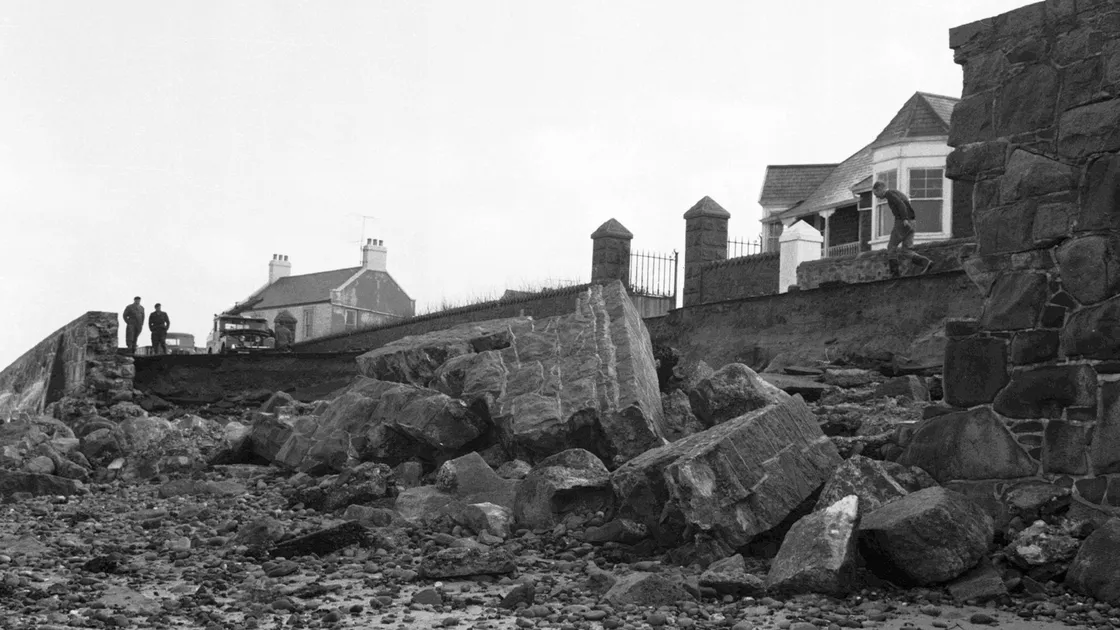
The day after the wall collapse Cobo people were questioning whether it was down to the virtual absence of the wooden breakwaters which once withstood the full force of the sea.
In the months to come, the repaired wall would be strengthened by steel sheets driven deep into the sands and thousands of tons of concrete which filled the gap between wall and steel.
So far, that work has done the trick, although nothing will ever stop the spray, salt and pebbles from blighting the road and buildings along this way.
Cobo of this era was a quiet place.
On summer evenings, the local women would react to the sound of fishermen parking their vans and shouting ‘mackerel, fresh mackerel’.
And on the steep lane rising from Le Feugre towards Ozanne Tower, the absence of motorised traffic was such that it was safe to run homemade ‘bogeys’ – go-karts – from the top of the hill to the bottom.
By the end of the 60s, architect Dennis Davison had begun to transform the area with the Terramar and Tropicana chalets looking down on the coastline from their elevation just off the top of Ruette de La Tour.
The architect built himself his own sumptuous two-storey house close by, one of a row of attractive new-builds on the edge of the lane leading up towards the aforementioned Ozanne Tower and Saumarez Park itself.
A few years earlier, builder Bill Norman had erected the two-storey house which, by 1964, had become Cobo Bay Hotel and filled the space between the Rockmount and its long-standing neighbour, Violet Lodge, with Les Pieux next door.
Fast forward to the 21st century and while Les Pieux is overshadowed by the presence of its prolific neighbours ‘the Cobo’ and ‘The Rocky’, that status seems just fine. After all, would there be a market for three beachside hotels, side by side? Doubtful.
The big question remains, how much more can Cobo alter in appearance, how much more housing can be squeezed in?
Who knows, but as long as this iconic quarter-mile coastal stretch remains undimmed, Cobo will remain a jewel in Guernsey’s crown.





You need to be logged in to comment.