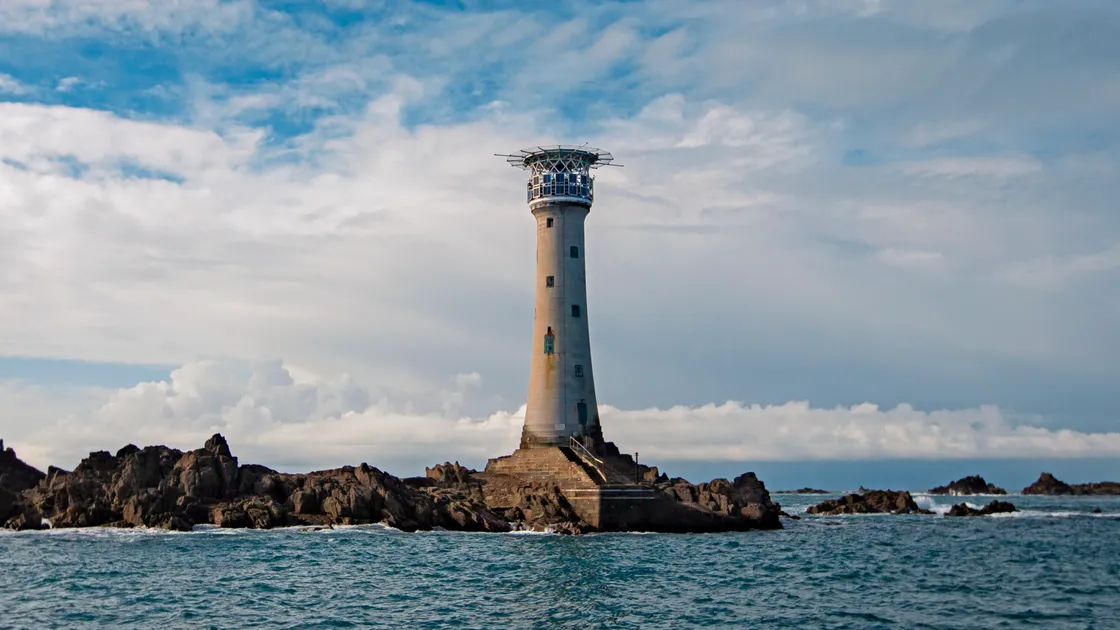
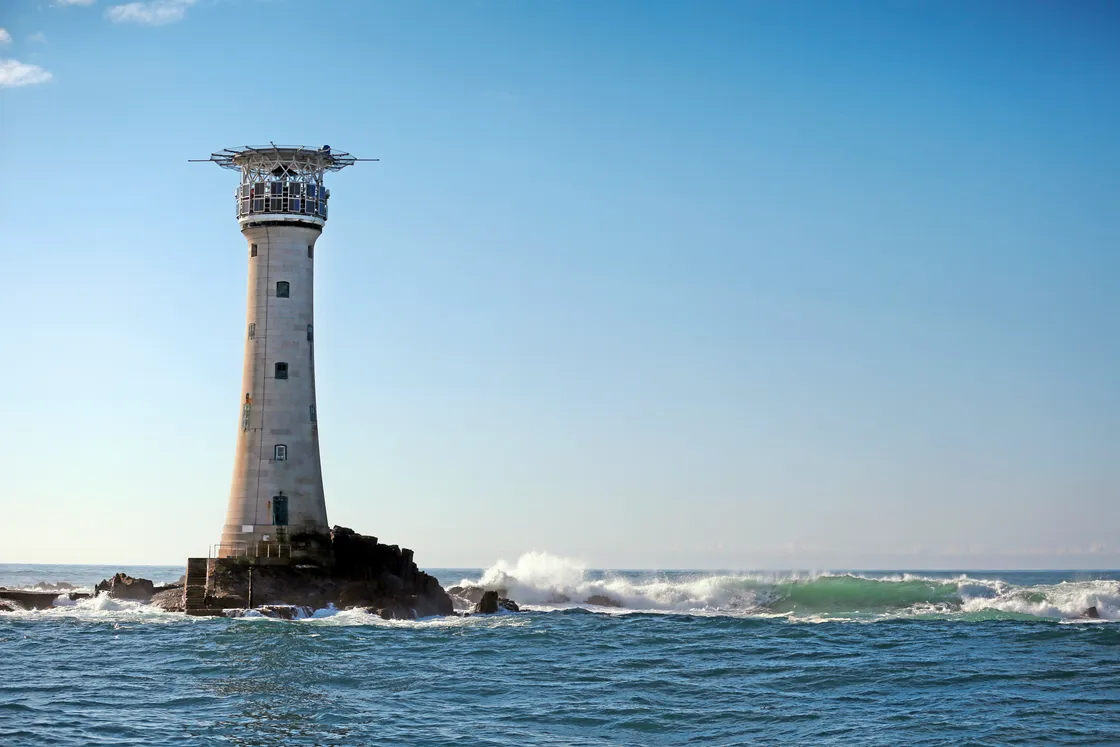
Long live our lighthouse, the one which has risen from the sea and saved lives for the last 163 years and counting.
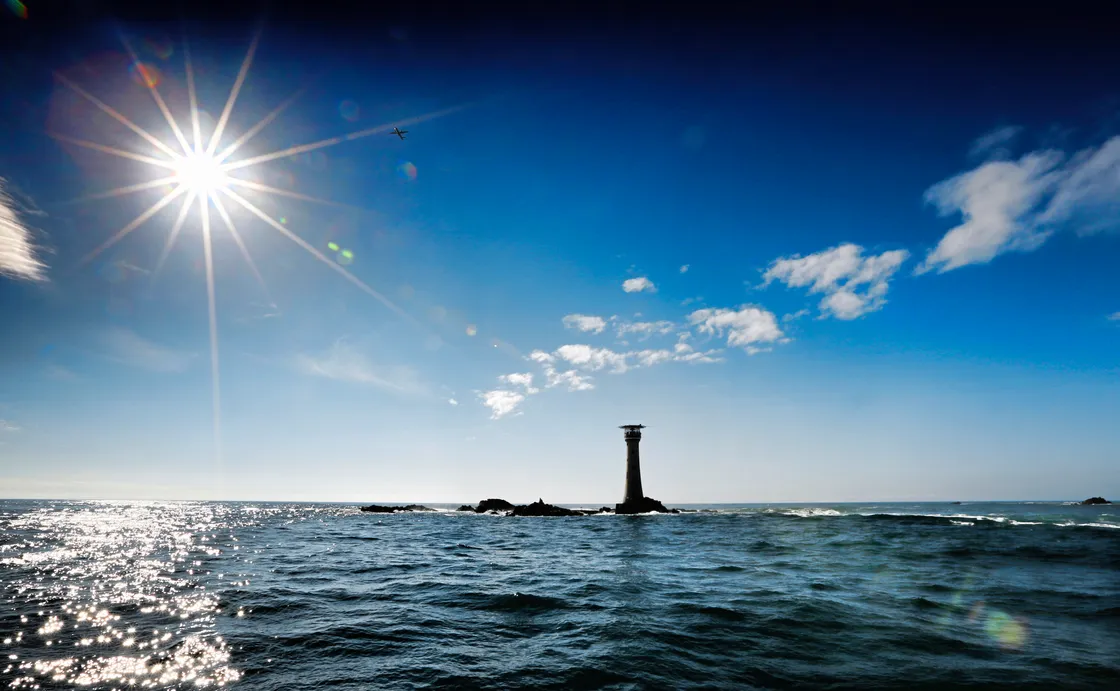
Let us face it. Guernsey just would not be the same without this 36-metre tall granite stick, reassuringly there for us to peer out every time we drive along this south-western corner.
In Guernsey terms, Les Hanois offers one of the most contrasting views for those who live along the L’Eree to Pleinmont stretch.
On a summer’s evening, when all is quiet, the lighthouse and the rocks are a wonder, producing a vista that only Cobo as the sun goes down can match on the west coast.
But, when the clouds darken and the storms hit, the reef becomes a maritime horror show, and there is no better place to see that unfolding mess of breaking waves and huge rollers than up on the Pleinmont car parks.
I went out to the Hanois once – and once is plenty from my perspective.
The late expert of the seas, Barry Paint, obligingly steered me in and around the many granite spikes that stretch from Lihou to the point, and the deep swells which seemingly came from nowhere turned me green in no time.
Sea legs I have not got.
But two men who have, and know the Hanois area like the backs of their salty hands, are Mick Smith and Rob ‘Zeb’ Le Noury. Few Guernseymen have circled underneath the towering lighthouse and nipped among the area’s notorious reefs more than these two.
So, quite obviously, to get a feel as to what dangers lurk around the Hanois, who better than these old mates to answer.
‘The breakers in there are horrendous and on a bad day they have got to be 50ft high’
‘Beautiful on a nice day… horrendous on a bad one,’ was Smith’s instant reaction to boating around the spot which over the centuries has claimed so many ships and far more lives – probably several hundred over time.
He adds: ‘[It’s] especially horrendous between the lighthouse and the Grand Mauve, where it comes off the deep into the shallows and you get a big swell, called the “crash”.
‘The breakers in there are horrendous and on a bad day they have got to be 50ft high,’ he says, while looking to Le Noury for approval and instantly getting it.
Zeb is no less experienced when it comes to experiencing the Hanois waters.
‘I have been around the back of there when it has not been very nice and you should not be there really. Trying to pull a string of pots on the top of the tide there, it can be evil,’ he says.
Mick: ‘I would say from the Haunted House around to Lihou, that corner of the island is really a sh*t-hole. The “townies” say when they get to Petit Bot they start feeling a bit of a swell, when they get to the Corbiere it is a bit worse and when they get to Pleinmont, it’s “whughhh” at that corner.’
They go there though because even in these octopus ridden times, it is productive.
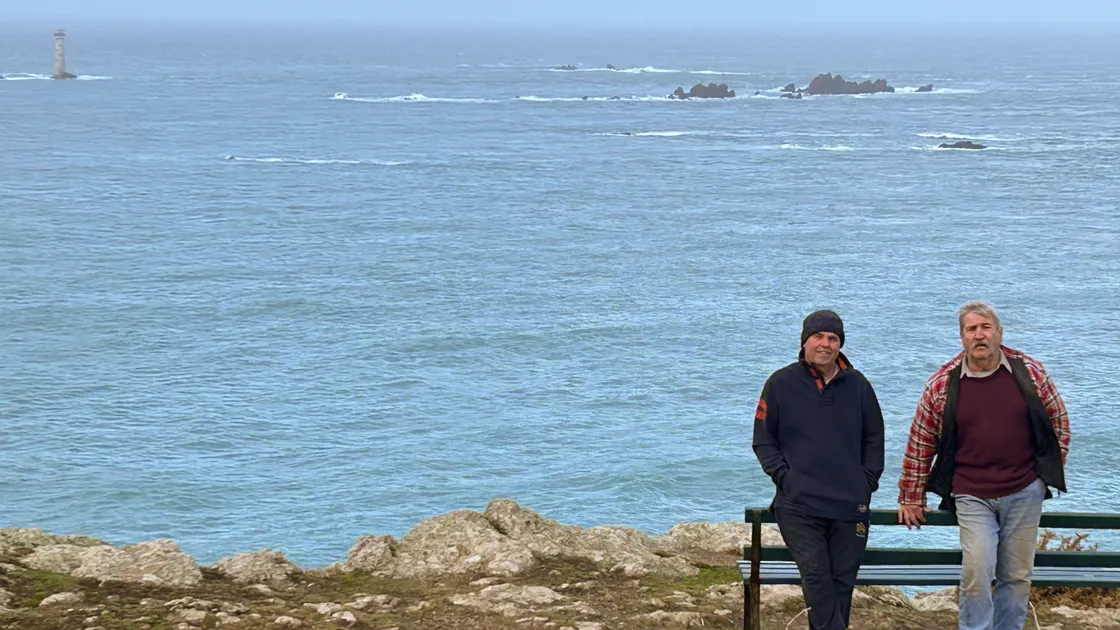
‘It has been a good fishing spot in the past,’ says Zeb.
‘All through the reef around there is good for lobsters.
‘If you go south of the Hanois, run up to what I call the Gold Rock, I call that the Bay of the Hanois where you draw a line from the back of the Hanois down towards there, it is a lovely little bay in there where there is good fishing. That side of the Hanois is lovely, but it is the other side that’s horrible.’
‘On the low water you can work through there because the majority of the reef is out of the water, so you know where you are.
‘When you run off the back of the Hanois there’s reef for about a quarter of a mile and then it drops off to about 200ft.’
While the light itself sits on the Bise, nearby rare rocks such as Ruaux, La Boue Ruaux, Le Haut Aiguillons, La Pere a la Sarde, Le Petit Hanois, Le Jument, Les Valpieds, Le Renouvette, La Mouettes, La Daindresse, Le Haut Epee, Les Belles des Epees and La Mauve combine to make the area so horribly, raggedly threatening.
Grand Hanois lies just to the north of the lighthouse and not too long ago was attracting the attention of these Portelet fishermen more than normal, as Zeb recalled.
‘After one of the storms two or three years ago on the Grand Hanois everyone was saying what’s that white/pale piece on the rock?
'What it was that a whole part of the rock had sheared off. It was probably 100 tons, a massive slab.’
Of course, over time and usually without realisation, these reefs are forever being re-shaped and as hard as granite is, that slab won’t have been the first to slide to the bottom of the sea.
The stone might look the same, but some of it is more secure and withstanding than the rest.
‘Someone told me that when they were building the Hanois they had been looking to build the light on the Grand Hanois, but they drilled it and concluded it was not safe enough,’ says Zeb.
Mick chuckles as he recalled once landing on it on a very calm day and looked to emulate what the ‘Cobo boys’ do with the Grosse Rocque. ‘We put a flagpole on it, but it didn’t last long.’
Meanwhile, down in the depths, still lie bits and bobs from the many wrecks, including the infamous HMS Boreas which claimed 127 lives.
'What it was that a whole part of the rock had sheared off. It was probably 100 tons, a massive slab’
‘You wonder how many wrecks are out there, the ones that nobody knows about,’ said Mick, wondering out loud as to just how many times have ships sailed up the channel, hit a storm and hit the reef and sunk before daylight with nobody on the island knowing it was there.
To back that up he recalled the discovery of a ‘massive anchor’ which was not too far from where the Boreas perished.
Zeb: ‘I’ve dived alongside the Mauve years ago and there’s cannons from the Boreas still there, as well as other little bits and pieces. It’s still all there, all jammed up in the corners.’
Both then and now, knowledge and propulsion are vital to all who sail these waters.
Recently, Mick was glad he had an anchor with him when close to the lighthouse, without warning, his engine dropped out. You don’t go where you want to, you go where the tide takes you.
‘I dropped the anchor and phoned up my mate to come along and tow me in.’
Danger had been averted.
Then there is the light itself, still the same height and solid as the day it was completed but offering different warnings.
‘Years ago when we were kids, they would just set off charges,’ recalls Mick.
‘You’d hear “boom” every five minutes. They’d hang the charges outside and it was like a cannon. That was their warning for fog.
‘Then they moved to the big foghorn which you could hear halfway around the island, but now you just hear “beep”.
It’s a ‘beep’ we would not want to be without, nor any ship or yacht straying into Guernsey’s dangerous west coast waters.
And thanks to its mighty presence, there should never be another Boreas disaster and passing seafarers are safer than they ever have been.
Hail our Hanois.
The wreck that forced a lighthouse build
Those aboard HMS Boreas that fateful, horrendous night in November 1807, were no strangers to Guernsey.
That very day they had been in St Peter Port, when the harbour and quay looked much different than it does now and was known to smell to high heaven.
The 195 on board, including their commanding officer, Captain Scott, would have seen a mucky old town where the only protected area was the Old Harbour with the beaches of Havelet and Glategny either side.
Then they got the word-of-mouth call that a pilot cutter from Rocquaine, with two men on board, was in difficulty off the west coast.
Despite the bad weather and strong north-easterly, the warship left the safety of the Russel and headed out to the west coast where the seas were as fierce as they can be.
But Scott found the cutter and the two local pilots went on board HMS Boreas to navigate them back to St Peter Port safely in darkness.
Lookouts were posted to peer through the dark and the 533-ton timber-built warship rolled heavily in the swell.
Then came the cry which would send a shudder through everybody on board who heard it: ‘Rocks ahead!’
It was the dreaded Hanois.
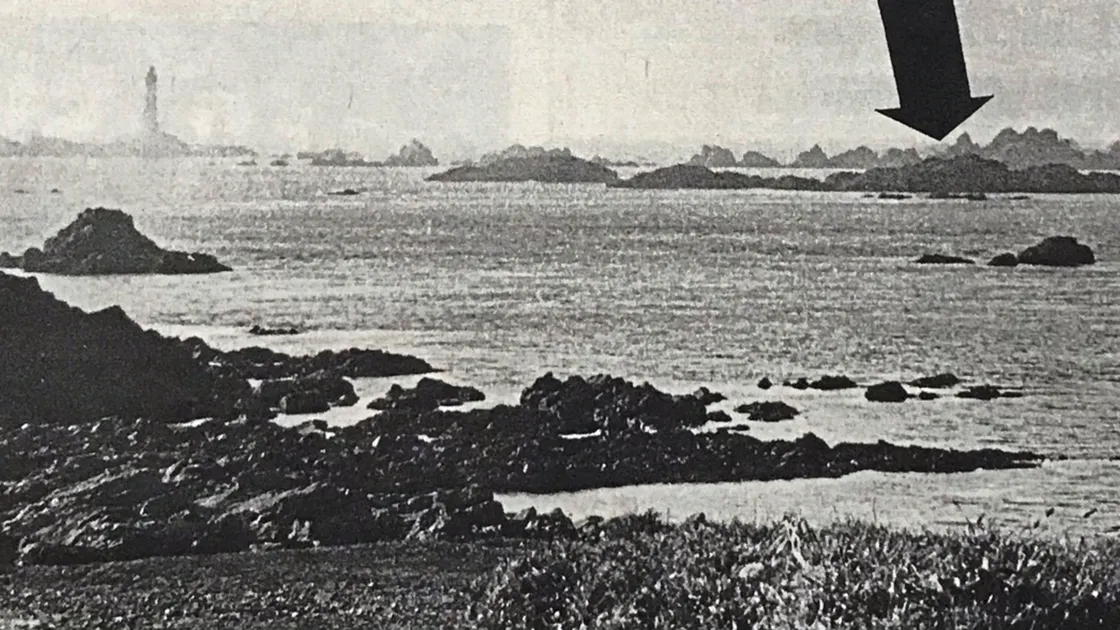
No quick reverse thrusts on these ships. Two minutes later the warship was stuck on one of the jagged and terrifying rocks.
Boreas’s timbers crashed against the reefs and from that moment her fate was sealed. It was, already, simply a quest for survival. Captain Scott gave the order to hoist more sail and, fearful of how long their frigate could withstand a pounding in seas that broke over the deck, heaved frantically.
The canvas stiffened in the wind and moved the frigate 20ft forward.
For a brief moment the men thought they were clear of the reef. But in no time there came another fearful jolt as the Boreas hit another rock, producing a large, gaping hole in her hull.
The sea rushed in immediately. It was literally all hands to the pumps, but all the pumps in the world would not save her and having not long been aboard the ship, the Rocquaine pilots decided it was time to abandon ship.
They cut their own boat adrift, jumped aboard and made for the shore.
Remarkably, history suggests that the two pilots made no attempt to raise the alarm, yet a mile or so out to sea amid the horror of the Hanois, British sailors were losing their lives.
It seemed cowardly and ignorant of the Rocquaine pilots to simply go home, but there was reason in their temporary silence. They knew how savage the sea can be in these parts and possibly judged it as suicidal to send anybody out to attempt a rescue of so many.
The crew, who fired cannons and flares in an attempt to raise the attention of west-coasters, were at the sea’s mercy while, on land, it was thought that the ship was French, so why help?
Captain Scott ordered for an allowance of spirits to be served to the frightened and the chilled, and to lower a gig on which six men, headed by Royal Marine Lt Bewick, would try to seek assistance for the main body of men. The separate launch and cutter also took men off the Boreas.
Years later, William Gilly, in his book Shipwrecks of the Royal Navy, wrote that the launch managed to reach the Hanois rocks, along with the cutter, but it is thought – and borne out by the subsequent enquiry – that he meant the Guernsey mainland. The greater part of the crew, chiefly smugglers and privateers who had been pressed into service, deserted and disappeared into the darkness of the cliffs. They would have been cold and wet, but safe. This meant that the cutter had to return to the Boreas with only four men.
When almost back alongside, the launch took on heavy seas and was half full of water.
Straining at their oars, the men decided to row back to Guernsey but a huge sea finally swamped their launch and they were rescued by the cutter.
The Boreas crew thought this horrific night would never end, but eventually dawn came and with it fresh hope. Luckily, HMS Thalia found those in the smaller craft and took them aboard, more dead than alive. Meanwhile, the men left on the Boreas waited as their ship was pounded by the frothy seas.
Captain Scott is thought to have ordered his men to seek shelter in the stern of the warship and huddle there as the dark green sea hammered relentlessly at the vessel.
Suffering from exposure, the seamen stayed at the stern until the early hours of the morning. Then they heard a hollow sound beneath them and the end came suddenly.
As the Boreas fell onto her side and settled in three fathoms of water, there was a fierce struggle by the crew to clamber onto rocks or grab makeshift rafts which had been constructed in the night. Captain Scott managed to climb aboard a raft, but he had to be supported by the doctor and the quartermaster. He collapsed and died in their arms and minutes later was swept away.
Admiralty by Vice-Admiral Sir James Saumarez, the officer commanding the naval forces in Guernsey, read as follows: ‘It is with deepest regret I have to acquaint you for the information of the Lord Commissioners of the Admiralty, that HMS Boreas, in standing towards this island yesterday evening, about six o’clock, run upon the Hanois rocks, the wind at the time blowing very hard at north-east.
‘I received information of this unfortunate event about two o’clock this morning, and immediately sent orders to the Brilliant and the Jamaica, the British cutter, and one of the government scouts, to proceed off the Hanois and afford her every assistance.
‘Their Lordships will be very much concerned to be informed that on the tide flowing, the ship overset, and became a complete wreck at about two o’clock. I am truly obliged to add, that Captain Scott, with the officers and men except those mentioned in the enclosed list, were lost with the ship.'
Lieutenant Wilson of the Royal Marines, and six men were sent off in the gig, and landed on the western part of the island and about 30 others in the launch and the large cutter were also landed, and the boats returned to the ship. ‘Through the great exertions of Lieutenant-Colonel Sir Thomas Saumarez, in collecting the pilots and boatmen in the vicinity of Rocquaine, about 30 seamen and mariners were taken off the rocks of the Hanois at daylight.
‘The greatest praise appears to be due to Captain Scott and all his officers and men, for their steadiness and good conduct under such perilous circumstances, in a dark and tempestuous night, in the midst of the most dangerous rocks that can be conceived, and I have most sincerely to lament the loss of so many brave officers and men who have perished on this most melancholy occasion.’
Yet, within a month a court martial hearing was taking place in Portsmouth.
High-ranking naval officers heard all the evidence and, ultimately, cleared all the officers and men of any blame, the exception being those who had scarpered on landing in Guernsey.
Thankfully, eight young boys aboard had survived and were given the chance to lead a full life, while the Boreas itself was soon forgotten and was left to be silently destroyed by the seas.
Boulders were driven over her by the flood tides and it was not until 40 years later that a Mr Bell, who was working on the barque Rose, went to the Hanois and dived on the wreck.
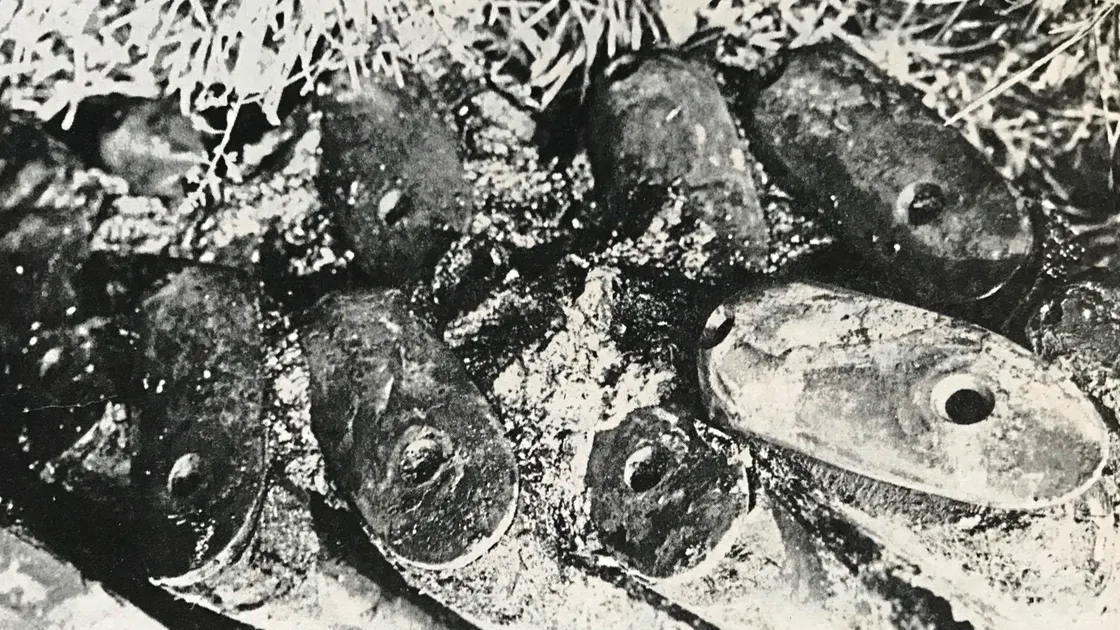
He discovered 15 guns and a large quantity of shot in a corroded condition, but made no effort to recover these objects and Boreas was left to further rot away.
Half-a-century after that fateful night, the Hanois lighthouse was built on a nearby rock, but it was mainly because of the naval disaster that Trinity House undertook to build the lighthouse we have long known and admired.