


In May 1989, a 67-year-old retired US Air Force Colonel sat down to write, for the first time, an account of the most harrowing night of his life – a night he barely survived and on which he witnessed the violent death of one of his fellow B-17 bomber aircrew, followed by the demise by exposure of seven more, in the cold winter waters off the northern shores of Guernsey.
Kenneth Vaughn of Belleville, Illinois was writing his account at the invitation of his second son, at that time a captain in the USAF, in preparation for the ceremony in which he would be presented with his Prisoner of War medal – a new medal signed into law by then President Ronald Reagan – which he would be able to place alongside his Air Medal and his Purple Heart.
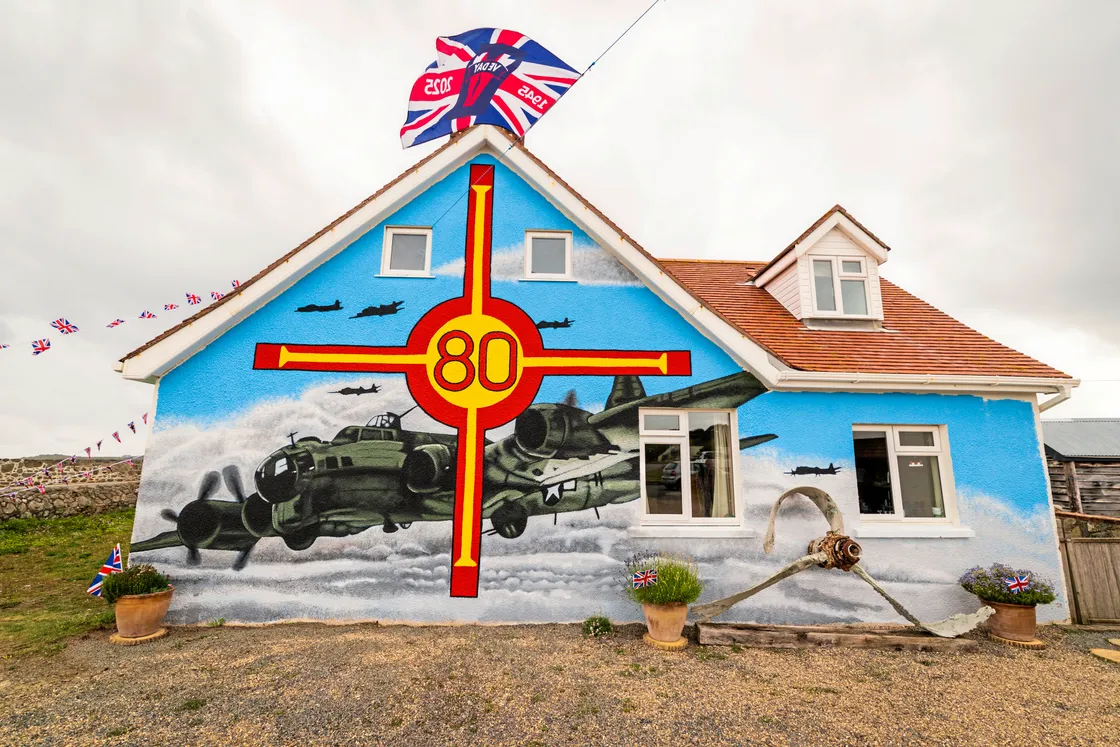
That son, Lt Colonel (retd) Robert Vaughn, is now to be found in Grapevine, Texas, teaching maths and coaching baseball. Earlier this year, his wife came across one of our stories online – one of our Freedom 80 series, building up to the 80th anniversary of Guernsey’s liberation on 9 May 1945. It concerned the imminent painting of the number 80 on Rob Le Noury’s gable wall at L’Eree and mentioned a Boeing B-17 Flying Fortress propeller which he had fished out of the sea near L’Ancresse. Could this be from one of the four engines of his father’s bomber, named Speed Ball?
I haven’t been able to answer their question with certainty. At least six B-17s ditched in our waters during the Second World War and Speed Ball wasn’t even the only one to ditch off our west coast on that last night of 1943. Local experts believe the propeller now on display at L’Eree is probably from one of these others.
As far as we know, no artefacts from Speed Ball have ever been recovered. Indeed, although its estimated location is 12 miles beyond L’Ancresse, its exact position has never been established. According to dive recovery expert Richard Keen, the wreck lies at a depth of about 70 metres of water. It’s one of the areas he hopes to see scanned in the not too distant future.
In the course of our correspondence, Robert told me that he still had his father’s account of that night – New Year’s Eve 1943 into New Year’s Day 1944. This constitutes a detailed history of the last night in the lives of eight of those men whose names now adorn the Allied Aircrew Memorial at Guernsey Airport, which was unveiled 10 years ago today. We are very grateful to Robert for being willing to share this account with us for this anniversary. In fact, he was not just willing but enthusiastic.
‘My father’s perspective was always one of extreme gratefulness,’ Robert told me.
‘He endured the war and captivity, when many others did not. For him, the war was very real, up close and personal. In retirement, one of his favourite volunteer duties was speaking to school children about America and that “Freedom isn’t free”. I’m keen to continue that practice of sharing the message of freedom to the next generation.’
Kenneth survived against all odds on New Year’s Eve 1943. But Robert points out that he was a survivor all his life. He was an orphan, who lost his adopted father when he was just nine years old. From this experience, he emerged as ‘a tough, no-nonsense, independent, hard-working man’, says Robert, which was ‘likely a primary reason he survived the shoot-down and the one and a half years he spent as a POW’.
‘I never recall him complaining about anything,’ he said, ‘despite the fact that he suffered some long-term physical pain and limitations due to exposure the night he spent adrift in the English Channel.’
For his eighth mission, Second Lt Kenneth Vaughn took up the role of co-pilot aboard B-17 Flying Fortress 42-29877, named Speed Ball. It belonged to the 511th Squadron, 351st Bomb Group of the 8th Air Force. The targets for this bombing mission were near Bordeaux in southern France.
‘We took off from Polebrook, England, around 8am New Year’s Eve 1943 and began the task of slotting into our appointed place within the formation,’ he recounted.
This was quite a task, as no fewer than 175 bombers were due to undertake the mission, meeting up from a variety of airfields. A further bomber stayed at Polebrook, loaded with ice cream. Its mission was to fly at altitude in order to freeze it, before returning to Polebrook for the base’s end-of-year party, which the crews were confident of attending. Little resistance was expected, making this a mere ‘milk run’.
Within a few hours of Kenneth taking off, the formation had relied on its Republic P-47 Thunderbolt fighter escorts to fend off enemy fighters and had reached the coast of Brittany near Treguier – about 70 miles south-west of Guernsey. They climbed to 18,000ft and headed out over Lorient and into the Bay of Biscay. The target area of Merignac Airfield was reached at 12.30pm but dense cloud precluded an attack. Instead, the bombers were instructed to release their deadly cargoes of 500lb bombs onto the secondary objective – Chateau-Bernard, south of Cognac. It was being used as a bomber training school, where anti-shipping tactics and night flying were taught.
‘Intelligence reports indicated very little opposition from this target but unknown to us, a Luftwaffe flak unit had just completed their gunnery training school at St Nazaire and were being transported to their new assignments,’ wrote Kenneth.
‘They were on railway trucks close to the airfield. The gunners watched as we headed towards them following the railway lines. Compounding this was our decision (because of intel) to descend to a lower altitude to ensure pinpoint accuracy with our bombs. As the formation headed over the target, it immediately came under intense anti-aircraft fire.’
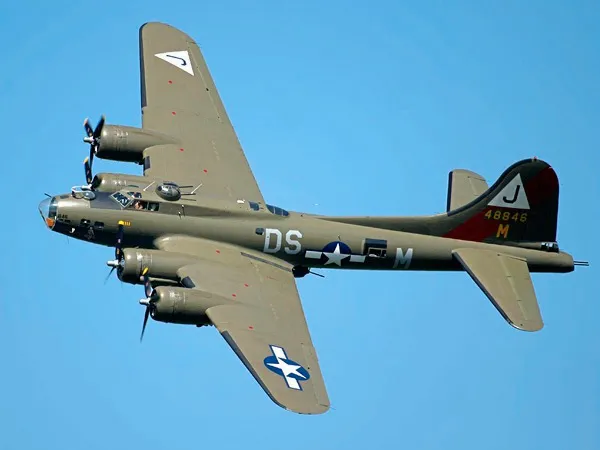
A number of B-17s were hit, though some of these were able to fly on. In all, 546 bombs were dropped before the surviving bombers formed up again for the journey back to England. Kenneth was in one of the unhindered aircraft but that luck did not last long.
By 2.35pm, the formation had begun its return flight across the Brest peninsula and again came under attack from German fighters.
‘For the second time that day the P-47s afforded us protection. However, the German fighters were successful in damaging many of the bombers in formation. We saw another B-17 below us and decided to join up with him for mutual support. When we got close enough we saw the hatches were off and no one on board. Apparently, the crew bailed out with the aircraft on autopilot and the B-17 continued to fly. I don’t remember the tail insignia because about that time fighters hit us again, killing our tail-gunner [Sgt Raymond Bittner], knocking out our two inboard engines, and severely damaging our airplane.’
The damage was such that Speed Ball could no longer maintain its altitude and slowly but surely began to descend towards sea level, ditching 12 miles north of Guernsey.
‘After impact at approximately 3pm, all nine of the surviving crew members managed to get into the two life rafts before the aircraft sank immediately,’ Kenneth wrote in his account.
‘Hopes rose when an English fighter buzzed the rafts and it was thought that rescue boats would arrive soon. However, darkness soon fell and problems began to develop. The rafts also had received battle damage and were lashed together in an attempt to keep them from sinking.’
Kenneth describes the desperate situation in which hand-operated inflation pumps eventually ‘broke down after continuous use and became ineffective’.
‘The surviving crew members were wet and suffering from exposure. The navigator [Lt Alfred Dearborn] and engineer [S/Sgt David Van Dyke] died sometime between 8-10pm. Shortly thereafter some rocks were seen nearby and our life rafts drifted upon them. A light was seen blinking in the distance and distress flares were fired at approximately one-half hour intervals until the supplies were exhausted. In the meantime, three more crew members died.’
These were S/Sgt Casimir Pavlic, Sgt Michael Morey and Sgt Carl Bekken.
Dawn brought a rising tide and the four remaining survivors – along with the two partially deflated life rafts – were washed off the rocks.
‘I climbed aboard one of the overturned rafts and pulled the bombardier up with me. When we looked around for the two others – the pilot [Lt Albert Jones] and radio operator [S/Sgt William Brennan] – they were nowhere to be seen.’
And so it was that of the 10 men who took off on Speed Ball from that Northamptonshire airstrip on the last day of 1943, just two ‘were eventually washed ashore on Guernsey Island’ at about 10am on New Year’s Day of 1944 – co-pilot Lt Kenneth Vaughn and bombardier Lt Charles Bronako.
‘We both were so weak from exposure that we were pulled out of the surf by German anti-aircraft personnel who had occupied the island,’ Kenneth wrote.

‘They carried us to the Happy Landing [sic] Hotel which had been converted to a hospital for German troops. After about 10 days, we recovered enough to be moved and were put on a boat to France and then by train to Frankfurt, Germany for interrogation.’
What Lt Vaughn leaves out of his account is the remarkable coincidence that they were not the only B-17 airmen to be held at the Happy Landings that night. The entire, rescued crew of another B-17 was being held there – a plane nicknamed Piccadilly Commando. They had lost an engine from some of that flak at Cognac and, unable to keep up with the main return formation, were then attacked several times more. They lost a second engine and then a lot of altitude before then losing all power as they prepared to ditch deliberately close to the nearest coastline they could find – that of Guernsey – in the hope of swimming ashore.
They had hit the water at about 3.45pm and all of them managed to get out of the aircraft before it sank. They had ditched about an hour after Speed Ball but much closer to shore and the wind quickly pushed their one surviving dinghy to the relative safety of the rocks, with half the crew on board and the rest in the water, hanging onto ropes. They were rescued by a German launch and taken back round to St Peter Port.
In his 1988 account of the night’s events, aviation and Occupation historian John Goodwin explains that Frank William Falla of La Passee – not to be confused with the journalist Frank Walter Falla – was among those who saw the flares set off by the desperate Speed Ball crew, some time after this earlier rescue.
Realising no effort was being made to rescue them, Frank broke curfew, stormed into a coastal gun position and tore a strip off the German personnel there.
‘He was assured that the navy would send a boat to pick up the airmen, but feels certain they were in fact left to their fate,’ wrote John.
‘Luckily for Mr Falla, no action was taken regarding his infringement of the curfew or of the more serious charge of entering a military area and, whilst there, of insulting a German officer.’
John also relates that during that subsequent train journey to Germany, Lt Bronako escaped by jumping from a toilet window and spent five months on the run before being picked up near Spain.
Kenneth ended up in a POW camp called Stalag Luft I near Barth on the Baltic coast. His description of life there details overcrowding, inadequate food, secret radios, life-saving Red Cross parcels and an inability to keep clean.
‘I did not brush my teeth for three months, and then only with a second-hand toothbrush that I bought using cigarettes for money,’ he wrote.
He lost two and a half stone in weight in 15 months, before the German guards fled to the west, ahead of the arrival of the Russian forces who were to liberate the camp.
He and his fellow men were flown back to France in B-17s.
‘I, with a small group, went to England to visit our old outfits before returning home to the US in July 1945,’ he wrote.
Kenneth stayed in the USAF until his retirement as a colonel in 1968, during which time he specialised in computing, installing the first computer into the Pentagon Operations Center in the early 1960s.
He died on 3 May 2017, aged 95. His and Bronako’s remarkable survival of the events of New Year’s Eve 1943 meant that they avoided the fate of their eight fellow crew members, whose names are among the 153 listed on the Allied Aircrew Memorial.
The bodies of Sgts Bekken, Brennan and Morey were washed up on Guernsey, where they were buried. In 1946 they were disinterred and then reinterred in Wisconsin, Rhode Island and St Laurent-sur-Mer respectively. The other five bodies were never recovered.
We would like to express our grateful thanks to Robert Vaughn for providing his father’s account and to Simon Hamon for additional information, including John Goodwin’s article for the Channel Islands Occupation Society review of 1988.






You need to be logged in to comment.