

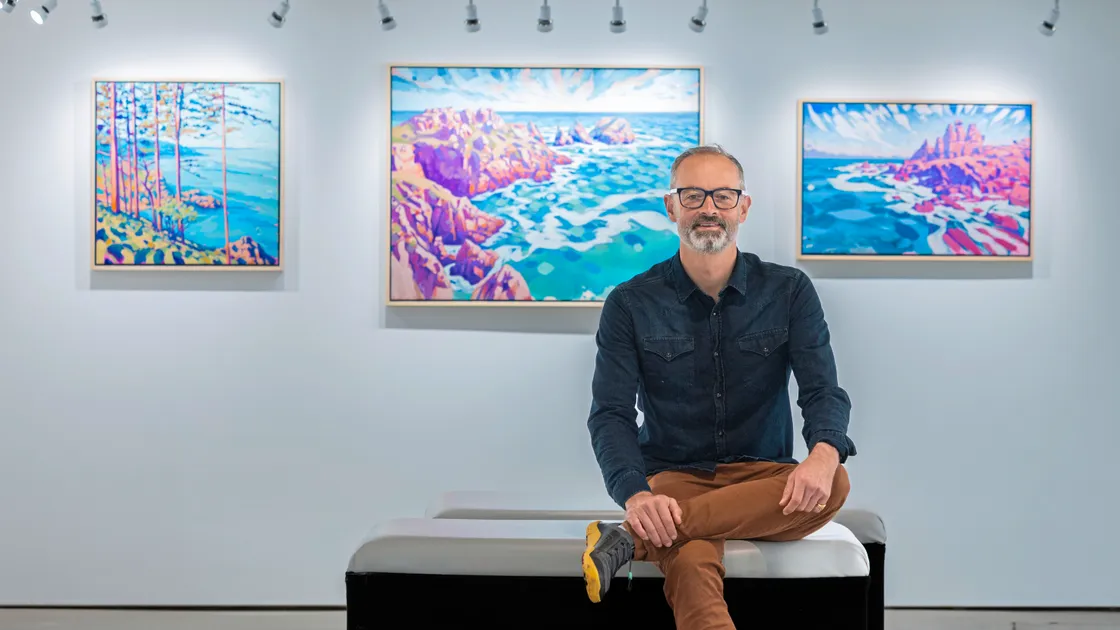
Art for Guernsey’s latest exhibition, The Lidded Lands, features artworks by James Colmer and Vesna Parchet and poetry by Magnus Buchanan. It explores Guernsey in Megalithic times.
AFG director Jock Pettitt got the idea for the exhibition while on a family holiday in Herm.
‘We were walking to Shell Beach and my daughter sat on the Robert’s Cross passage grave. We chatted about what it could be. There were bones in there – which we, as adults, would have known were a rabbit’s – but she was full of interest and nine-year-old wonder.’
This sparked an idea.
‘We have stones, passage graves, menhirs, but in the modern world they kind of sink into the ground. So it occurred to me, what would happen if we stripped away the built environment of today? Who built them, what were they doing?
‘Immediately I knew that James had to come to the table, especially after the work he did on Finding Turner [and AFG project which began in spring 2025], and then I thought of Vesna, too. They would bring together big, bold colours. But there was the last piece of the puzzle to fit in.
‘I met Vesna in London and we sat talking about the show. How did these people communicate? Probably not through writing, but we thought it would be interesting to put in a written structure to tie it all together. And that’s when we invited Magnus.
‘It was greater than we hoped. The value of the words has done it for me – captured the questions.’
As this was where Jock had the idea, the sister isle was where the two artists and poet visited first.
‘We collaborated through the summer, starting with a trip to Herm together. Many of the poems came out of the conversations we had there. For example, we were all interested in the way in which the early peoples perceived colour. The absence of the colour blue in ancient texts became the subject of one poem. Through the summer, we kept corresponding about the areas that we were exploring. The relationship between people and animals, and particularly dogs, was another topic that we all started envisaging together.
‘It was great for me to get ideas from the pictures as they formed, and also to see words I was writing spring to life in new canvases that James and Vesna created from them. It’s magical to work alongside such talented artists – like having someone inside your mind’s eye.’
There’s a tangibility to these structures, both metaphorical and cognitive, did Magnus visit the stones and if so did he ‘hear’ and ‘feel’ them?
‘I’ve always enjoyed visiting these sites – day and night,’ he said. ‘I like to place a palm against the stones and close my eyes to feel what comes from inside the stone. There’s something both comforting and frightening about the size and age of these places. Over the summer I spent time at all the main ones with my son Merlin who uses them as something of a prehistoric playground.’
While writing, there must be a feeling of empathy with the people who built these structures.
‘Part of my family is Hebridean, which also has its own connections with the stones including Skara Brae [a 5,000-year-old Neolithic village in Orkney]. As someone who has settled in Guernsey, it’s great to get in touch with those roots at both ends of Britain.
‘I spoke with Phil de Jersey at Guernsey Archaeology who was really helpful and granted me my “poetic licence” by explaining how little is known about these peoples. I like to imagine quite a matriarchal culture and this seems supported by the shape and form of the burial passages alongside the rather phallic menhirs dominating our hillsides.’
As Guernsey’s ancient past has not been widely (if at all) conveyed through poetry, or indeed fiction, does one feel a kinship with writers such as Alan Garner and Arthur Machen?
‘Yes, I love the stories by young adult writers like Alan Garner which were published by Puffin when I was growing up. Looking over the poems, I think that I was also influenced by the Caribbean poets I’ve read and heard too, people like John Agard, Grace Nichols and Kamau Brathwaite whose poems evoke a spirit of song and dance coming out of a rich oral culture.
‘My wife Charlie is also really interested in this era of Guernsey as well as the links between mythology and human nature, so I’m sure that we’ll keep exploring this world together.’
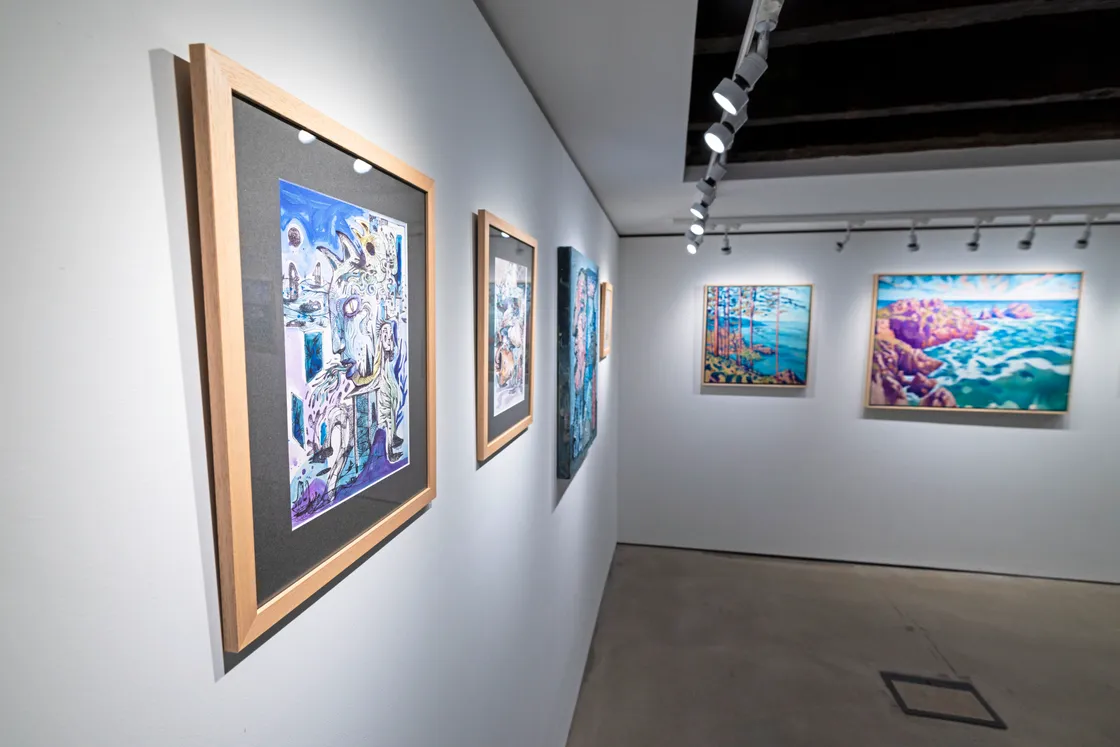
People can listen to Magnus’s poems on headphones as they view the artwork around the gallery.
Vesna’s work revolves around growth/transformation, the conscious/subconscious and the real/abstract – were these themes explored for this project?
‘For The Lidded Lands I captured my impressions during my visit to Guernsey early on this year. I was very struck by the monumental stones and ancient places of worship, the sense of wonder and mystery of why and how people would have created these places in ancient times, also that they still shape the landscape to this day.
‘On the one hand I was trying to channel myself to a time and place of a distant past, at the same time creating an artwork, which is completely tied in with the present. I like the colliding ideas behind “imagining the past”, somehow they do end up evolving into their own stories.
‘Even though I always lay down ideas in my sketchbook drawings, when I approach a canvas, I like to keep ideas loose and work along while I develop a full image over time – very often I paint over parts, layering the paint and creating a lot of texture, there is a kind of mapping of time and depth.’
She admits that myth and folklore has informed her work.
‘Mythologies have been part of my inspiration for previous works, I love how collective stories and superstitions have survived and used to this day. I depicted specific animals in some of the paintings of the exhibition, because they have been part of many myths and folklores, fascinating how they have been triggering humans’ imagination for many millennia.
‘I did visit a few dolmen during my visit, also some on Sark and Herm. I did some outdoor drawings and also took many photographs.’
Vesna said he had not previously known about the neolithic sites that existed on the Channel Islands.
‘I was astonished how many still existed. I went through a number of books to read about local folklore stories and superstitions and was lucky to have spoken to different people with deep knowledge about them during my visit.
‘It was the mixture of the ancient sites and the unique landscape that really moved me most. I spent many hours walking along the coast, taking in the dramatic seascape and rock formations and letting my imagination go.
‘I became very absorbed by the natural shapes of the stone and their powerful presence, how each stone has its own character, rocks that stick out the water that resemble a head, an object or animal. The beauty of stones shaped by both humans and natural forces.’
James enjoyed being part of a group for this project.
‘It was like having workmates,’ he said. ‘To have people to talk to and bounce ideas off has been great.
‘Some of the artwork came from the poems and some of the poetry came from the artwork. We were part of a WhatApp group and the ideas kept bouncing back and forth. Then Vesna came over in May and we explored the islands.’
James became interested in Herm as a sacred place.
‘There’s a mound on the west coast of Herm, to the north of Jethou, called Crevichon, and that sparked my interest. The community that was there is now underwater. What did that mean to them? I started looking into the tide rising, it’s history. As an artist I wondered how they would record this.’
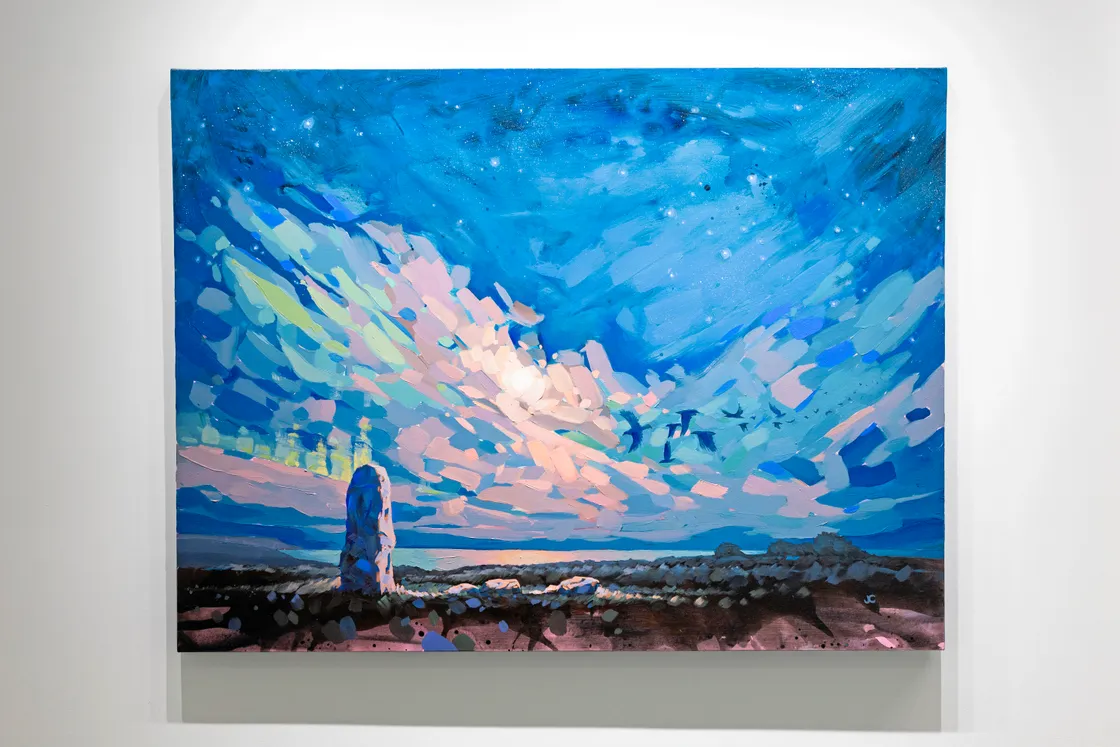
James said that although his work for the project had his usual vibrant aesthetic, he come across something more spiritual.
‘Everything they experienced they probably put it down to “the gods”. At the same time, they would be so in tune with nature – going out in boats with no weather forecasts to guide them, they had a deeper connection. When I’m on the cliffs or on a beach, it has a profound effect on me. And I wanted to capture that in the paintings. The vibrancy of colours.
‘Nowadays there is a return to nature, outdoor life and spirituality – if you want to call it that – which gives you a sense of being.’
As well as experiencing his and Vesna’s artworks, James urged people to read Magnus’s poems – or listen to them while viewing the work.
‘It gives it a deeper context. You start to work out what we’re doing with our paintings. I want people to work it out for themselves. If you want to have a deeper connection to the artwork, the text is the key.’
The Lidded Lands is at the AFG Gallery, Mansell Street. Opening times 10am to 5pm, Tuesday to Saturday.

You need to be logged in to comment.