There are some caveats that need explaining before we can leap into a top 10 of Guernsey storms. The first is that there are different types of storm that can cause various types of damage, including snow storms and electrical storms.
So for this feature – and bearing in mind that it was prompted by the recent experience of Storm Goretti – senior meteorological officer Adam Heaume restricted himself to ‘low-pressure systems (mid-latitude/extra-tropical cyclones) that bring storm force winds and rain’ and so these entries are listed in order of the strength of gusts.
Even then, the wind-speed recorders available to the Guernsey Met Office have varied over the decades and no one detection device can ascertain all of the gusts that occur, as they are by nature extremely localised. Plus wind speed recording has evolved since Elisha Dobree first started making his weather observations in 1777. So, for consistency, this list is ordered by recordings at Guernsey Airport.
Yet another thing to bear in mind is that some storms can blow out quickly, while others stick around or arrive after a deluge – all factors which greatly affect the amount of havoc they can wreak.
So with all of that in mind, the following is one version of a top 10 of the biggest – in this case, the gustiest – storms Guernsey has endured.
1 – Saturday 15 December 1979
Perhaps the first thing you’ll note is that this is just a date, rather than an imaginatively named storm.
‘It was only in 2015 that the UK Met Office adopted a naming convention for storms, in an attempt to provide consistent messaging and clear communication, which in turn would improve public safety,’ Adam tells me.
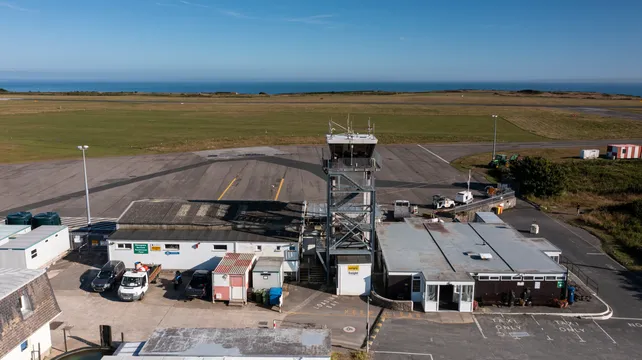
Regardless, this storm produced the highest wind speed ever recorded at Guernsey Airport – a gust of 83 knots (96mph), timed at 10.32am.
Adam describes it as ‘the most severe gale yet recorded at the airport and one of the worst in the last 150 years’.

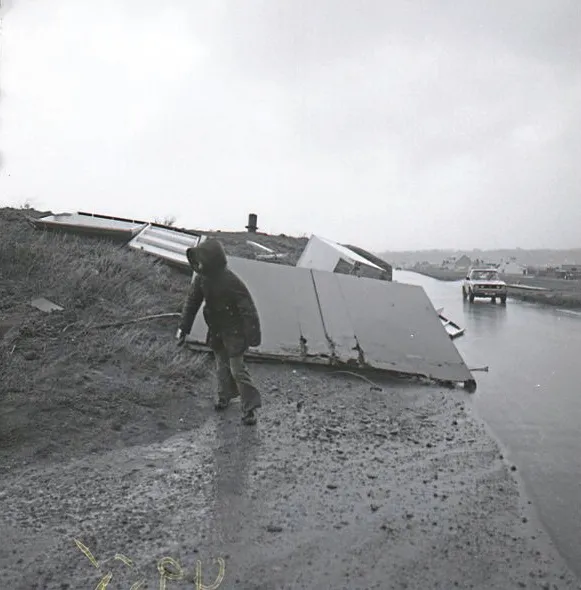
Our headline was Hurricane Havoc! and we carried stories of smashed up vineries all over the island, walls collapsing onto cars at Vauvert and a lorry being tipped onto a yacht at North Side.
‘The new hotel being built at La Mare, Vazon was badly affected,’ we reported, ‘with gaping holes being opened up in its roof.’
At Les Islet in St Peter’s, the Le Lacheur and Vidamour families were evacuated, shortly before a mature elm tree fell onto their homes.
The lifeboat spent pretty much the whole stormy day out at sea, having first departed at 4.25am to bear an injured seaman from the Finnish vessel Atlas to hospital. A second crew took the Sir William Arnold out to conduct a box search near the Casquets at 10.30am, looking for the Ondine, whose radio had fallen silent mid-sentence when contacting St Peter Port for a bearing. The lifeboat searched for seven hours without success and then at dusk, it turned back to the harbour to refuel. A third crew was on standby to continue but it was decided to resume the next day. However, by then the vessel had been found by a French lifeboat 47 miles away from the Casquets, off the Devon coast. The crew was unharmed.
The south-west of England had recorded gusts up to 100 knots (115mph), so it was no wonder that glam rock legends Slade – already on the island – were unable to get their equipment over for their Saturday-night gig at Beau Sejour, which had to be postponed until just before Chriiiistmaaaaas.
Perhaps we should call this one Storm Noddy.
2 – Thursday 15 / Friday 16 October 1987
‘This infamous storm provided the only other gust in excess of 80 knots (92mph) recorded at Guernsey Airport,’ Adam says.
‘You’ll recall the BBC weather presenter [Michael Fish] informing viewers there would be no hurricane forthcoming, and technically he was correct, but we would go on to experience hurricane force winds through the night.’
The strongest gust recorded anywhere on the island was at the St Peter Port signal station, which registered at 96 knots (110mph).
‘110mph hurricane blasts island’ ran our headline on the Friday, with reports of boats being found on their sides, windows blown in at GT Cars at the Halfway, Maison Carre at the Bridge and the Iron Stores on North Side, while at the Albert Marina, a pontoon was smashed into three pieces.
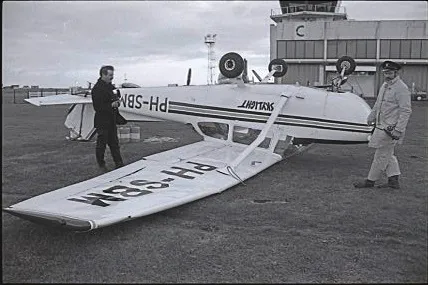
The strongest gust at the airport may ‘only’ have been 81 knots (93mph), but the winds there were enough to flip a Cessna 172 onto its back.
Trees blocked roads all over the island, cutting off the Jerbourg peninsula and blocking Queen’s Road and Belmont Road in St Peter Port.
‘Roads and lanes in the western part of Castel took on the character of a maze as early morning motorists tried one route after another only to find their way blocked time and again by fallen trees,’ we reported.
According to Guernsey Met Office records, ‘at least 2,000 trees were blown down, probably as a result of softened ground from the recent heavy rains as well as the storm,’ while ‘many greenhouses were demolished and numerous slates and tiles dislodged.’
At L’Eree, the entire gable end of one house collapsed, exposing the contents of one bedroom, which were quickly removed by the winds.
Among those who suffered the worst would have been the 117 passengers on board the Devoniun, a ferry heading for Torquay from Jersey which was ‘hit by the hurricane off Le Hanois at midnight’, was forced to steer into the wind to avoid rocks and eventually found shelter in St Peter Port harbour at 7am. Captain Robin Craythorn said the conditions were the worst he had seen in 15 years and described the passengers’ experience as ‘quite harrowing’.
3 – ‘Burns Day storm’ of Thursday 25 January 1990
‘Storm destruction!’ ran our headline on Friday 26 January, the day after the highest gust ever recorded at Guernsey Airport on a January day registered 77 knots (89mph).
In an entry about Alderney, met office records state ‘gusts of more than 90 knots were reported’ during the storm. This might sound a bit vague but there is an explanation. According to our front-page story entitled ‘Alderney chickens are blown away’, ‘the maximum wind speeds could not be measured as they went off the end of the scale at 90 knots (104mph)’.
The story explained that ‘700 chickens were blown away when they escaped from their damaged enclosure’ and concluded that ‘none of the chickens was recovered’.
Roof tiles flying off the roof of the Georgian Hotel forced police to close Victoria Street, while in Guernsey, operations at the Princess Elizabeth Hospital were halted due to fears for the integrity of the bitumen roof above the operating theatre. It had been re-roofed at the same time as the entrance block, which had already lost its roof when the decision was made to down scalpels.

We reported that the wind was so strong at noon on the Thursday that ‘firemen were unable to use their ladders to reach some of the damaged roofs’, which paints a picture of desperate running repairs across the island, as 40 roofs ‘were either ripped off or so badly damaged that emergency repairs had to be carried out’.
According to our front page, the White Rock signal station recorded a steady wind speed of 83 knots (96mph) and a south-south-west gust of 90 knots (104mph) at 11.46am.
This coincides with perhaps the most dramatic moment of the storm, when the Sark boat waiting room cabin at the inter-island quay was picked up and blown over the side, landing half in the sea and half on the roll-on, roll-off ramp, where it was destroyed.
‘Sark Shipping Company managing director Peter Drake said that it was very lucky that there was nobody in the waiting room. Yesterday afternoon there were about 30 people in it.’
‘Luckily in the Bailiwick no one was killed,’ reads the met office record of the storm. However, Jersey suffered a fatality in their parish of St Peter. We reported that ‘a 74-year-old woman died from severe head injuries after being struck by falling branches while walking her dog’.
4 – Saturday 8 January 2022
Adam Heaume describes this one as ‘the wild-card’. In stark contrast to all the other storms on this list, it barely registered in our pages. Our front-page headline on Monday 10 January was ‘Plans for 90 new homes at Castel Hospital site’ and the story featured a photo of Deputy Dave Mahoney who was quoted as saying ‘we just like to get on with it in the background and get things done’.
However, on page three we had a photo sent in by Tony Rive of a fallen tree.
‘Torrential rain and very strong gusty winds took one victim on Saturday as a tree fell across Fort Road, St Martin’s in mid-afternoon,’ ran our caption.
‘The pine tree came down as Guernsey Met recorded a gust of 87mph – some 20mph more than the strongest winds recorded anywhere else at that time across the British Isles. No-one was hurt but the road was closed for a while as the tree was cleared.’
In fact, we appear to have rounded this down. The Guernsey Met Office record features an extra decimal place.
‘Parts of the west coast of the island experienced very strong westerly winds with a violent squall producing a gust of 76.4 knots (87.9 mph).’
5 – Storm Goretti – Thursday 8 January 2026
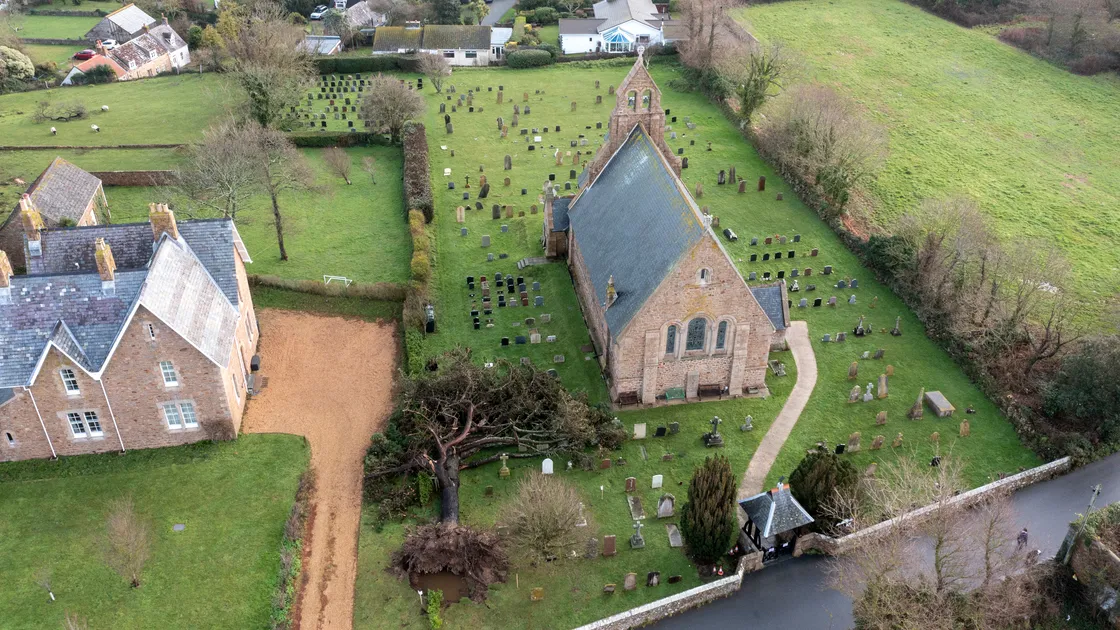
Unless you were hiding in a darkened cellar – and nobody would blame you if you were – this most recent storm will not have escaped your attention.
Adam’s records state that ‘the winds remained relatively light’ during the day, ‘but near continuous rain and drizzle contributed to some of the damage that followed’.
‘Early in the evening, a reported gust of 99mph at St Mary’s airport on the Isles of Scilly reaffirmed forecasters’ concerns. By this stage the storm had arrived in Guernsey and the wind strength had increased significantly.’
By 5pm, mean wind speeds had increased to gale force 8. They then strengthened to strong gale force 9 by 7.15pm and intensified to storm force 10 shortly before 8pm, with a peak mean wind speed of 54 knots (62mph).

‘Storm force conditions persisted for approximately two hours before dropping back to strong gale force 9 shortly before 10pm. A continual decrease followed, and the wind veered W-NW gale force 8 by 1am in the early hours of Friday, then further to near gale force 7 by around 2.30am.’
The highest gust recorded at Guernsey Airport – 74.1 knots (85mph) WSW, was recorded at 10.20pm on Thursday.
‘Undoubtedly, there were parts of the island that experienced higher wind speeds due to local factors, hence the apparent random nature of the damage caused. Initial analysis of data from Alderney Airport shows a peak mean wind speed of 63 knots (72mph, or F11) with a maximum gust of 80 knots (92mph).’
Hundreds of trees came down, blocking roads and damaging properties – notably destroying the gable end of a house at Clos des Pecqueries – while dozens of people had to be evacuated from Mon Plaisir flats in the west of St Peter Port. However, despite the damage and the apparent danger, no fatalities were reported, nor even any serious injuries.
6 – Friday 23 November 1984
‘Hurricane wreaks havoc’ ran our headline the day after this storm, which could justifiably be described as ‘the wet one’, given that the peak of the storm coincided with a very high spring tide at 7.30pm.
We reported that ‘huge seas smashed into the west coast and poured through homes’ and that ‘big boulders and waves 40 feet high made roads impassable.’
‘The sea wall at La Saline, near the fish factory, was breached, one at Rocquaine was cracked, and seawater poured waist-deep down roads and flooded large areas of the coastal hinterland.’
A lake was quickly formed measuring 200 yards by half a mile and, in places, five feet deep.
One recently-refurbished home was 3ft deep in water within 10 minutes of the waters arriving and the level had receded by only three inches in five hours the following day. The flood water also contained some of the contents of the cesspits of nearby properties.
Two other cottages had flood water pressing against their front doors until they burst open, instantly flooding their homes.
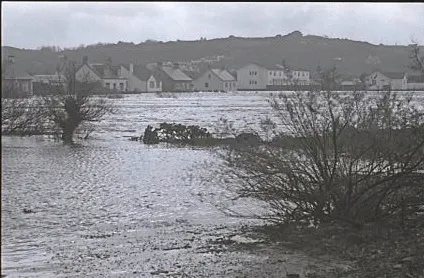
‘Firemen and States Works employees joined forces in clearing a culvert, the latter using diving suits.’
Boats had been left floating in fields and an entire greenhouse was picked up and thrown across a road in Torteval.
A tragedy was narrowly averted when Peter Snell went to inspect damage to his garden at Rocquaine and spotted a boy on the beach, who had gone to watch the waves in the belief that the storm was dying away. He was dragged out by a wave but Mr Snell and others were able to haul him back onto dry land unharmed.
But it wasn’t just the west coast that suffered. Boulders and waist-deep water were hazards faced by motorists along the eastern seafront from the Red Lion to the Halfway, and there were also problems at Bordeaux Harbour where ‘a policeman who was trying to salvage a boat by hanging onto a chain asked a man who was in the area with a Land Rover to help him – the man refused and drove off’.
‘Jersey also suffered,’ says Adam, ‘although their highest gust was only 59 knots (68mph) compared with our new record for November (now equal with 2016) of 73 knots (84mph) and that measured in Alderney of 85 knots (98mph).’
7 – Storm Angus – Saturday 19 / Sunday 20 November 2016
‘Gale force winds occurred at times during the Saturday evening,’ Adam says, ‘but the full force of Angus was not to arrive until the early hours of the following morning, when the winds swung round to the south west and increased to 51 knots (59mph) gusting 71 knots (82mph) by 2.15am. The weather station at Chouet reached a steady wind speed of 60 knots (69mph) but the highest gust of the night – 73 knots (84mph) – was actually recorded at Guernsey Airport at 2.19am. This equalled the highest November gust on record and was the strongest gust experienced by the island since 1990.
‘Alderney’s winds peaked a little later at 2.54am when gusts of 82 knots (94mph) were recorded. The timing of the storm probably helped to ensure that no injuries were reported, nevertheless there was considerable damage to the island’s trees and many house roofs, fences and sheds.’
According to our reporting, the trouble actually started on the Friday night when the storm brought lightning which struck a house in St Peter’s and damaged a tumble dryer, causing the property to become smoke-logged.
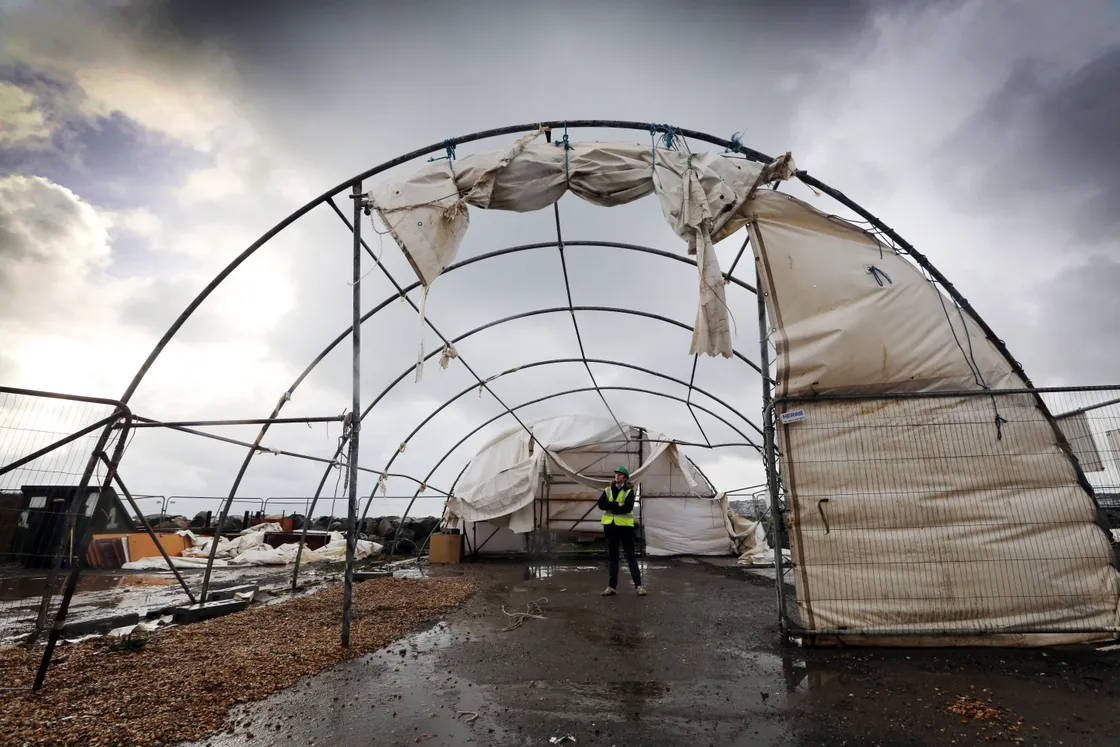
A DSV freight trailer was blown onto its side at Longue Hougue, where a very large recycling tent was ripped apart, and a Blue Islands plane was damaged at the airport.
We interviewed several tree surgeons, including Tree Care director Marcus Barnes who conducted the ‘tricky operation’ of removing a Monterrey pine at Upland Road, believed to have been planted just after the Second World War.
‘It was caught by one of the giant gusts, and the crown acted like a big sail, twisted the tree around and cracked it up the middle – you could fit your arm in the crack,’ he said.
An appeal was also published for the owner of a trampoline to come forward and reclaim it, after it had blown over a three-storey St Peter Port house and landed on a van.
8 – Saturday 26 November 1983
This event makes it into the top 10 courtesy of a gust measured at 72 knots (83mph), despite Guernsey getting away with virtually no damage.
Storms were brought up the English Channel by a depression tracking over southern England but in the following Monday’s edition, the only evidence was a short piece on the back page – in the days before it was given over to sport – reporting that States Works had been busy clearing six trees that had come down over roads and repairing roof panels at Mont Varouf School.
Compare this to Storm Ciaran in November 2023, which did considerably more damage but fails to make the chart on account of its relatively weak maximum gust at Guernsey Airport of 68 knots (78mph).
=9 – Wednesday 13 December 1978
A shed was blown into the road at Les Sages in Torteval, four trees came down over roads and several ships either gave up trying to get to Guernsey or called in unexpectedly having given up trying to get to their intended port.
Our edition of the same day reported the strongest gust having been 69 knots (79.5mph) at 6.01am but another, stronger gust must have come along after the print deadline, as Guernsey Met Office have the peak gust as 71 knots (82mph), recorded at the airport. This was a record for December at the time but was to be broken the following year.
=9 – Sunday 2 December 2007
A total of 43.9mm of rain fell over a weekend which ended with a gust of 71 knots (82mph) being recorded at the airport at 8.05pm on the Sunday.
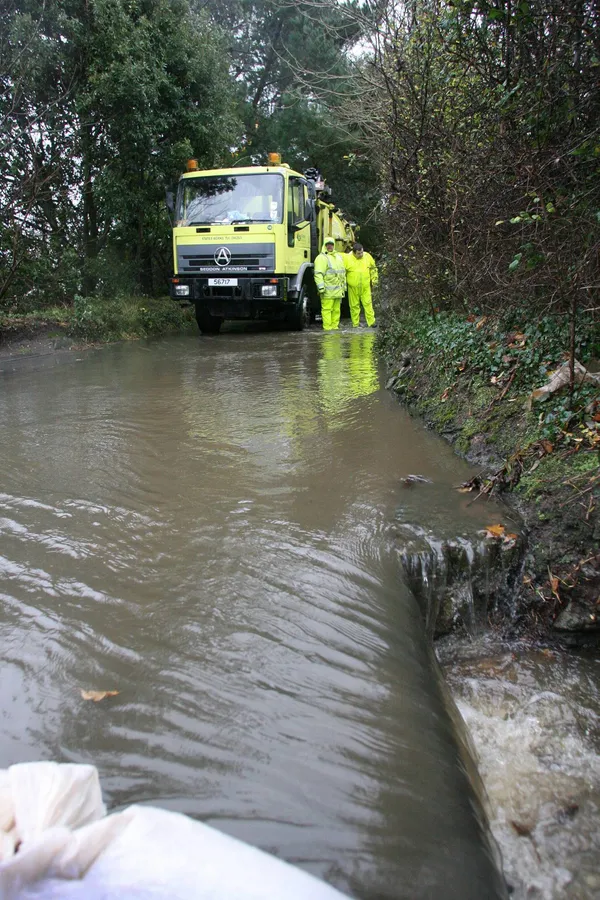
The wind helped to accumulate debris which blocked drains and culverts, leading to flooding all over the island, including Talbot Valley, Rue du Pont Vaillant, Route de la Charruee, Douit Lane, Victoria Avenue, Rue Thomas and the Coutanchez. But apart from a wonky chimney that needed securing on Vale Road and a tree in the Forest ‘that was at risk of falling’, this top-10 storm was remarkably uneventful.
Plus... Sunday 12 September 1869
There is one other storm I’ve come across which I think deserves an honourable mention – one that cannot appear on Adam Heaume’s list by dint of pre-dating Guernsey Airport, and indeed mechanised flight.
It also pre-dated the Guernsey Evening Press by three decades but happily, The Star was up and running and was able to report on it on the following Thursday. ‘Everywhere trees were uprooted, broken down, or stripped of their branches, orchards and gardens destroyed, field crops such as beetroots, parsnips etc were shorne [sic] of their leaves through which they would have derived a principal part of their future nourishment, roofs were wholly or in part carried away, chimneys were thrown down and cornricks and hay stacks scattered, to the great injury of their contents.’
The report described boats being sunk at their moorings or ‘lifted up and carried away by the wind’, while ‘several fine trees were blown down’ at Le Foulon Cemetery and at private residences from Mount Durand to the Rocques Barrees.
‘So great was the devastation that on Sunday morning, when the farmers were proceeding into town with their milk carts, they found the roads in many parts impassable owing to their being strewed with fallen trees and branches.’
The worst loss was said to have ‘fallen upon poor fishermen and cottagers who are ill able to support it’. ‘But it is satisfactory to know that the De La Court Fund, which is destined to meet calamities of this kind, is in a highly prosperous state, and it cannot be doubted that it will be dispensed with a liberal hand on this occasion.’
Perhaps the weirdest part of the report is when it makes mention of a previous article in the Comet newspaper, which described waves out west leaping upwards ‘only to be pressed down’. The Star corroborated this peculiarity of the storm. ‘While the wind swept with fury over the island it seemed, at the same time, to exercise a downward force, as many of the trees which suffered were broken short off, or pressed onto the ground, which would not have been the case had the force been applied laterally.’
Anemometer readings showed the ‘average hourly velocity’ in the 12 hours until 9am was 68mph, with a peak between 2-3am of 100-105mph. Elsewhere in the same edition, a reader’s letter bemoans the ‘reckless, ruthless, tasteless slashing, polling, cutting and carting away the belts and rows of trees which once so sheltered and adorned the interior of our island,’ condemning the practice as a ‘suicidal mania’ and blaming it for the downing of several ‘venerable trees’ at the New Ground – Cambridge Park – and Les Cotils.
‘There is nothing in the shape of a tree or a bush from Grand Rock to the Couture, all within the last year or two have been either carried away or left as a row of bare poles,’ says the correspondent, explaining that the westerly hurricane had met with no opposition as it whipped towards the 70-year-old trees.
There is a recency bias in this top 10 which comes about due to the chosen method for ranking the wind speeds, but that can’t be helped. After all, for all we know the worst storm ever seen in Guernsey might have been in 487 BCE, blowing down all but the dolmens. When it comes to seasonality, I don’t suppose we should be surprised by the fact that all of the storms in our top 10 occurred between October and January.
But is there anything to be concluded from their distribution throughout the week? Though years apart, I couldn’t help noticing that the 10 storms on the list are bunched up in this respect. Going by the strongest recorded gust at the airport, there was one on a Wednesday, two on a Thursday, two on a Friday, three on a Saturday, two on a Sunday and none on a Monday or Tuesday.
Now I know it’s a small sample size but even if you accept that a couple of days are likely to remain blank in such a distribution, it’s a further coincidence that the two blank days are consecutive, and that the next day is the only one to have suffered just one storm – and one of the lesser ones at that.
Is there anything in this? Does it represent, statistically, something beyond a standard deviation – and if so, what could be the explanation? I would be pleased to receive your suggestions.