Changes being proposed to the trial by jury system in the UK could see all but the most serious cases dealt with by a judge sitting alone and only those who commit offences attracting a sentence of more than five years facing the ‘12 good men and true’ of the jury.
In Guernsey the Magistrate’s Court judges deal with cases where the maximum penalty is two years’ imprisonment or less, and anything more serious goes to the Royal Court.
But unlike the UK and Jersey, the Bailiwick does not have trial by jury and has, for the best part of 850 years, used elected lay-people, jurats, to sit on the most serious cases and civil actions.
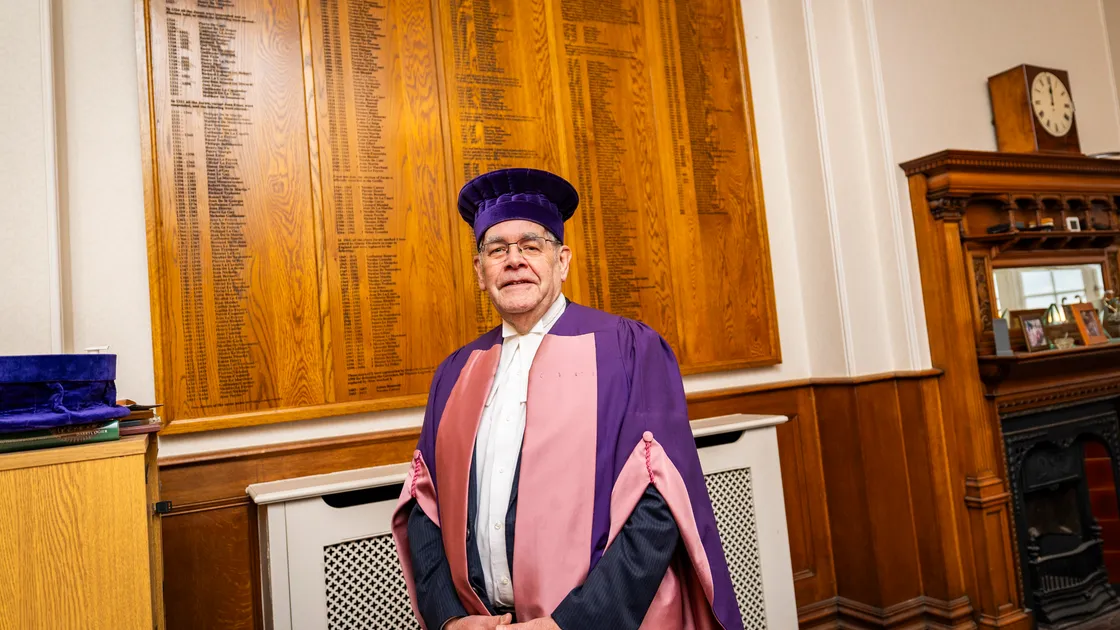
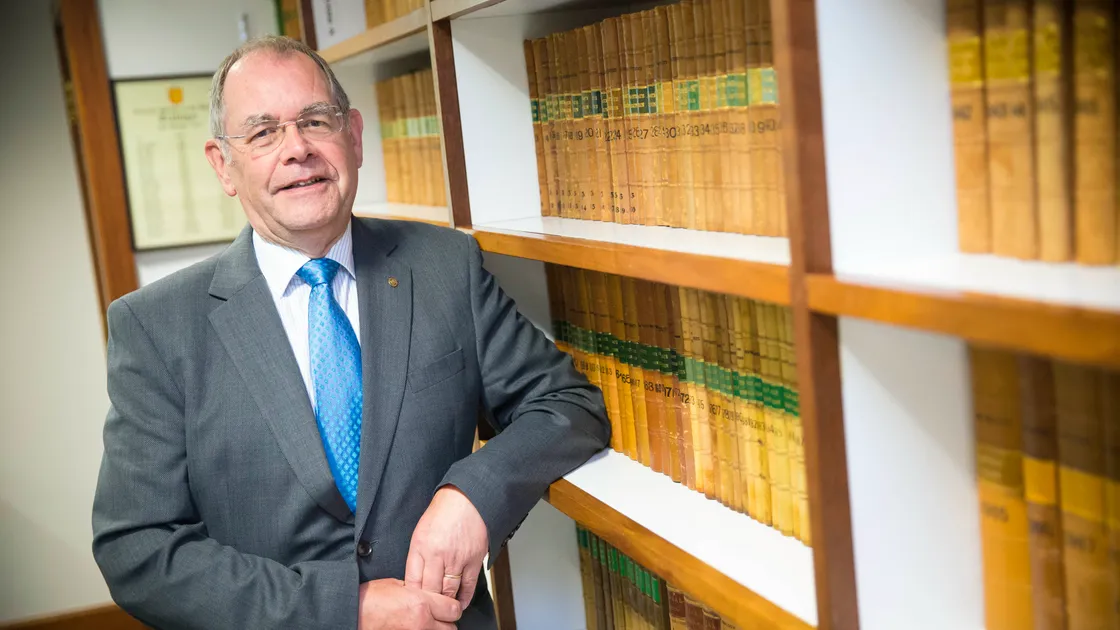
Jurat Stephen Jones OBE is the longest-serving member of the jurats’ bench. He will have served for 18 years when he retires this August.
However, jurats can retire after they have completed three years’ service, as long as they are aged 65 or over, and he said that in his experience the average term of office was between six and eight years.
The official retirement age for a jurat is 72 but even then, people can stay on the reserve bench for a further three years if their appointment to that bench is approved by their colleagues and many choose to do so. ‘I have never been to a jurat’s retirement dinner where they weren’t really disappointed that they were having to retire,’ he said.
The Royal Court calls the role ‘the highest honour that Guernsey can confer on a resident of the island’, but Jurat Jones modestly thinks this is perhaps a bit over-the-top.
‘Yes, it’s an honour and a challenge,’ he said, ‘but I think we all feel that it’s a very important contribution to the community.’
A jurat’s role is to decide the facts of a case, to listen to the evidence and reach a decision, whether it be in a criminal case or a civil hearing.
They do not require any legal background, although their experience in a professional role can be helpful.

Jurat Jones worked in the finance sector and said that has helped him in a number of complex civil matters on which he has sat.
Jurats and the presiding judge are also responsible for deciding the sentence in criminal matters in a collegiate manner.
‘The decision as to what the sentence should be is the decision of the jurats with the judge, but the judge presents the sentencing remarks,’ he said. ‘So often people think it’s the judge alone who has done the sentencing but that is not the case.’
The judge is present while the jurats consider the appropriate sentence and advise the jurats about sentencing guidelines. The judge is not present when the jurats are deliberating at the end of a criminal trial.
If there were one element of the role which presented the greatest challenge, he said it would be the commitment involved. When people consider putting themselves forward for the role come and speak to him, that is what he would say: ‘On average, we will be called upon for some sort of jurat duty 80 days in a year, and that’s a very significant commitment for a volunteer role.’
There is a small amount of remuneration for the jurats, which is a share of the fees charged by the Contract Court for conveyancing but it does not reflect the very many hours jurats dedicate to the role in a year.
‘People ask us if we enjoy the role and mostly what we try and say is we find it stimulating. We enjoy the camaraderie we get from it, but enjoying what we have to do isn’t the right word.’
Sometimes the jurats hear and see some disturbing material during the course of a court case and in the event that one of them feels they need to talk about it to a third party, counselling is offered.
But Jurat Jones said he was not aware of this ever being taken up by anyone, although it was possible that he did not know about it.
Generally, the jurats are their own support network. ‘The support that we get from each other has, for me, been satisfactory, and I think that’s the same for all my colleagues that I’ve worked with.’
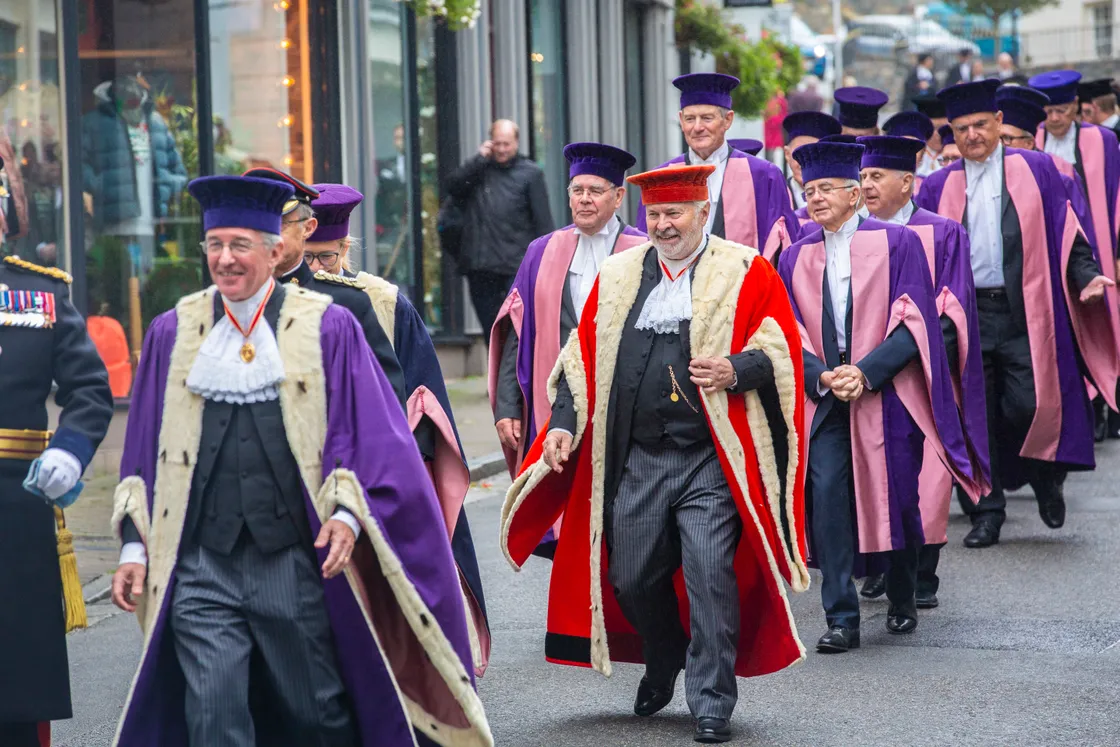
The first jurats were elected in the Middle Ages, with the first recorded mention of their existence being in 1179, although it was not until the end of the 13th century that their names started to be recorded – these can still be seen on the Roll of Honour board in the jurat’s chambers in the Royal Court building.
Whilst at first jurats were elected for life, later on this changed to the system we have today where the retirement age is set at 72.
Given that the service is so ancient there have been some attempts to change it to the more common jury service.
‘There have been discussions over the years about changing,’ said Jurat Jones. ‘But there are difficulties around having jury service in a small population, particularly because of everybody knowing everybody.
‘It is interesting that the jurat service is admired by visiting judges, for example, and others who look at our system.’
One of the significant differences between the Guernsey jurat system and the UK’s juries is that while in Guernsey a majority verdict is acceptable, a jury has to be unanimous, or close to unanimous.
That can lead to a lot of pressure on the jury members to agree, and one strong-willed person swaying the rest is a possibility.
Jurat Jones explained that jurats consider all the evidence that they have heard, and express their thoughts and opinions, but do not try and influence anybody else, because they only need to have a simple majority.
‘We might change our minds because we hear what one of our colleagues says, but we’re not in the position that our personal views are challenged by our colleagues.’
There have been a few cases where a defendant has been found guilty by a majority of five to four and this has later been used by his defence advocate as part of an appeal against sentence.
‘The defence has tried that appeal in the past but lost.
‘The Court of Appeal is absolutely satisfied that a five to four majority is satisfactory.’
Being such a small community there is always the possibility of a particular jurat being asked to sit on a case of a person whom they know or have dealt with before.
Jurats are very conscious that they must step down if there is any perceived conflict, and with 16 jurats, plus a reserve bench, there is generally someone else who can be called upon to replace a colleague who is conflicted.
Another benefit of the jurat over the jury system is the practical matter of dealing with the courts on a daily basis. ‘What’s happening in the court, in the environment of the court, is not a surprise to us.
‘If you could imagine a jury, a person who normally is a teacher walks in and has no idea who prosecution and defence are. They don’t know why that person is sitting over there – because he’s in the press – and don’t know who’s going to speak when. They have a small amount of training, but only an hour or so; we know what to expect.’
As well as the commitment to the role, Jurat Jones says another important point he makes is the challenge of being sure.
Most people will know that the prosecution must prove its case ‘beyond reasonable doubt’, but today the jurats are told that they must be ‘sure’ that the case is made out.
‘Most of us who have had careers where we’ve had to make decisions as a result of our job, it is always on the balance of probability – “more likely than not; this is what we should do” – and that’s how decision-making almost always happens.
‘You’re moving from an environment where you have been used to making decisions on that basis to where your decision has to be that you’re sure.’
So, he stresses the importance of good decision-making, adding that being able to live with that decision has a whole different impact to what the jurat might have dealt with in their working lives.
‘In my career, I’ve had to make lots of difficult decisions,’ he said. ‘But the decision at the end of a trial sometimes keeps me awake longer than anything I ever had to do for work.’