Two kayaks and a whisky bottle lie empty on the shoreline, as two men slowly awake from their rat-interrupted slumber and begin to take in the dawn.
A beautiful mauve light is bathing the rocks, turf and waters around Lihou Island, as Le Hanois pulses its two white beams every 13 seconds.
Conscious that the island’s under-used house is about to go into private hands for a generation, they enjoy the unique view while they can, they begin to regret that others will be denied it and – neither knowing the other is awake – they each come to the same conclusion.
‘This has got to be shared.’
Two decades and a few months later, I arrive at the Prosperity car park at L’Eree on my way to interview one of those men – Richard Curtis, the island’s first warden – along with his only successor in the role, Steve Sarre.
I open my car door with both hands and a firm grip, for fear of losing it altogether, as Storm Ingrid hurtles in from the east and photographer Sophie and I allow ourselves to be blown across the millennium-old causeway to the couple-of-hundred vergees of remoteness poking out of Guernsey’s west.
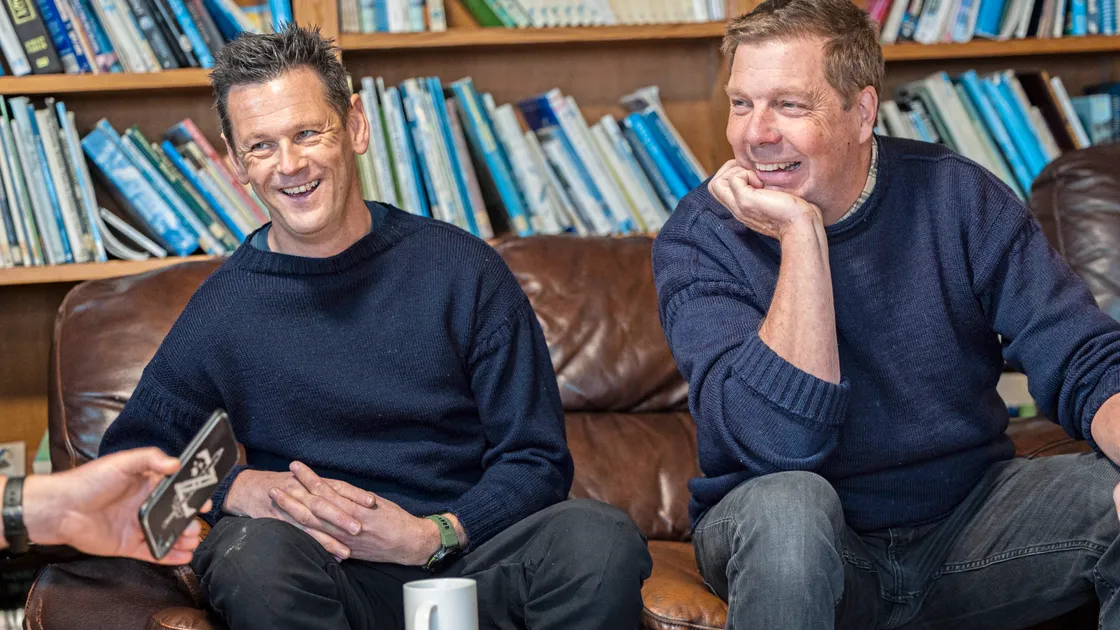
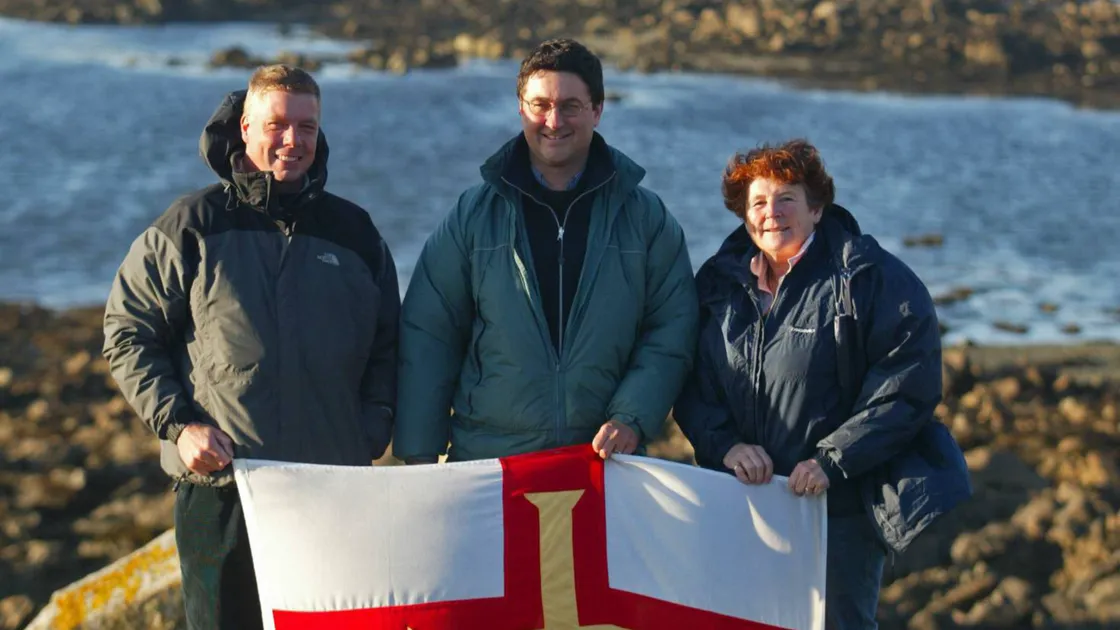
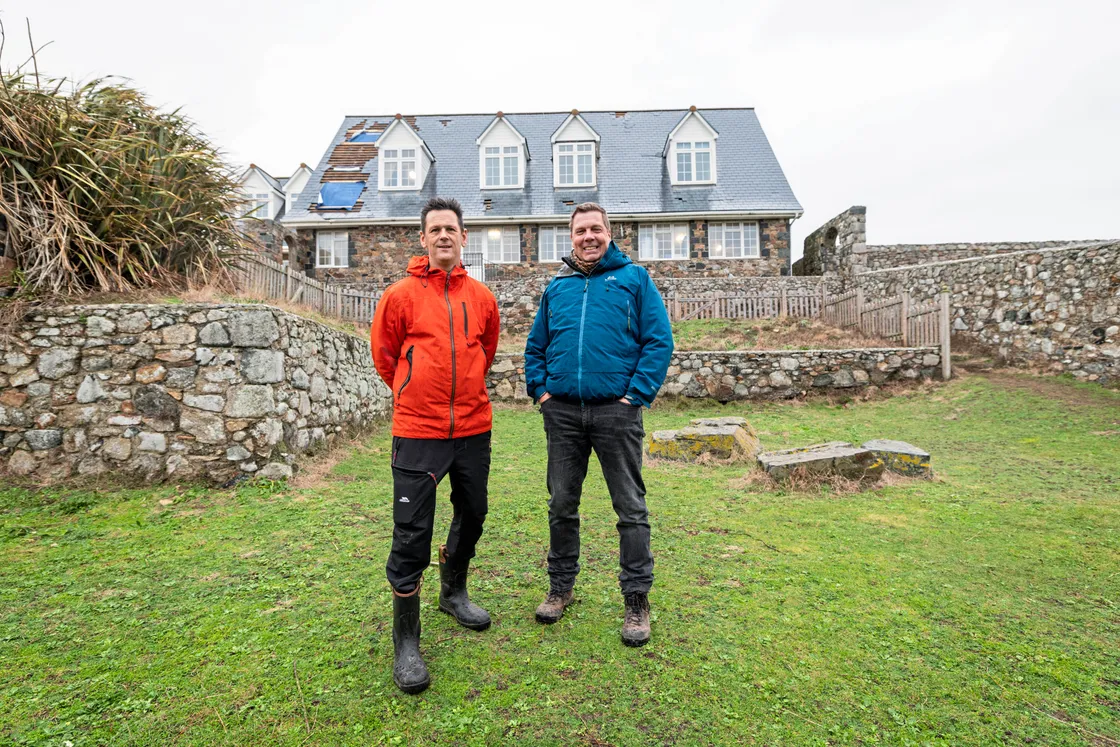
In so doing, we’re taking advantage of an occasional visit to the house – and to Steve – by Richard, who has been living in France for the last six years, where he runs a complex of gites with his wife Emma. As the two men pose for an outdoor photo, he compares the Dordogne site to this windswept outpost – the former is in a sheltered valley but endures night-time temperatures of -10C in the winter and daytime highs of 46C in the summer.
Comfortably ensconced in the book-lined lounge, Richard takes us all back to the impromptu trip that started it all.
‘Dave Le Feuvre and I kayaked across with a bottle of whisky and camped just outside the house,’ he says.
‘We were both at the Youth Service and had an education and youth background.’
He tells of the dawning previously described and concludes that it was ‘a light bulb moment’.
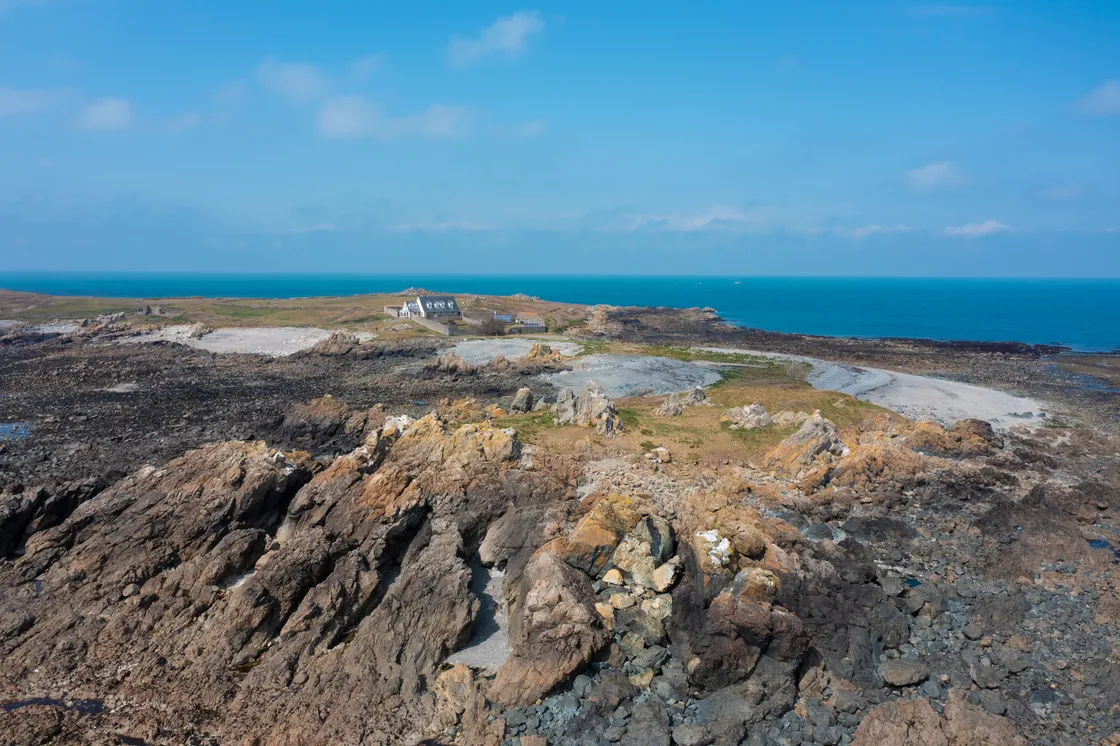
They both knew, through the Guernsey grapevine, the ‘well-known secret’ that the bidding process was about to begin for the 21-year lease of the house, its grounds and a three-metre zone outside of the property’s walls.
‘There were two or three private individuals who wanted to turn this place into a private dwelling,’ says Richard.
‘The States were conducting the tendering and they were driving prospective tenants across the causeway in Land Rovers to show them the island. It was appalling because an island like this needs to be for the people of Guernsey.’
Nevertheless, the States was always resolved to ensuring that the island itself would remain accessible to the public, even when the house and its grounds were leased. Richard says the Barclay brothers were among those making enquiries about the house but when the States made this stipulation clear, they turned their attention to Brecqhou.
Richard, Dave and some like-minded islanders soon formed the Lihou Island Charitable Trust and by the time Guernsey’s parliament came to debate the future of the house in December 2005, it had come down to a choice between leasing the house to a private family – known as ‘tenant A’ at the time – or to that trust.
Leading the charge for the more lucrative private option was then Treasury & Resources minister Lyndon Trott, who pointed out that since buying the house for £430,000 in 1995, it had brought in a mere £8,000 against an original estimate of £50,000. The £16,250 per year offered privately was therefore the right thing for the hard-pressed Guernsey taxpayer.
Deputy Martin Ozanne had other ideas and laid an amendment that would offer a mere ‘peppercorn rent’ but would retain the house as a self-sustaining asset for islanders, especially for the young – a rare wilderness in an otherwise crowded community.
Richard says the to-and-fro of the lengthy and at times embittered debate was like a movie, with everything in the balance as it was carried over from the Thursday into the Friday. But in the end, it swung the way of the trust – 24-11.
Our own editorial on the Monday characterised this as a seductive but erroneous decision, chiefly on the grounds that it was unsustainable – that the ambition of 1,500 bed nights a year was unrealistic, and the trust would inevitably require bailing out.
‘The likelihood is that the taxpayer will expensively end up subsidising a small group of students and bird-watchers,’ the opinion column concluded.
But there’s been no cap-in-hand moment and anyone who has tried to book the house can testify that on the day when slots become available, demand is high, veering feverish by dawn. Bed nights average 1,800 annually.
Richard recalls one of the deputies who voted against Deputy Ozanne’s amendment – the late Deputy Francis Quin – visiting the house on a mulled-wine day, shaking his hand, enthusing about the trust’s work and admitting he’d voted the wrong way.
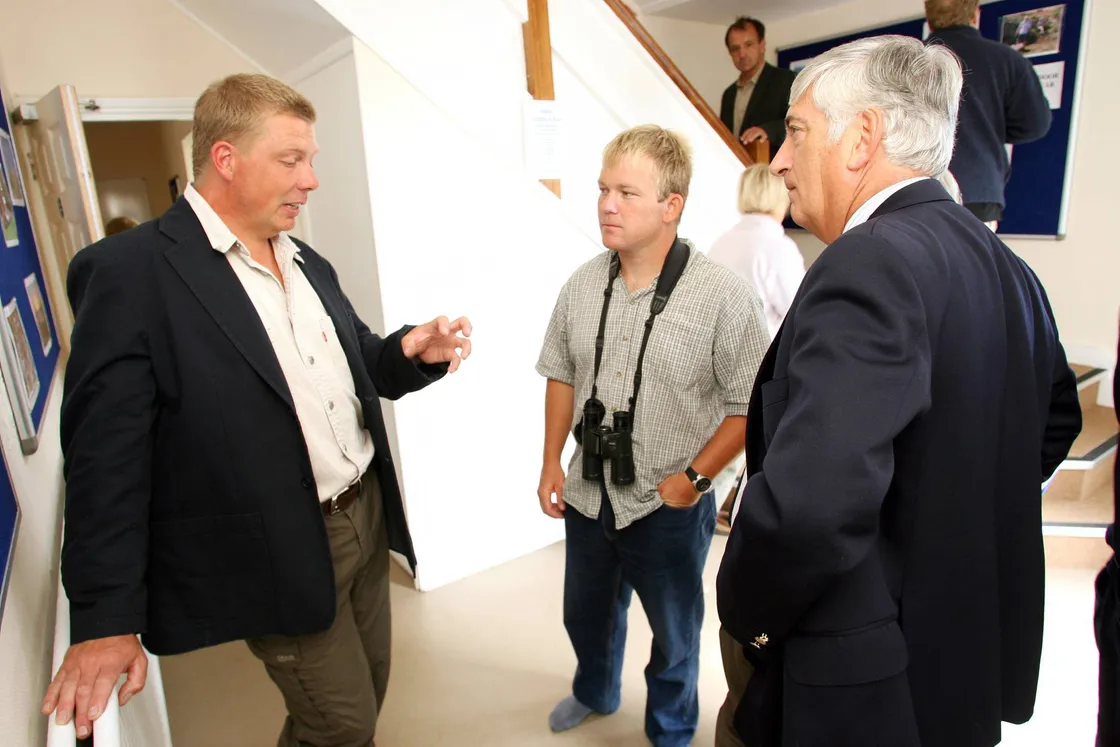
A year from now, the original lease will be up. Steve says a big celebration is planned to highlight all the trust’s good work, ahead of the process of renegotiation.
But Richard acknowledges there is an element of formality about this. There is a right to renew, he explains, as long as the trust fulfils the conditions on the original lease, which he clearly feels it has done in spades.
The trust has paid its peppercorn rent during these last 20 years but the two wardens have paid their own price in proverbial blood, sweat and tears.
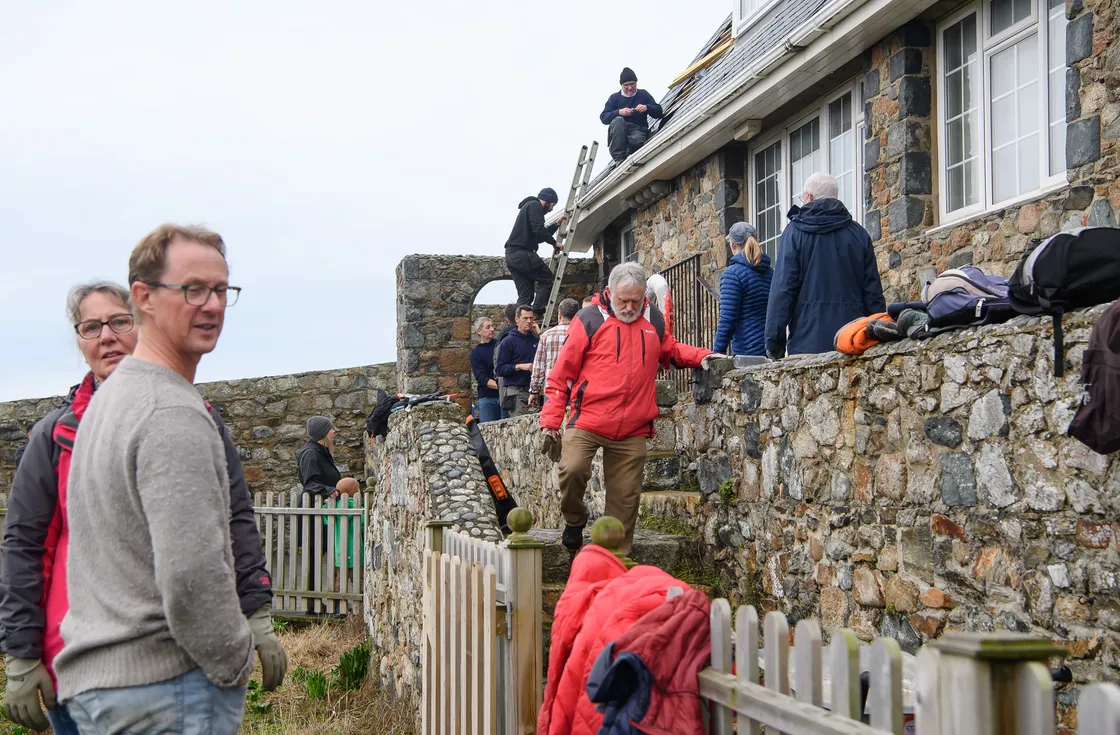
At the time of our visit, there are still holes in the roofs of the house and outbuildings from Storm Goretti and while our time is strictly limited by the tide, Steve is destined to remain in the house for the whole week, patching up as well as he can until proper repairs are possible.
‘I didn’t expect to have Covid and two storms to deal with,’ he says, more in amazement than dejection.
‘That was not in the job description. Covid in particular was terrible. If it hadn’t been for the support of the States and other charities, that would’ve killed us. The last storm [Ciaran] was devastating because the window was gone and I had no idea what I was doing. This time round, I’m feeling a lot more confident because I’ve got the contacts and I know what to do.’
Richard isn’t having any of this ‘no idea’ narrative and quickly affirms that when choosing his successor – out of 16 applicants – seven years ago, ‘I really wanted Steve because of his practical knowledge and the support of his family’.
‘I think he’s better than he thinks he is,’ he says. ‘No disrespect to caretakers but it’s much more than being a caretaker of Lihou. You have to be a water engineer, an electrician, a teacher and there’s safeguarding, repair work, preventative maintenance and so on.’
The to-do list is certainly long, after one of the worst storms to hit the island in living memory. Steve hopes to open up the house to visitors by the time the school bookings begin in April, but this is weather-dependent. There was certainly no roof work possible on the day of our visit.
‘It’s a bit sad really,’ says Richard.
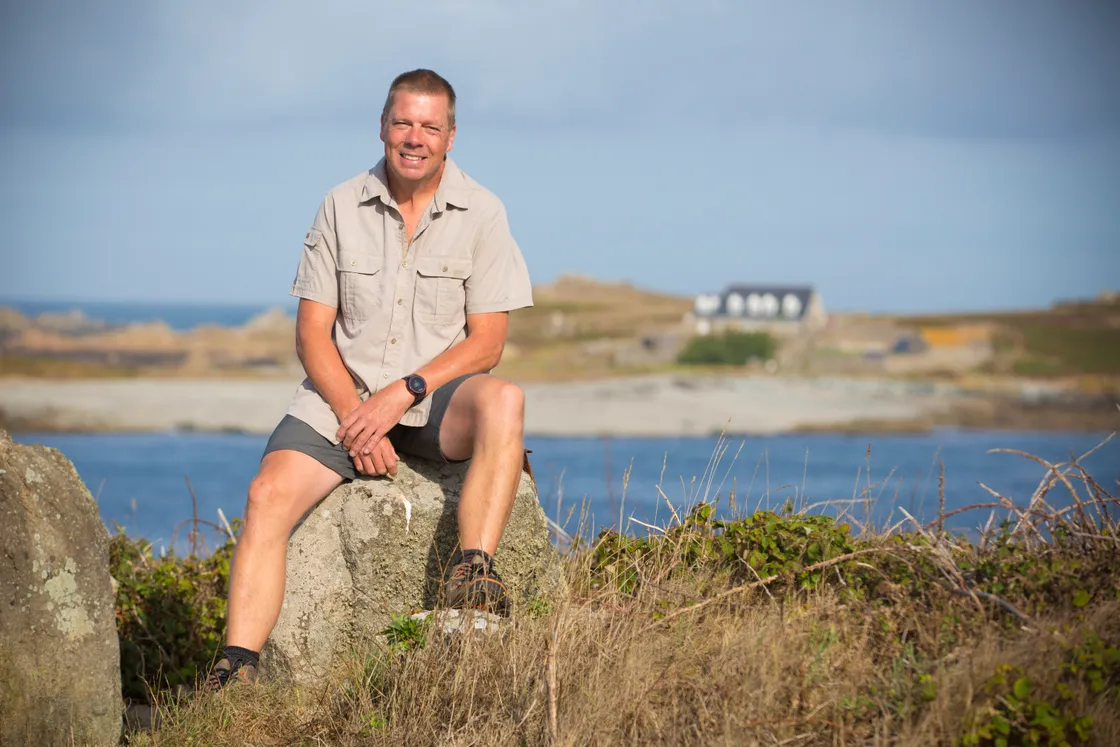
‘There are many, many people who have used the house over the years that it’s been running but I don’t think people really appreciate how hard this house is to manage, run and maintain. They come across and have a really great time – be it families or school children – and I believe they get a lot out of it, but what they don’t appreciate is that it’s not on-grid. So, it’s making its own electricity, it’s making its own water, it’s dealing with its own sewage and it’s dealing with the weather.’
He goes on to point out that if you were building a house there now, you’d build something very different.
‘It would be low-slung, turf-roofed and built into the hillside. It would still offer all of the same facilities but it would be much more appropriate for the current weather, especially in view of climate change.’
But there it sits, with its slate roof exposed to the enthusiastic elements.
Steve’s challenges are many but he seems to approach them with alacrity. And when I ask if there are some days when he feels like he has the best job in the world, he emits an ‘absolutely’ before I can finish the question.
‘Working with the schools is fantastic,’ he says.
‘Come April, we get really busy with school groups, so we’ll be doing lots of walks and talks around the island – looking at the flora and fauna – and we’ll be doing some rock-pooling and we’ll go and look at the stars. And then there’s the more adventurous stuff like archery, team games and swimming. But I love all the different seasons – this time of the year is brilliant for fishing and enjoying the peace and quiet away from the seagulls and stuff.’
Steve takes particular pride in having facilitated a visit last year by a student who uses a wheelchair. This required several carers to accompany him but it meant that the magic of an overnight stay on an island cut off from ‘mainland’ Guernsey had become feasible for someone who may previously have thought it was out of reach.
When I ask if there have been any ‘hairy moments’, he quickly reels off some of the assistance he’s had to provide to people trying to wade back to Guernsey through the onrushing tide, after leaving it late.
Richard chimes in with his own memorable moment of jeopardy.
‘There was one time when 101 Squadron, Royal Engineers came over to clear the island of unexploded ordnance and they magically found exactly 101 pieces of ordnance,’ he recalls. ‘They gridded off the whole island with barrier tape and then searched each grid with ground-penetrating radar. It was a big operation – it took two weeks.’
As an aside, he describes the effect of insular isolation on one of the soldiers, who was found trying to escape on a raft made of blue barrels he’d taken from the shed. Richard was asked to take him out to Le Hanois Lighthouse, where he was picked up by helicopter.
‘The squadron didn’t have time to blow up everything they’d found,’ says Richard, ‘so they left about 10 tank shells buried behind the house and I was the only person other than them – for security reasons – who knew where they were.’
Understandably nervous, he contacted the Environment Department, who sent someone over in a boat with a bomb disposal expert.
‘He said to me “Have you got any electric cable? I’ve forgotten the detonation wires”. Well, I only had 50 metres, so there we were, lying face down on the grass as it went off. I was in the Royal Artillery, so I’m used to big bangs, but my body literally left the ground. My kids were in the house and heard bits hitting the roof.’
We all agree Richard has won the ‘hairy moment’ contest.
Sophie and I wish to offer our sincere thanks to Emma for chivvying us out of there when we were all for continuing our chat. With such a low pressure system over us, we knew the water would be higher than advertised and the causeway inundated that bit earlier. So it was straight back on with the wellies and out into the teeth of a rain-encumbered easterly.
‘I can’t feel my face,’ said Sophie, half-way across.
When Richard and Emma overtook us at a striding pace and then accelerated, that focused our minds and we were wading through about 15 inches at the end. It would’ve been a bit embarrassing to have to be rescued by Steve after all he’d said.
As we made our way up the slipway to the car park, Richard shared a few parting thoughts.
‘Whenever I come back to Guernsey, I always like to pop over and see Steve and see how he’s doing. I was involved in founding the trust and I’m still very passionate about it. The fact is that Steve has had it really hard over these last two years – harder than I ever had it. And there he is, alone there tonight. It’s really a lot to deal with.
'It’s absolutely fantastic that the community gets behind events like the duck race and the mulled wine and mince pie day, and they come in such large numbers to help out after a storm like Goretti. But what’s really important is that the trust doesn’t just need that help, it needs continued help. The boring support, if you like. We need to bolster our numbers with people willing to do the day-to-day work, people who come over perhaps twice a month and get to know where the paintbrushes are.’
Anyone interested in volunteering with the Friends of Lihou can email warden@lihouisland.org.gg for an application form.