As islanders huddled in their houses recently to wait out Storm Goretti, it brought to mind a far more dramatic storm memory for three local women.
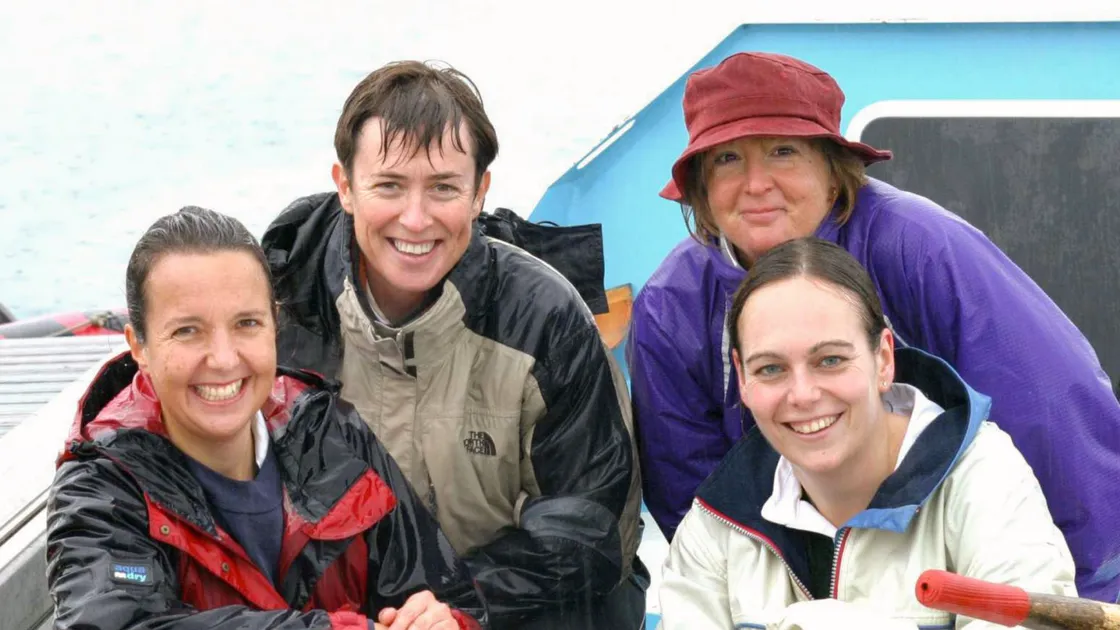
Mission Atlantic rowers Sarah Day, Lois Rawlings, Paula Van Katwyk and Kathy Tracey survived hurricane-force storms during a record-breaking 67-day voyage from the Canary Islands to Antigua, which they completed 20 years ago today.
Storm Goretti seemed nothing in comparison.
‘It made me think, this isn’t so bad when you’re in a nice dry house,’ laughed Sarah.
The crew were about 10 days into the race when a tropical storm battered the fleet. The rowers feared their boat might capsize, or even break, as it was pounded by 25ft-high waves.
‘The whole boat would leave the ocean and then slam back down,’ said Paula.
‘We tried to fit all four people in the stern cabin, but it could barely fit four people in there.’
Lois added: ‘We had to batten down the hatches and spent the night rolling around on the ocean wondering if the next wave would be the one that capsized our boat.
‘The row reinforced my total respect for the sea and mother nature. It could be calm and beautiful one moment and then, within a matter of hours, we would be being hurled around the boat by waves the size of mountains in lashing rain.’
The crew had to cross within a mile of Shirley Heights lighthouse to officially finish the race and the weather very nearly prevented them from doing so.
‘Our rudder sheared off with only 200 nautical miles left to the finish and it could have meant the end of our race,’ explained Lois. ‘We improvised and strapped two oars to the side of the boat so that we could steer it, “gondola style” to the finish.’
They can scarcely believe that 20 years have passed since they became the first women’s four to not only complete the race, but to row across any ocean.
As the anniversary approached, Lois looked back over the diary she had kept during the voyage.
‘It brought back such a mix of emotions – predominately pride in what we achieved and how we overcame all of the challenges that we faced,’ she said.
‘It took a massive team of people nearly two years to even get the four of us to the start line and we will forever be grateful to them all for their support and belief in us and our ambition.’
She updated her diary as she went with the best and worst things she had experienced. Her favourite things included: Smash (plain or with pepperami), dolphins swimming alongside the boat, north-easterly winds, daily visits from Colin the sea bird, rowing at night with the stars and the moon, sunrises and sunsets. Her least favourite things were the rest of the food (‘amazing just how much one’s sense of smell and taste changes when miles from land’), rowing into a head wind, storms, continual rain, wet bedding, wet everything, flying fish and being isolated from the outside world.
‘One of the hardest things was losing our comms three weeks into the race and not being able to contact home for weather updates, or receive messages from friends and family and the race organisers,’ she said.
Paula agreed. ‘Lois and I really struggled with it as we had promised our families we’d be in touch.’
They even spent the festive period at sea.
‘It was my first, and only one since, Christmas Day spent at sea,’ said Lois.
‘We each had a handmade cracker made by our support team which was the highlight of the day, along with all of the handwritten messages from home that had been hidden in the boat.’
They did, however, have one unexpected Christmas visitor.
‘We bumped into a Spanish fishing boat that day,’ said Paula.
‘We hadn’t seen anyone else for about three weeks.’
One of Paula’s most enduring memories is the tankers they encountered on their voyage.
‘They were scary when they came over the horizon and they felt too close. All you could see was a mass of lights coming at you.’
On one particularly memorable night, she and her cabinmate awoke to panic outside. The rowers thought a tanker was heading for them, but closer investigation soon revealed it was actually just the moon coming up.
With nothing to see but sea for days on end, the night sky took on a special significance and, with no light pollution around to taint it, it was often a spectacular sight.
‘The stars at night were just ridiculous,’ she said.
‘My main memory was how beautiful it was,’ said Sarah.
‘Absolutely stunning. I remember the storms and the magic and the power of the teamwork and the resilience and fixing everything that broke.
‘It was such an empowering experience.’
Although completing the race was a personal challenge, the team did face some competition.
‘We had a big rivalry with the other two ladies’ crews before we went away. They used to call us the Guernsey Milkers and we called them the Row Girls,’ said Sarah.
But they were far from intimidated by the competition.
‘We were determined we were going to get there in 50 days. We’d told our families. But the weather didn’t help us at all.’
The rowers mostly survived on dehydrated food, to which they needed to add boiling water. Unfortunately, putting the kettle on is not as simple as it sounds when you’re in the middle of the Atlantic in a storm.
‘There were days when boiling water was seriously hazardous,’ said Paula.
But what kept the rowers going during the many challenges was thinking about those they were trying to help with their fundraising efforts for the Guernsey Society for Cancer Relief and MS Guernsey.
‘We chose to be out there and there are people dealing with their own personal storms and they don’t have that choice. It made me take stock,’ said Paula.
‘I look back on the row with immense pride,’ added Lois.
‘It was the hardest challenge I have ever faced but we were the first women’s four to cross any ocean, which made the 67 days, seven hours and 20 minutes totally worth it. We also raised thousands of pounds for two very special local charities.’
Reserve crew member Cat Peet never got to actually take part in the race, but she has fond memories of her involvement.
‘What an achievement, I’m so proud of them,’ she said.
‘It was a privilege to have played a small part in their epic journey by training alongside them and helping them get ready. One unforgettable night row I spent the entire time hanging over the side of the boat, generously feeding the fish somewhere off the south coast.
‘I was somewhat relieved I never got the call-up and so were they. And twenty years later they’ve never let me live it down.’
Kathy now lives back in her native New Zealand but she returns to the island regularly and the whole team, along with their coach Bob Place, had a reunion two years ago at the Peninsula Hotel, where their spare rudder and photo have been given pride of place on the wall.
The experience they shared 20 years has created an unbreakable bond.
‘It’s friendships for life,’ said Paula.
‘It was a great life experience. Sometimes it feels like a lifetime ago, but the memories are inscribed on my brain.’