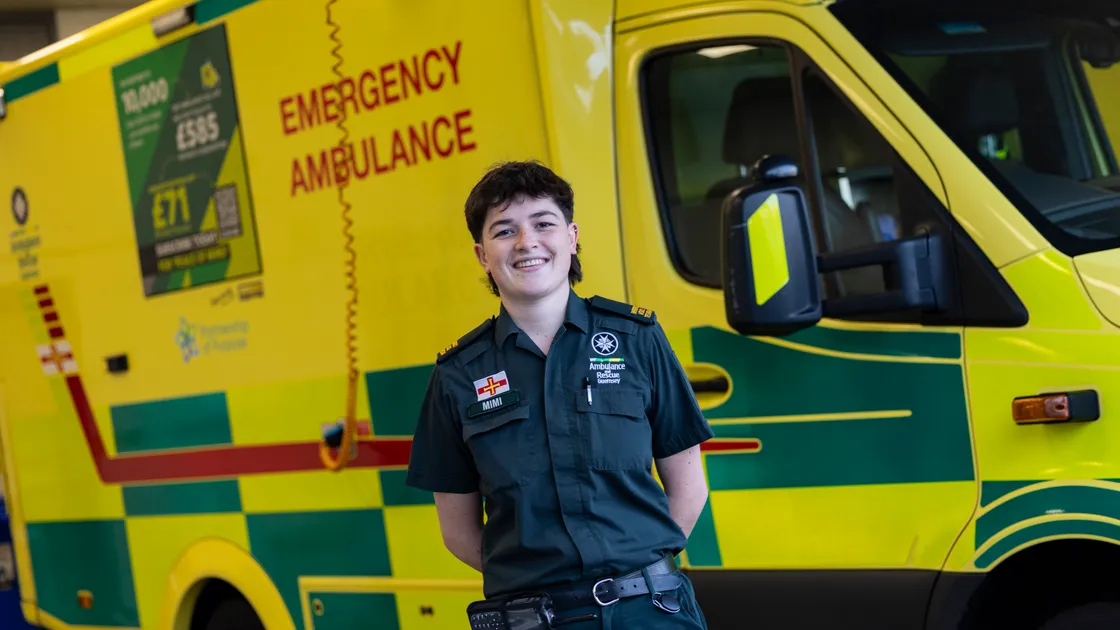
It has been a couple of weeks to remember for emergency medical technician Mimi Smith-Le Flocq.
Recently she claimed an armful of awards at the annual Ambulance and Rescue awards, and a few days later found out that she had qualified as an emergency medical technician.
She is motivated to continue progressing in her career, which started when she was just a teenager.
‘I was fairly new to the island at the time and joined through the patient transfer service.
‘I did that for nine months, which was a really good foundation to join the service,’ said the 23-year-old.
‘It definitely allowed me to develop my communication techniques and manual handling.
‘Then I progressed to an emergency care assistant, which involved training and driver training on and off-island.’
During that time, she learned how to assess patients to figure out if they are what the ambulance service calls ‘big sick’ or ‘little sick’ and how best to help them.
She worked as an ECA for about a year before going off-island to do her medical technician training.
‘It involved four months of learning before coming back and putting those skills into action on the road,’ she said.
‘An EMT has the capacity to make decisions so they can be a senior clinician on an ambulance.
‘They have a broader range of knowledge than an ECA, but a slightly narrower one than a paramedic.
‘The skills are more limited but they’re skills to save someone, basic life skills and can do the most important parts of pre-hospital care.’
ECA training is all on-island, whereas EMT training is 16 weeks of learning in a classroom in the UK.
Miss Smith-Le Flocq then did 11 months on the road in Guernsey to gain practical skills.
She passed her EMT training shortly after the awards ceremony.
‘I’m now hoping to progress to a paramedic, that’s my career goal,’ she said.
‘As a technician you can do a lot to help people, but in some situations we’d be calling for a paramedic to assist with pain relief and further drugs they need.
‘To be a paramedic without having to call for backup and helping people using my own skills would be awesome.’
To become a paramedic requires either a university degree, or staying in Guernsey to do a paramedic apprenticeship.
The apprenticeship requires several years of experience as an ECA or EMT and then a short conversion course in Guernsey followed by distance learning, but one week a month you have to go to the UK to study with colleagues from a UK ambulance setting, or in the classroom.
‘This route is more practical-based.
‘You get to learn on the job which definitely benefited me,’ said Miss Smith-Le Flocq.
‘I’m a more practical learner and that solidified my skills a lot better.
‘You also get to learn more slowly, rather than having all of the knowledge and then being let loose and, for me, it was nicer to be in a station where everyone knows each other and gets on with each other. It’s like a little family.’