‘Knowledge is understanding that a tomato is a fruit. Wisdom is not putting it in a fruit salad.’
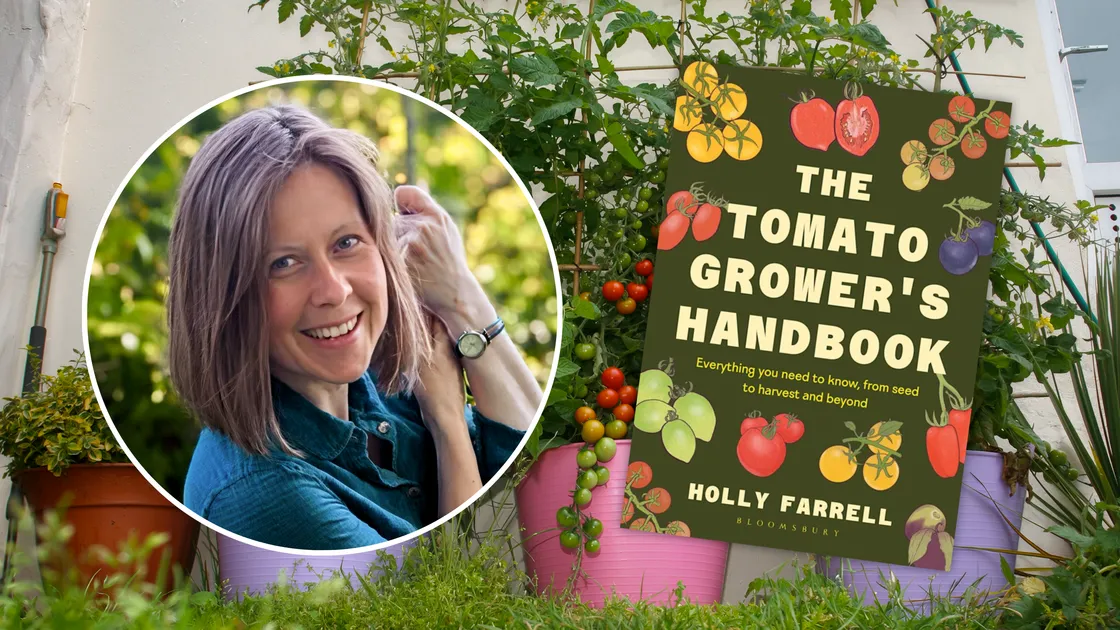
This famous quote by Miles Kington is the perfect introduction to Holly Farrell’s essential guide, The Tomato Grower’s Handbook.
Over the last decade Holly has authored and co-authored 19 practical and accessible gardening books, written for publications such as The Simple Things and The Garden magazines and is a three-time Garden Media Guild Awards finalist and a winner of PJ Redoute Award.
She is also the Guernsey Literary Festival’s speaker liaison and a volunteer librarian at a local primary school.
So, presumably, she’s from a family of writers and gardeners?
‘While growing up, the extent of my interest in both books and the outdoors was lying on a rug in the garden and reading 20p car boot sale Agatha Christie novels. But I have always loved reading and appreciated plants and flowers.’
Writing for a living was still quite a way off. After school she went to York University and gained a degree in history and became a property manager for the National Trust.
‘After uni I had a period of bad burn-out,’ she admitted. ‘No-one knew at the time but I was later diagnosed with autism.’
After being stuck indoors for a long time she watched a DVD about living in a cottage and growing your own food.
‘I thought then, that’s what I want to do. So I went to Dorset for six weeks and worked on an organic chilli farm. It was so good.
‘I wanted to be a gardener and the best place to study horticulture was at the Royal Horticultural Society Gardens Wisley. But to get into it to be a student I had to go back to college to get a further year’s worth of qualifications.
‘I did two years at Wisley. It was a really good course in practical gardening. You would do four days in the garden, working in different departments, then a day of lectures.’
Holly studied there from 2008 to 2010 and came out with a Wisley Diploma in Practical Horticulture.
‘It really was a brilliant course. I worked with some of the finest gardeners and horticultural scientists and there was great camaraderie between the students.
‘While I was there I managed to get a placement writing for the RHS magazine, The Garden.’
Holly’s first feature was a report on the trials of green beans.
‘The RHS did trials on 20, 30, 40 cultivars, growing them all together. A committee of experts then assessed the entries and the best received an RHS Award of Garden Merit. The trials are then reported in the RHS magazine. These trials are part of the RHS’s mission to inform and inspire gardeners so they can shop in good faith.
‘From then on I carried on writing articles and I had my first book published.’
Some of Holly’s books for the RHS include Miniature Garden Grower, The Little Book Of Happy Houseplants, Gardening For Mindfulness and Get Growing, alongside The Herb Almanac and Healing With Plants for the Chelsea Physic Garden and The Kew Gardener’s Companion To Growing Herbs for the Royal Botanical Gardens Kew (as well as many others).
It was only a matter of time before the tomato became the subject of one of her books.
‘I’ve been growing them for years, outside. Here in Guernsey I have a little greenhouse, so I’ve got lots of experience growing them.
‘I’ve been researching what are the best, what other gardeners are doing, the best way to grow them, always what’s best for the environment and wildlife – so no chemicals or weed killers.
‘Tomatoes are trouble-free. Things that you grow at home need to be. If you’re going to grow a crop it’s not going to be cauliflower, is it?’
The book’s subtitle is ‘Everything you need to know, from seed to harvest and beyond’. Clear, colourful and concise, it is split into six chapters: Getting Started, How to Grow, Harvest Time, Preserving and Recipes, Tomatoes to Try and Extra Stuff.
After deciding that you want to grow tomatoes, Holly believes it’s worth asking yourself a few questions: What kind of tomatoes do you like to eat? Where will you grow your plants? What varieties will you try? How many plants can you feasibly fit in your plot?
‘Do you want to grow heirloom – also known as heritage – tomatoes? Or do you want to grow hybrid?
‘Do you love the flavour of a particular tomato? Whether they are good for cooking or eating raw? You can get green tomatoes that are ripe. Black tomatoes. As big as your palm or raindrop-sized?
‘You can only get these by growing heirloom tomatoes.
‘When breeders are breeding new varieties, especially for supermarkets, they take into consideration how long they’ll last on the shelf, how red and how round they are, their sweetness, resistance to disease. These are hybrid or F1 tomatoes.
‘Once, all fruit, flower and vegetable varieties were heirloom, because that was the only type there was. Pollinated by insects or the wind, growers and farmers would keep back some seed each year to sow again the following spring. Heirloom tomatoes are the variety our grandparents grew.
‘However, seeds from an F1 plant won’t reliably produce the same variety again the following year. To grow the same again you have to buy more seeds from the breeder.’
I think it’s safe to say which side of the fence Holly sits.
Obviously, it’s up to the grower, but whichever you choose, with The Tomato Grower’s Handbook you don’t have to have acres of land or glass or in-depth horticultural knowledge to feel the excitement of seeing those first few shoots pushing through, watching as they bloom on the vine or tasting them in your BLT.
‘Tomatoes are one of those crops that benefit from a book like this. There are so many types, so many varieties you can enjoy. Tomatoes are really easy to have a go at and are really rewarding to grow if you’re a beginner.
‘You can grow them on a windowsill. Stick them in the middle of the table and help yourself from the plant – eating a tomato straight off the plant is hard to beat – in a hanging basket or put them on the back step. There are lots of different ways.
‘Once you have grown your own, you won’t look back.’
Still in the garden/greenhouse, in the future Holly hopes to write a series of handbooks on different fruit and veg similar to The Tomato Grower’s. Outside the garden she has different plans.
‘After writing so many non-fiction books I’ve been looking more towards stories – stories for children and young adults, adventures, picture books. The kind of books I love to read.’
No doubt we’ll soon be needing a separate Holly Farrell section in our bookcase.
The Tomato Grower’s Handbook by Holly Farrell is published by Bloomsbury priced £14.99, and will be available at Writer’s Block and The Lexicon. But we have a copy to give away. For your chance to win, email competitions@guernseypress.com with your contact details and the answer to the following question:
Where did Holly study? Was it:
a) Bisley
b) Wisley
c) Sisley
The deadline for entries is 5pm on Saturday 28 February. No prize or cash alternative is offered.