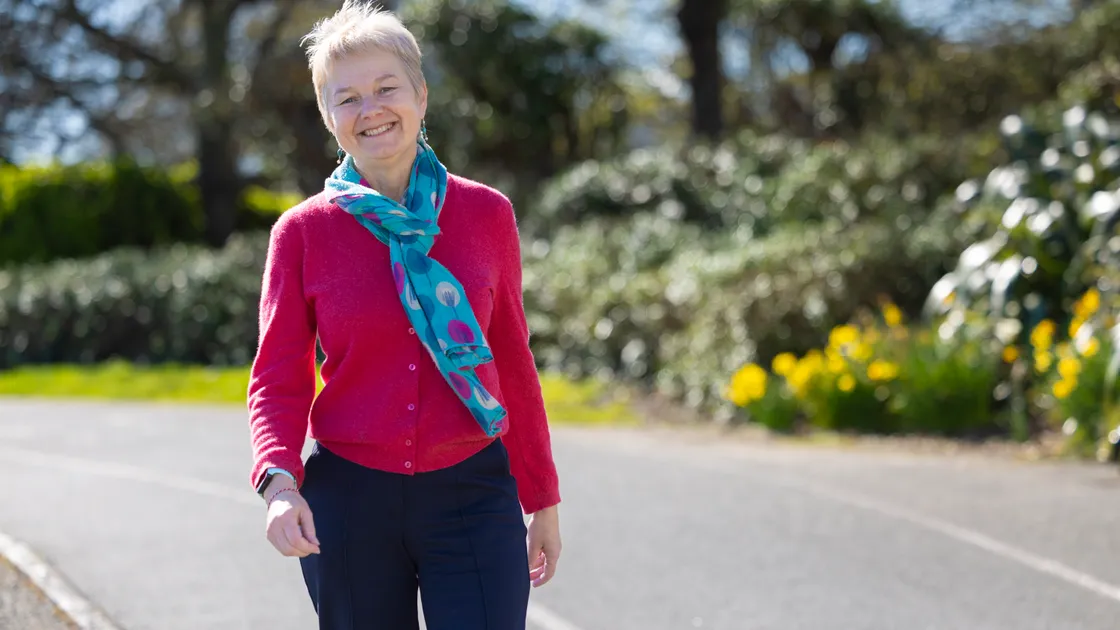
In January 2018, Jo Walker, a local resident and keen runner, experienced a severe cold and cough, leading to her slowest half marathon in April. She was initially thought to have had pneumonia, but was later diagnosed with a rare immune condition affecting her kidneys and lungs.
‘I thought “I’ve got a million things to do, I don’t have time for this”,’ she said.
‘My motto is always “I’ve got to crack on”. But I was off work for about three months, with a total lack of energy, feeling sick, couldn’t get comfortable and unable to do very much at all. I had my 50th birthday on 2 November – awful. The next day, I’d realised I hadn’t passed urine for a whole day. Like a very good wife, I waited until half time in the England rugby match before saying to my husband, “I think you better take me to A&E”. I can’t explain to you how awful I felt.
'I was airlifted to Guy’s Hospital in London that Monday for a biopsy and told I’ve got this immune condition. I don’t understand it – it’s got a complicated name. But it basically attacks the blood vessels, and I’ll never get rid of it. I’m on medication for life to keep my immune system suppressed.’
By the time Jo arrived at Guy’s transplant clinic – which works in partnership with the local renal unit to offer Bailiwick residents specialist emergency care, diagnosis, treatment and management of all types of kidney disease – she had a renal function of four, meaning she was in complete renal failure. It is thought that, instead of pneumonia, her illness was actually the start of her immune condition, attacking her lungs first.
‘They can’t tell me why, or how I got it,’ she said.
‘But the best bit of advice I got from the renal unit was not to waste time trying to work that out. Just focus on what you’re doing next.’
On returning to Guernsey, Jo was immediately introduced to the renal unit as its new, unexpected dialysis patient.
‘It’s unusual to go straight on dialysis with no previous symptoms,’ she said.
‘The renal unit had never even seen me before, and I was on another planet, in total shock. My husband said for the first two years, I hardly spoke. I just had to function.’
Jo spent the next three years on dialysis, and was told that with her rare condition, she would only match with 15 out of 100 people for a transplant. While visiting the renal unit for four hours a day, three days a week, she soon became close to the nurses, and the other patients and members of the Guernsey Kidney Patients Association, of which there were about eight.
‘They’re amazing, they’re just your second family,’ she said.
‘The knowledge and support from the staff is first class. And the humour and banter with the guys also going though it just helps keep you going.
'I spent a long time with those people, so I still pop in to see them. We’re so lucky over here, we’ve got the best of the best from Guy’s coming over regularly to see the patients. And with the GKPA, you can still travel. Life doesn’t stop, but it takes a bit of engineering. The unit works out where else is safe, hygienic and then coordinates with the other hospitals for you so you feel confident when you’re on holiday in another country. I’ve had dialysis in Cyprus, in Paphos. And in Barcelona – that was an eye-opener – there must’ve been about 40 people on dialysis. My Spanish is limited, but I had an English-speaking doctor with me for the whole four hours, just to make sure I was OK.’
A phone call in the middle of the night told Jo to get on the red-eye flight to London, as a kidney match from a deceased donor had become available.
‘I still had zero expectations of getting that transplant,’ she said.
‘I just remember shaking in the trolley all the way down to theatre, and when I woke up all I could think was “Oh my god, I’m alive”.
‘I’ve now got more kidneys than a steak and kidney pie. They put the new kidney in the front, and leave your other two to shrivel and die. I spent the next 12 weeks at Guy’s, going for tests and making sure my body didn’t reject the organ. It was during Covid, so it wasn’t an easy time to be there. It was flipping hard, but you crack on, and I haven’t been on dialysis since. Every year I send an email to the transplant clinic for the family of my donor. All I know is it was someone younger than me who’d had a brain haemorrhage. I don’t know if they even read my emails, but I’ll forever be grateful.
'How amazing that somebody had that wish and the family honoured it at what must have been such a traumatic time. Six months to the day I did my first parkrun with a transplant.’
Jo never went back to her job in finance, and her husband took early retirement so the pair could travel and enjoy life together.
‘My priorities have changed completely,’ she said.
‘You appreciate a lot of things and take life a bit easier. I reassessed my life and thought “Why am I working 50 hours a week and running around like a headless chicken?” I now do eight hours a week at Creasey’s and I love it.
‘Life’s too short. We’ve got no children, we’re just living life, travelling and doing what we can together, while we can. We know, at some point, my transplant won’t continue to work. Don’t know when, so we just try to make the most of life. I feel very fortunate. My advice to anyone going through kidney failure would be speak to the renal unit, the GKPA, and just go one step at a time. If you only get out of bed today, that’s a success.
'Be kind to yourself, seek the support that’s out there for you and focus on going forward.’
‘I see it like a job – it’s just something I have to do’
John Savident has been going backwards and forwards to the Princess Elizabeth Hospital’s renal unit for dialysis for more than 20 years. Olivia Thompson found out how it has not stopped him living his life.
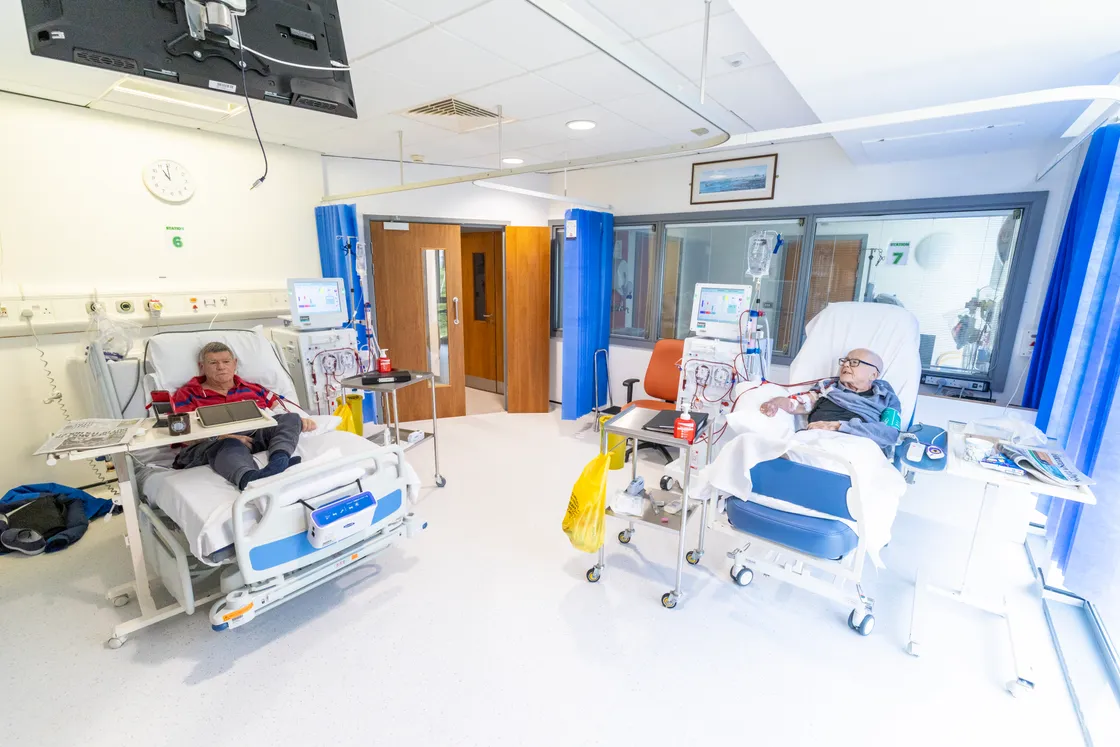
Since experiencing kidney failure when he was younger, John has had to have three sessions of dialysis a week. Dialysis is a life-saving medical process that filters waste, toxins, and excess fluid from the blood when kidneys fail. It acts as an artificial kidney system.
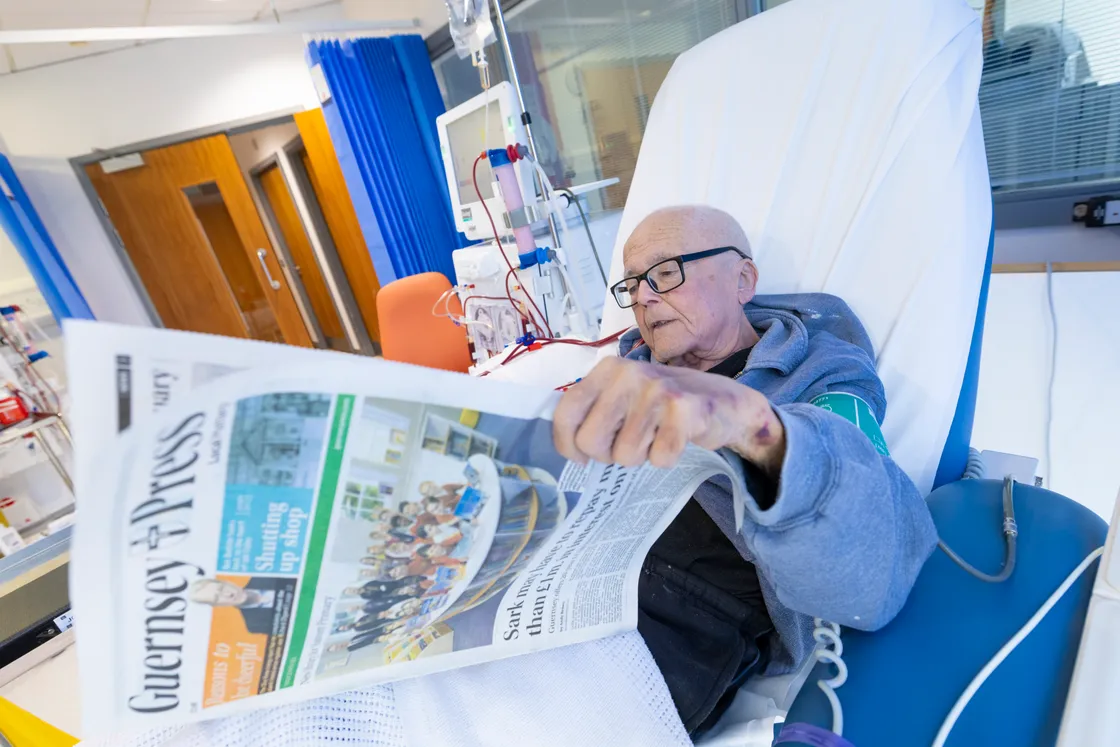
‘I come on Monday, Wednesday and Friday mornings. Treatment starts at 8.30am and I usually leave just before 1pm. Towards the end I get tired so I just go home and rest. I am back to normal the following day,’ said John.
‘If I have a rest I feel fine – that’s how I deal with it, but everyone deals with it in different ways.
‘I drive here and I drive home. It’s never stopped me doing anything – I used to work on days that I didn’t have dialysis. I can go on holiday, I can still go for meals with my friends, go to the football.
‘I’ve got to look at the positive side – it’s not going to cure me but it helps keep me going.’
Having been on dialysis for such a long time his sessions have very much become a part of his routine.
‘I see it like a job – it’s just something I have to do,’ said John.
Spending about four hours at the renal unit each time he goes, John spends a lot of time with the nurses and other staff, and other patients.
‘We come in, talk about football, watch TV or have a sleep,’ he said.
‘This is a great unit, the staff are great – they could not be more helpful. I see more of these people than I do my friends.’
As well as the nurses on the unit, patients also see a dietician to help advise on what foods they should and should not eat, such as those that contain a lot of potassium. The patients also have targets on how much fluid they should drink, as the more they drink, the more fluid they have to have taken off.
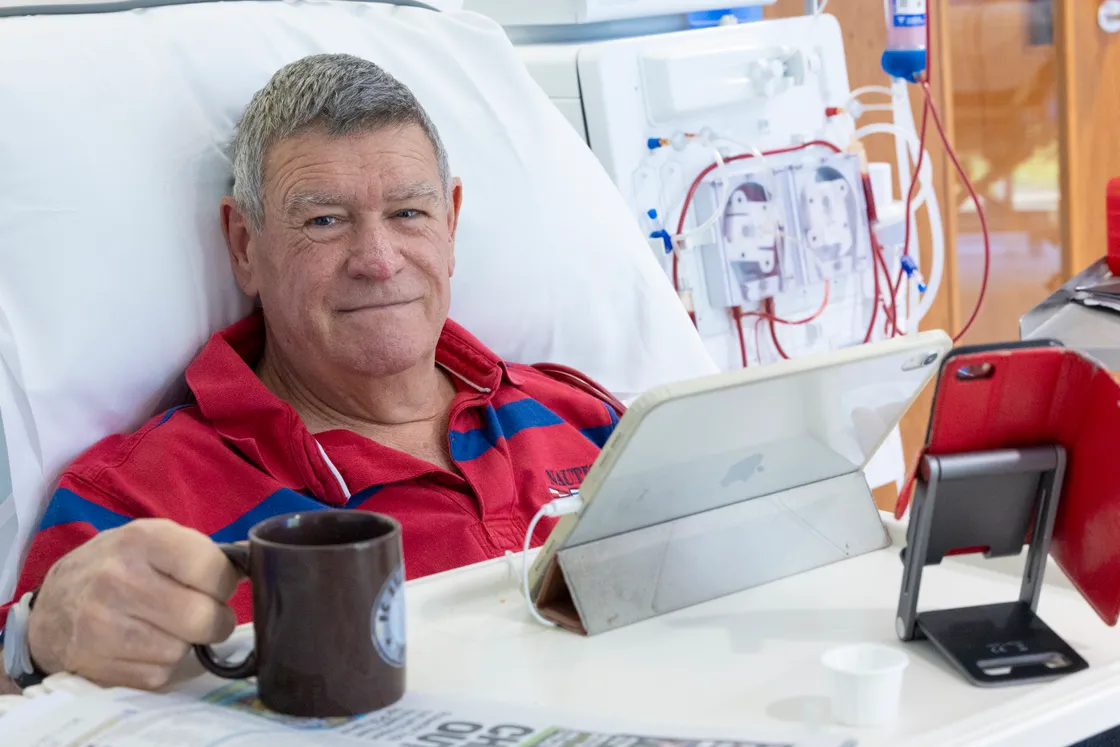
Dave Smith, chairman of Guernsey Kidney Patients Association, has also been on dialysis for a few years after he was diagnosed with a rare disease, anti-GBM (anti-glomerular basement membrane) disease.
‘It’s the way it is, the alternative is being six feet under,’ he said.
‘We’re very lucky to have such a good renal unit here.’
Guy’s and St Thomas’ provides a full kidney service for Guernsey and works closely with GPs and other hospital specialists.
Dialysis slots can be arranged in the UK and abroad for patients who travel. The renal unit does a handover in essence for while the patient is on holiday.
Earlier this year Dave went on a cruise where he had dialysis sessions on board.
‘I was a bit nervous as the first session was while we were going across the Bay of Biscay, but it was fine, and the nurses were very good at needling,’ he said.
‘It’s arranged through a holiday dialysis company and the unit is in contact with them.
‘There are so many places you can go and there is nothing that it has stopped me going.’
The GKPA has supported the renal unit by supplying equipment alongside its support of patients.
The Transonic HD03 Hemodialysis Monitoring scanner cost £37,000 and is crucial for detecting issues before major, invasive surgeries are needed. Through collections, cake sales, donations from local businesses and a Christmas raffle, the local charity raised enough funds to purchase the island’s first scanner.
‘It’s a great piece of equipment, it can help detect things earlier,’ said Dave. ‘We’re really lucky to have it.’
He said he would like to see a testing service rolled out in Guernsey to help people get diagnosed quicker, when things can be done to help slow the progression of kidney failure.
‘That’s really where we want to go next with the charity,’ he said.