

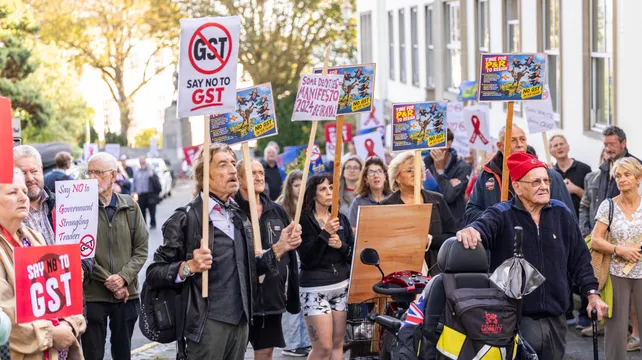
Politics has to allow space for politicians to change their minds. Circumstances evolve, fresh evidence comes to light, and the realities of governance often force difficult revisions of old convictions. There is, however, an important caveat to insert before going on: when around a dozen deputies effectively rode into office on explicit anti-GST tickets, the electorate is entitled to ask precisely where practical pragmatism ends and an outright breach of trust begins.
So, when a deputy abandons a stance built on carefully articulated and arguably axiomatic principles, it’s only fair to ask a straight-up question – what changed?
In January 2023, Deputies de Sausmarez and Burford delivered two of the Assembly’s most compelling speeches against a GST package. Neither buried their head in the sand over Guernsey’s fiscal challenges. Both accepted that fresh revenue had to be found.
Yet both concluded that GST was the wrong lever to pull.
Their objections were far from ideological dogma. They were anchored in two practical warnings. First, that islanders were already enduring an unprecedented financial squeeze. And second, that any safety net pinned to GST would inevitably fray over time.
Three years on, neither concern has evaporated. Quite the opposite; time has only sharpened their teeth.
Deputy de Sausmarez’s first warning was one of timing. While saying that higher earners would pay more under the broader package, she insisted this could not be viewed in a vacuum, detached from the lived reality of ordinary households. ‘It does not escape the fact that we have to look at this in the context of what is, to many people’s lifetime experiences, an unprecedented squeeze in terms of the cost of living,’ she told the Assembly. ‘It is just so much more difficult for people to make ends meet.’
That was January 2023.
Today, the vice has only tightened. Food prices continue to soar, housing costs remain under intense pressure, and energy bills have surged. The States’ own statistics show domestic fuel and light prices rising by roughly 19% in a single year alone. Across the board, baseline costs have ballooned.
The latest Household Expenditure Survey, drawing on data already two years past its sell-by date, simply proves what islanders already know – real incomes are down, costs are up, and tightening belts is no longer enough. For an increasing number of families, the next step isn’t budgeting; it’s packing up and leaving.
Given the facts, you might reasonably expect P&R to have factored these obvious shifts in consumer behaviour into their revenue model. Not so. The committee’s revenue figures assume islanders will keep spending like it’s 2018. But if households are already cutting back – and are then squeezed further by a new tax at the till – the actual yield will inevitably fall well short of P&R’s ambitious arithmetic.
More to the point, Deputy de Sausmarez’s original logic is stronger now than when she first voiced it. If introducing GST was impossible to justify during the headwinds of very early 2023, how has it become easier after three more years of grinding inflation and ever-increasing costs?
Her second concern carried equal weight: the illusion of permanence.
Deputy de Sausmarez acknowledged that mitigations could soften the initial blow but insisted they could never alter the inherent DNA of the tax itself. ‘GST is inherently regressive,’ she warned in 2023. ‘I know there are mitigating factors, but it is not going to make GST not regressive.’
Flying in from a slightly different angle, Deputy Burford nonetheless arrived at the same destination, pinpointing what she called the Achilles’ heel of the proposed safety nets. Her concern was never whether support would exist on day one, but whether it would survive in the long run: ‘How long would that brief respite for lower-income households remain before they find themselves back to where they were or possibly even worse off?’
Deputy de Sausmarez echoed the sentiment, warning that mitigations are often ‘the first things to be left behind’ when future tax hikes arrive.
Crucially, no Parliament can bind its successor. As Deputy Burford previously pointed out: ‘No States can bind another or indeed itself. Any resolution today to require a States' decision before raising GST is essentially meaningless.’
She was equally prophetic about how easily a ‘low’ tax rate becomes a convenient tap for future spending, famously warning the Assembly: ‘Need an extra £15m. to balance the books? Hike GST to 6%. Want to increase capital transfer? Call it 7%. New drugs and treatments? Make that 8%.’
That warning makes P&R’s latest messaging all the more bewildering. The committee’s newest member, Deputy Niles, recently pitched a 3% GST rate as a ‘compromise’, claiming it is ‘the smallest number that closes the gap and protects the services people rely on.’
Yet by P&R’s own figures, a 3% rate is projected to yield just £39.5m. And even then, this headline number looks drastically overstated given that the committee has failed to model business adaptation, shifting consumer behaviour, or the direct inflationary costs of implementing the tax. Set against a funding gap pegged anywhere between £77m. and well over £100m., depending on what day of the week you ask, a £39.5m yield doesn’t come close to bridging the divide.
Claiming a 3% rate ‘closes the gap’ takes a remarkably creative view of simple addition. Far from balancing the books, a 3% starting rate merely gets a foot in the door. Once established, Deputy Burford’s 2023 warning becomes a self-fulfilling prophecy – 3% becomes 5%, then 10%, creating a ratchet mechanism that only ever turns one way.
While future Assemblies could easily vote to ratchet GST upward, raising tax allowances or income support alongside it remains an entirely separate political fight. In the meantime, unless politicians actively choose to defend them, inflation steadily erodes the real value of the fixed safety nets. Three years of stubborn inflation have validated both deputies’ warnings in textbook fashion.
Going back to where we began, politicians are allowed to change their minds. Guernsey’s financial baseline remains contentious, and P&R may genuinely feel they have reached the end of the road on alternative options. Nevertheless, the principles articulated by Deputies de Sausmarez and Burford in 2023 remain as sound today as they were back then. The cost-of-living squeeze has materially narrowed, not widened, the margin for error. The risk to lower-income families is clearer and harsher than ever.
If these concerns were strong enough to reject a GST package three years ago, islanders have every right to ask what has changed to render these core principles irrelevant today. Asking the question isn’t an attack, it’s basic democratic accountability.




You need to be logged in to comment.