

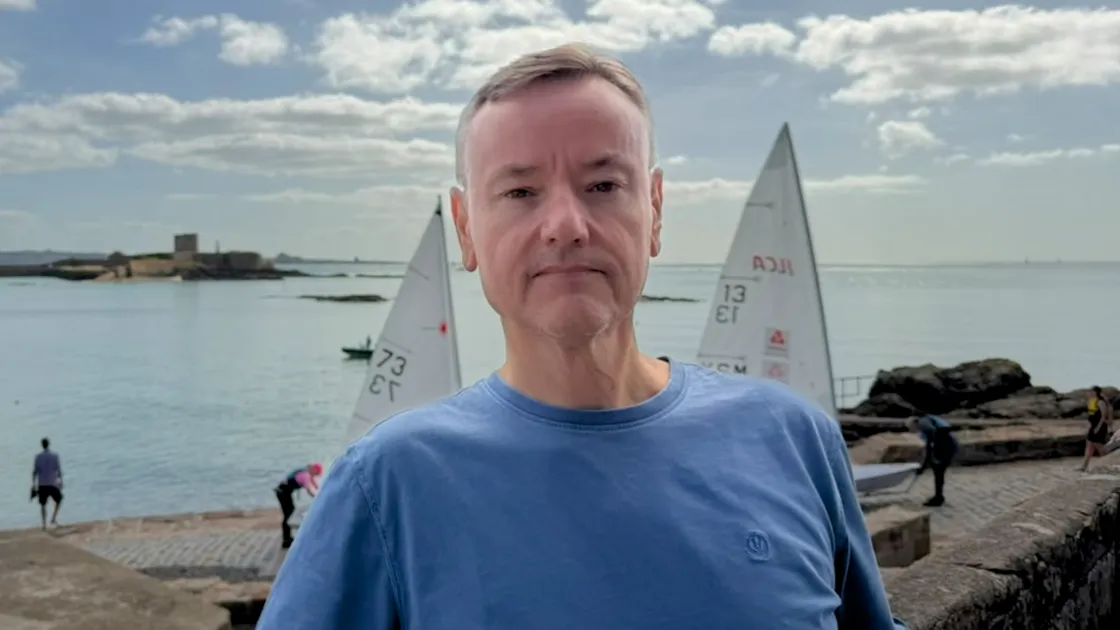
Having already penned almost a dozen books about various aspects of Channel Islands history – many of them commissioned – Jersey historian Ian Ronayne has now written an account of the tragic sinking of HMS Charybdis, along with HMS Limbourne, in 1943.
‘This one’s for me,’ he says.
‘I’ve always been interested in military history and broadly aware of the story of HMS Charybdis and the graves to be found in Jersey and Guernsey. But to be honest, not as many people in Jersey are aware of the story as you’ll find in Guernsey where, traditionally, more has been made of it.’
Ian is at pains to stress that he’s not claiming to have discovered a ‘forgotten story’. However, while researching the history of the Dido-class cruiser at the National Archives at Kew in London, he ‘discovered lots of intriguing and poignant facts’ which quickly compelled him to dig deeper.
The resulting book is called On Sorrowful Tides, published by Seeker Publishing, and was launched yesterday at the Jersey War Tunnels and then today at the German Occupation Museum in Guernsey.
It is ‘a single, compelling narrative that succeeds at being immensely informative and highly readable’ according to one reader called Jerry, who happens to be a former fleet commander, a knight of the realm, and – currently – lieutenant governor of Jersey. Sir Jerry Kyd provides the foreword for the 200-page history.
‘Writing a book like this is all about what you put in and what you leave out,’ says Ian.
‘You have to tell the story of the battle of course, but to do that I wanted to introduce readers to the ship and the men who served on her.’
The book therefore goes into some detail about the construction of the ship in Birkenhead, along with its service prior to that fateful night in the English Channel when it took part in Operation Tunnel and was sunk by German torpedoes at the Battle of Sept-Isle.
‘The National Archives have quite an extensive collection of files from the Royal Navy, with details about the action itself, the resultant loss of life and how they dealt with it. This is the military event in detail, but they also have a lot of information which shows us the human element – heart-rending information about families trying to find out what happened to their loved ones.’
This hinges, Ian explains, on a radio message to France from the German authorities which gave the impression that many had survived and were in captivity, rather than in a watery grave.
Ian’s introductory chapter describes this facet of his research as ‘a deeply poignant discovery’. Namely, that ‘the families of men lost on that fateful mission were put through the most agonising ordeal because of conflicting information about whether their loved one was alive or dead’.
The scale of the story is another aspect which Ian believes has been somewhat overlooked.
‘I’ve made a special effort to put the tragedy in context,’ Ian says.
‘The sinking of HMS Charybdis resulted in one of the biggest losses of Allied lives at sea during the Second World War, but it rarely gets the attention that some other tragedies have had. There were 500 men who lost their lives when Charybdis was torpedoed. It was a rare naval loss but from a less significant ship than, say, HMS Hood or HMS Prince of Wales.’
As well as the events of Operation Tunnel, Ian wanted to include the reaction in occupied territories to the washing ashore of sailors’ bodies. These fetched up on our coast, that of Jersey and also along the French coast.
‘I wanted to include how the people of Guernsey showed their respects,’ he says, ‘and my goodness how they showed their respects.’
To the surprise of many, the German military authorities allowed islanders to attend the funeral service at Le Foulon on 17 November 1943, when 19 of those washed ashore were buried. The enormous crowd that gathered – estimated to be up to 5,000 – left the occupiers in no doubt as to where their allegiance lay.
Full naval honours were also afforded Joe Kane for his burial on 6 December. His body had washed ashore after the initial funeral, but this time there was no announcement in the censor-controlled newspapers, nor for the burial of an unidentified victim of the sinking whose body washed ashore still later.
While Le Foulon has 21 graves for seamen from Charybdis – 20 named and one unidentified – Jersey’s Howard Davis Park is the site of fully 38 equivalent graves. However, only 11 there are named.
It’s safe to say that when people gather at Le Foulon, as they do each year, to commemorate the tragedy, they are commemorating all who perished, wherever their remains lie – in the water or on land – whether named or unnamed. The story belongs to them all, and to those who survived and, in many cases, were redeployed – obliged to move on into the next pressing military engagement with the memories of lost shipmates haunting them.
The War Graves Commission has the names of the 462 men who perished on Charybdis and the 42 on Limbourne who died that night, or later from their wounds. These lists are faithfully replicated by Ian in the book's appendices, which he makes no apology for making extensive.
‘Telling this story is important,’ he says.
On Sorrowful Tides by Ian Ronayne, published by Seeker Publishing, at £14.95, will be available in local bookshops and online at Amazon and occupationbooks.com. It is launched at the German Occupation Museum today at 4pm.
WIN
Seeker Publishing has kindly donated a copy of On Sorrowful Tides for the Guernsey Press to give away.
To be in with a chance of winning it, email competitions@guernseypress.com with your contact details and the answer to the following question:
Who has written the foreword for Ian Ronayne’s new book about HMS Charybdis?
Competition closes at midday on Friday 2 October. No cash or alternative prize offered.






You need to be logged in to comment.