
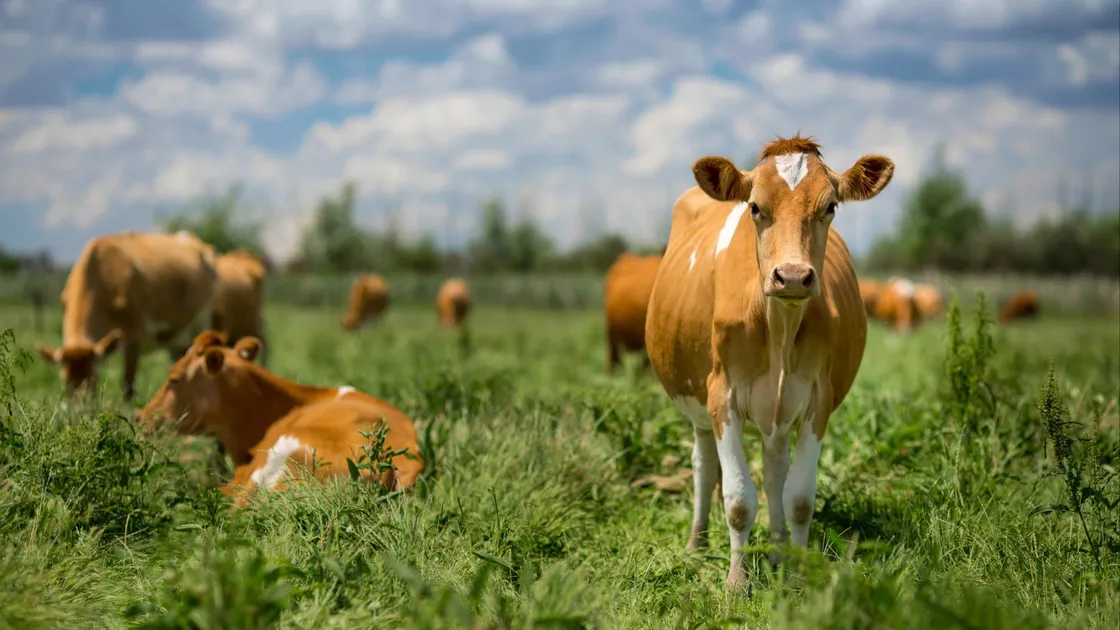
The history of Guernsey’s dairy industry stretches back more than a thousand years when a group of French monks sought refuge in our small island home.
In the year 960AD, the Duchy of Normandy was at war, and nobody was safe from the effects. With many monasteries and churches ransacked and destroyed during the conflict, the monks of St Michel found sanctuary in a small island in the English Channel. Legend has it that they brought with them the Isigny cattle of Normandy and the Froment du Leon breed from Brittany. These two breeds are the ancestral relatives of the modern Guernsey cow.
There is no definitive historical record identifying the exact origins of the Guernsey cow, but there is an undeniable truth that the Guernsey breed produces some of the finest dairy products in the world and has been recorded as doing so since the 18th century.
As centuries passed, smallholding became widespread. Several hundred farming families survived on just a few small fields where they grazed a handful of cows. Today that number has reduced to just 11 farming families, all RSPCA-assured and responsible for safeguarding 1,250 of the Guernsey breed’s purest cows within the same patchwork of small fields.
In the early beginnings of dairy farming, milking cows was a way of life, not a business. Each family only needed to maintain a sufficient number of animals to meet their personal needs. By the early 19th century, some farmers began to transition to the concept of dairy herds being established as a business. In this way, those farmers gradually began to increase the numbers of cows and started to develop small commercial herds.
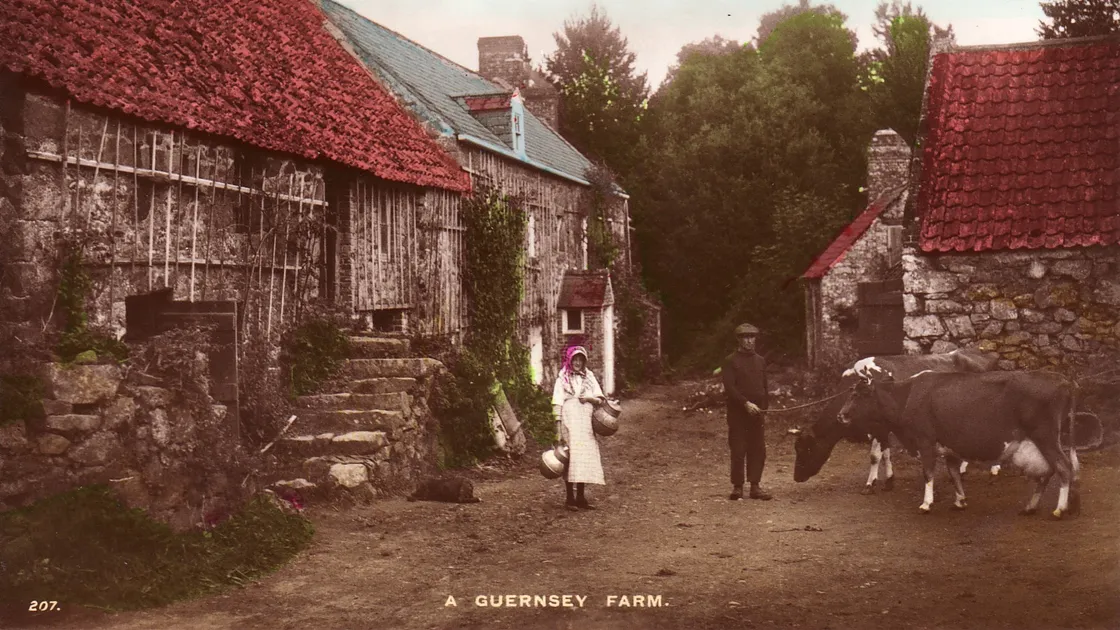
Each farming family would have the knowledge of how to make full use of their cow’s milk. In the days of family smallholders, a ‘farm’ with a handful of cows would likely have space to house the cows in a few wooden stalls built into a room on the ground floor of their farmhouse. This tradition had the effect of allowing the body heat of the animals to rise upwards and help warm the rooms above where the family lived.
For those smallholders producing excess milk or those farmers who had small herds working on a commercial footing, their milk and dairy products needed to be sold to island customers.
Often dairy farmers would do this themselves, with the customer coming directly to the farm to buy their milk, cream or butter. However, a service industry soon sprang up to bridge this gap – namely that of the dairyman, or milkman as they became affectionately known.
The earliest milkmen worked during the era of raw or whole milk (pre-pasteurisation) when they would collect the milk ‘warm’ from the farm and then go door-to-door to sell it each morning to customers. Even up until the early 20th century the dairyman was still delivering raw milk from a traditional Guernsey can.
They began travelling by handcart, progressing to horse and cart, and then moving on to vehicle deliveries. However, no matter what the mode of transport, their service remained the same.
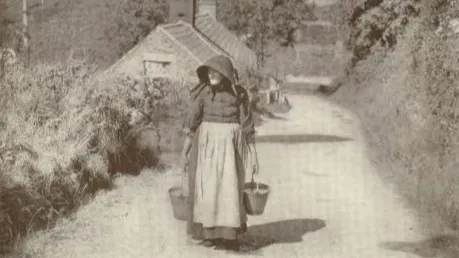
With the cows spending most of their days at pasture, milking was often undertaken in the field. This was carried out with the milker sitting on a simple short three- or four-legged wooden stool, which would bring the milker to exactly the right height under the cow’s udders. Expressing the milk from the cow’s teats was originally done into a large traditional Guernsey milk can or a pail or bucket.
If the cows were indoors because of bad weather, they would be milked in their stalls. Once milking was over, the milk would remain in or be transferred into the iconic, traditional Guernsey milk can. These came in several sizes. The larger size was the one favoured for milking. They were a practical design, durable and resistant to crushing and buckling because of their shape – an important thing when dealing with the large, heavy and occasionally wilful Guernsey cow.
The cans had a tight-fitting lid which meant that if they were to be dropped or kicked over, they wouldn’t spill any milk. Most had only a single handle, but the very largest had to have two because its weight, when full, needed two people to carry it.
For centuries fresh milk was drunk raw or whole. This meant unpasteurised. Milk would be stored in the large Guernsey milk cans, with the lids pushed tightly in place. However, because the milk came directly from the cow at body temperature it was already warm, so it was advisable to drink it within a day or two. Storing milk needed a cool, shaded space to try and reduce the temperature and slow any bacteria growth. This was very often dependent on the weather. Hot weather would spoil any milk because the natural bacteria in the milk would proliferate.
Following the Second World War German Occupation and Liberation of the island, and by 1955, there were still some 350 small dairy farms on the island, each with only a handful of cows.
In our next chapter next week, we explore how the dairy industry evolved during the 20th century to where there are now 11 working dairy farms holding just over 1,250 milking cows, each year these producing around 7.6 million litres of milk.






You need to be logged in to comment.