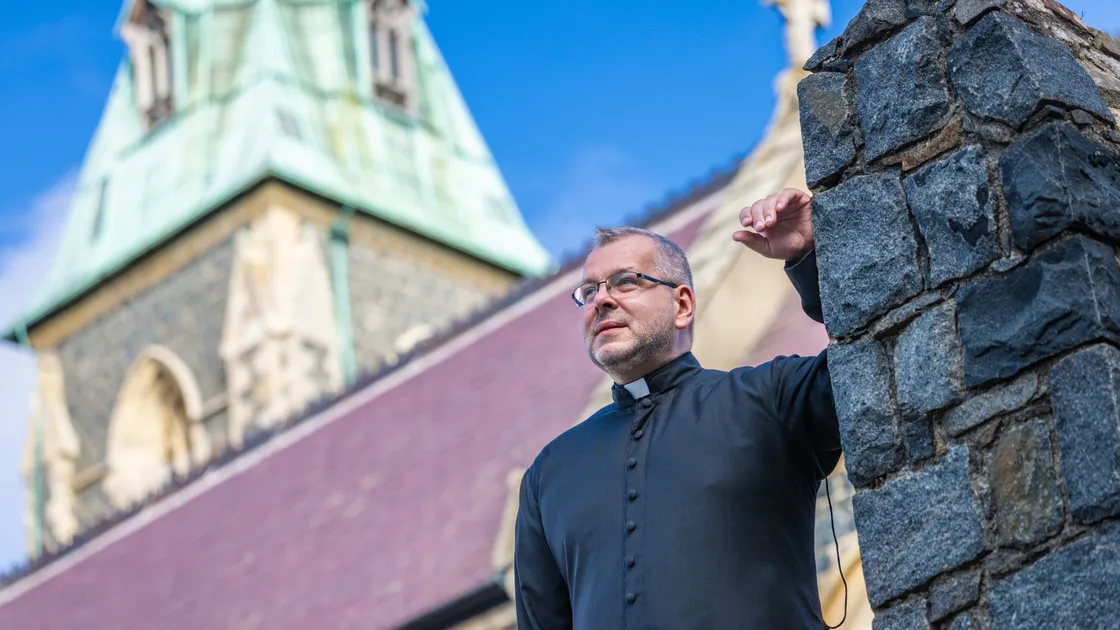
In the early autumn sunshine, Guernsey’s new Catholic Dean is following our picture editor’s instructions and consequently looking epic in front of the spire of St Jo’s (or ‘the Church of St Joseph and St Mary’, to give it its proper title).
While I wait, I greet a passing nun whose wide smile seems to indicate a degree of excitement about the fuss being made of the new arrival. She introduces herself as Sister Rita and animatedly tells me, in an Irish brogue that I’ve associated with her uniform since childhood, that Father Marcin Drabik has been absolutely loved in his previous haunts of Jersey and the Isle of Wight. She seems certain of a hat-trick of insular approvals.
Before I actually get to sit down with the new dean in the living room of Ampthill House, which stands tall on the slope between the church and Victoria Road, I meet his dog Bilbo – a 14-year-old German shepherd-rottweiler cross. He amiably licks my hand and takes an unhealthy interest in my scabby shin while I wait for the coffee I’ve been offered.
Being an inveterate coffee snob, I usually refuse such offers but for some reason I’ve strayed, and I am rewarded with a coffee of such high quality that if Father Marcin had mumbled ‘the coffee of Christ’ as he proffered it, I would have answered ‘Amen’.
I’m conscious that the photos and coffee-making have already consumed about 20 minutes of his day, that he has taken up our appointment despite a mass being said across the way, and that he has another place to be, immediately after we finish. Yet, while I’m nervously hurrying as a result, Father Marcin slows the pace down, fixes me with a look of quiet focus and takes the time to give thought to his answers.
‘My first experience of the Channel Islands was at the very beginning of my Great Britain adventure, which was Jersey,’ he says, in response to my stock ‘Is this your first time on the island?’ opener.
‘My first four years in the Portsmouth diocese were there, and during this time Canon Michael [Hore] invited me here to Guernsey quite a few times to help celebrate some religious events as spiritual support for the Polish community. So I did know and I do remember a little bit about Guernsey from the past but it’s almost 20 years ago.’
He admits to having found the language ‘a bit of a challenge’ in those early days, especially as he was ‘facing English, but Jersey English, so it was more interesting’.
‘I still have not very good English and not a good accent but I’m proud of my background,’ he says.
That background saw him raised in a part of southern Poland that belonged to the voivodeship of Krakow but has since become part of Silesia.
‘I was brought up as a Catholic, going to church every Sunday,’ he says.
‘My family gave me a lot of example of the faithfulness.’
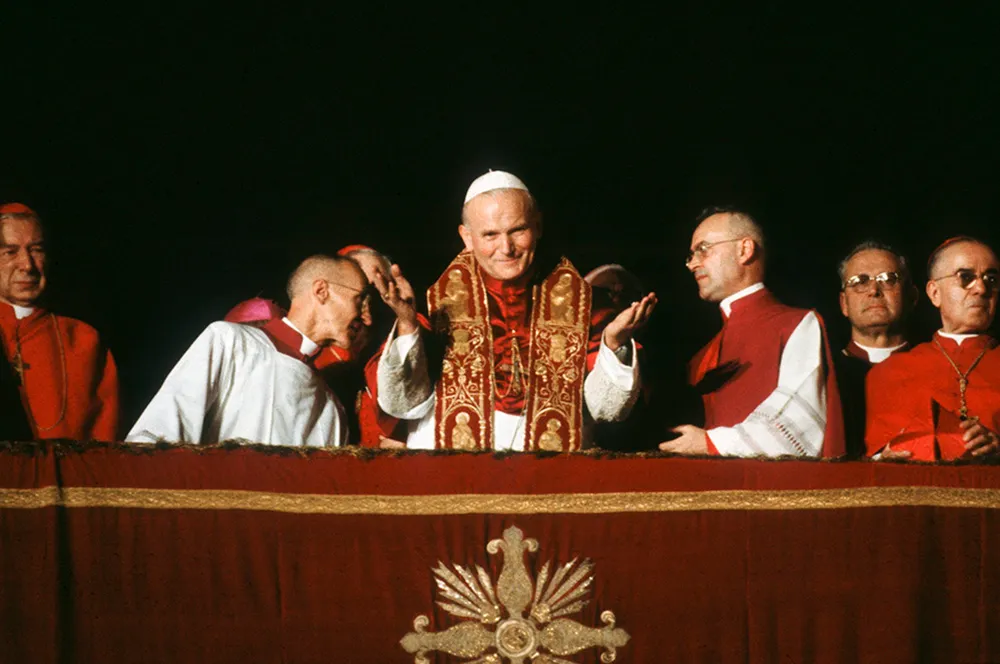
Another more high profile example will have been Karol Wojtyla, who hailed from a town about an hour away by road, who rose to the top job in 1978 and became Pope John Paul II. Was he old enough to remember the event, I wondered, and if so, did it inspire him?
‘I still remember this huge joy within my family,’ he says.
‘It was the Communism time in my country and the message came through on the radio. I remember, as a very small boy, I wasn’t absolutely sure why they were all rejoicing. But during my school years I remember that whenever the Pope visited Poland and preached these homilies, during the one-mile walk home from school, all of the streets were full of the voice of Pope John Paul II.’
His family, who were ‘miners in the coal mines from generation to generation’, were nevertheless somewhat taken aback when Marcin suddenly announced he was planning to go to the Krakow seminary. Not just because he was forsaking the mines, but also because he had seemed to be heading away from, rather than towards the church.
‘I had three years of being very anti-Catholic faith,’ he tells me.
‘I was searching for God in different denominations and in different religions like Buddhism and Hare Krishna. So I was wandering around and finally coming back like the prodigal son and saying: “I do apologise. I wasted my time and I didn’t appreciate that the true and the real presence of our Lord Jesus Christ is in the Holy Eucharist”. So from this moment when I realised the Holy Eucharist is the centre of our life, I fell in love first with the Holy Eucharist and then I felt my vocation was to be as close as possible – and then it started.’
He concludes that for all the talk about ‘searching to find God’, there’s a lot to be said for trusting God to find you.
Marcin was ordained as a priest in 1999 in Krakow Archdiocese, just as Wojtyla – now St John Paul II – had been 53 years previously. But his fascination with other religions remained, such that alongside his religious instruction at the seminary, he completed a university degree in Japanese Shintoism and its correlation to Christianity.
‘I had to ask my superiors for a special agreement that I would go so far with my degree,’ he says.
Soon, he was serving as an assistant priest in a Polish parish where he met another priest, originally from that parish, who held the post of Catholic Dean of Jersey.
‘He came for a coffee and said “Please come to Jersey because we need more priests there and we have a very big Polish population”. I said “No, I can’t because I’m still learning how to be a priest”. But then he phoned me every year until 2006 and then I said okay.’
After his time in Jersey, he moved to other parishes in the diocese, including the Isle of Wight.
‘Some priests have already named me “Islander”,’ he admits.
Father Marcin is now incardinated to the Portsmouth Diocese, which means he is no longer a Krakow priest. And that shift is not just a change of lingual and geographic landscape – it’s also another Christian terrain.
‘Poland is still a quite Catholic country, so when I first came to the Channel Islands, I was moving to a country where the Catholic faith is not the main one and I could see also the other Christian denominations more and more, which was something quite new for me,’ he says.
‘So the ecumenical way of having friends among the pastors and ministers of different churches like Anglican Church, Baptist, Methodist, Evangelical, Pentecostal was something new. To get to know their background and their story was a very special thing. I hope this friendship will be the same here, so we can meet as ministers of different Christian denominations and share our experience and our faith with each other.’
This latest posting has come at the behest of the current Bishop of Portsmouth, Philip Egan, who has appointed him dean and pastoral co-ordinator for the parish of Our Lady and the Saints of Guernsey, which Father Marcin describes as ‘a huge and amazing responsibility’.
In his announcement of this and a raft of other postings, Bishop Egan recently conceded that ‘moving from one appointment or diocesan role and then settling into another is about the hardest thing we do as diocesan priests’, as well as being ‘a very great challenge for our deacons and – of course – not least for all our parishioners’.
Father Marcin’s approach to this challenge is philosophical and, it turns out, literary.
‘Christianity generally is about the challenge of changing,’ he says, ‘because we are called for repentance and when we are called by Jesus Christ to follow him and take the cross every day, it means that every day will be some kind of test or trial – beautiful things, but when we follow, we go. When we move, everything changes around us. So even if we say we are not keen for the changes, we have to realise that we are the people of constant adventure. This is why I like Tolkien and I’m a fan of The Hobbit and The Lord Of The Rings and others, and why my dog’s name is Bilbo Baggins. Because I think Tolkien’s stories represent this constant facing of adventure and change, and the tension between evil and goodness. There is always something to change within us. We mature and grow up and it changes us, then we approach some professions and we want to be promoted and we learn skills and open the door to constant changes.
'So I can’t imagine that we as specialistic Christians can say we don’t like change. We are rooted into change.’
The most challenging part of this latest change for those within the parish was undoubtedly the departure of Father Marcin’s predecessor, Father Inna Gade, who has been deployed to Southbourne and Iford in Dorset as priest in charge. Before his departure, Father Inna offered to show Father Marcin around the island.
‘He was really dedicated to this one day with me and I loved it. I walk in his steps and I can see how many marks he has left here in a beautiful way, because he was very much loved. It is beautiful to replace a priest who was loved. Some people say it will be “difficult to fill his shoes” but I’m not going to, because everyone is different. I have to walk in my own shoes and then if one day people will say “We appreciate your trace, your mark on this island”, then I will just say a huge thanksgiving to God and to them as well.’
With masses to be said not only at St Jo’s but also at the Church of Our Lady Star of the Sea (aka Delancey) and Notre Dame du Rosaire – in a parish which is also home to St Anne and St Mary Magdalen Church in Alderney, two primary schools and a college educating children aged 2-18 – the new incumbent has much to do in serving the Catholic congregation. So he is grateful to have the help of ‘a fantastic man, very dedicated and spiritual and an inspiration to me in many ways’ – namely, Father Benedict Ndikum from Cameroon. Father Marcin admits to having been unsure how this would work, not having worked with an assistant priest before, but after two weeks, he says, ‘it’s working like a dream’.
He also carries the support of the Benedictine sister in Krakow who was once assigned to pray for him throughout his life, ‘that I might never lose my way’. He once met her, albeit on the other side of a grille and curtain – he never saw her face – and was able to thank her, but years later, he has no way of knowing her identity or whether she still lives.
‘I have always carried the certainty that her prayers stand behind me in everything I do,’ he recently told his new parishioners.
By the time you read this, Father Marcin will have attended the installation of the new Anglican Dean, the Venerable Matthew Trick, and then he has his own installation to organise, to which he wants to invite all the ministers of the other denominations.
‘Everywhere there are different circumstances and different mentalities from our different backgrounds,’ he says, ‘but people are always the same because we are human beings. I love people and I think we can build a future together and face challenges with good relationships.’
His enthusiasm is in part fuelled by the welcome he feels he’s received, ‘which was beyond my expectations’, which resulted in his penning a recent newsletter featuring two pages’ worth of thank yous.
‘And then I realised I haven’t met even 50% of those who are doing something for the parish,’ he tells me.
‘I’m looking forward to visiting the prison and the hospital and in a moment I am going to visit some sick people. They are very close to Jesus Christ’s suffering on the cross, so they can teach us a lot.’
Having lost his father six years ago, Father Marcin still has his mum back home, along with his brother, who continues the family tradition by working as a miner. He also has a younger sister living in Norway.
But as I leave Ampthill House and allow Bilbo another lick of my hand, it’s the grandfather back in Poland that I’m thinking of, courtesy of a parable-like recollection that Father Marcin dropped in, during our conversation.
‘One of my grandads – a miner – was very much offended that I did not continue the tradition of generations of my family. But I remember the moment when we met years later, when I was clothed in my black cassock and he came for some family celebration in his black miner’s uniform and I joked to him “Grandpa, I haven’t really much changed because you are dressed in black and digging in our earth for the treasures to help people to live, and I am in black and I am preparing to dig in the people’s souls for them to have a treasure of the presence of the Lord”. He smiled and said “Yes, it’s quite similar” and we made peace.’