If, like me, you have books beside your bed but find you just don’t have the time to read more than a few pages now and again – while somehow still finding time several times a day to ‘check’ multiple social media accounts – we are far from being alone.
A survey undertaken by the Guille-Alles Library early this year, in conjunction with Guernsey Arts, the Guernsey Literary Festival, Bright Beginnings nursery and the States of Guernsey, found that 70% of children don’t often see adults reading, while more than a third of adults specifically said that social media was preventing them from reading more. If we combine these findings with the view of 90% of adults, that reading has a positive effect on our wellbeing, then we’re left wondering why on Earth we’re still sitting there scrolling.
Actually, before we come down too hard on ourselves, we are of course up against a tsunami of extraordinarily sophisticated programming funded with more profligacy than any nation on the planet, using a wealth of data about our own specific wants, needs and desires to ensure our attention remains fixed on our screens.
What chance have we got?
Well, into this slough of despond now ride Guernsey Mind and the Guille-Alles, on a mission to encourage us all to make some kind of pledge to ourselves that we’ll eschew our asinine apps in favour of a few leaves of copy-covered paper bound together into a book.
And with this year being the National Year of Reading – which I’m still having to remind myself has nothing to do with Berkshire – and with today being the annual World Mental Health Day, perhaps there’s never been a better time than right now to make that promise to ourselves.
‘There’s lots and lots of research which shows how beneficial reading for pleasure can be for your mental health and wellbeing, so partnering with Guernsey Mind was a good way to put a spotlight on that,’ says head of marketing and customer services at the Guille-Alles, Adam Bayfield.
In fact, the National Year of Reading – a once-in-a-generation initiative from the UK government’s Department for Education in cahoots with the independent charity the National Literacy Trust – has dedicated the entire month of October to this subject of reading’s mental health benefits.
The story told by the local survey, which enticed the engagement of more than 4,000 children and more than 2,000 adults, is a little less alarming than in the UK, with 39% of children and 64% of adults saying they read regularly, compared to 19% and 50% in the UK.
‘Our results are more encouraging than those of the UK but we heard from lots of people saying that they would like to read more,’ says Adam.
‘There were lots of people saying “I find I’m just looking at my phone before I go to bed and I want to read more”.’
That certainly rings true with me. Among the books on my bedside table is the Broken Earth trilogy by N K Jemisin – gifted to me by an old school friend who lives in Geneva, simply because he wanted me to read them. It was a generous gift and a friendly gesture of connection which I have thus far spurned, as I haven’t opened them. Because first I want to read the Orson Scott Card sequel to Ender’s Game which has been lent to me by someone else. But first I need to finish the book I’ve borrowed from the library about post-war Spanish culture. I’ve renewed it five times and I’m only just over halfway through. Then there’s the book of four plays by Victor Hugo, from which I hope to extract a monologue suitable for the next eisteddfod – still unopened but already renewed once. There’s also a pile of unread editions of this newspaper and a load of football magazines to catch up on. At this rate, I’ll be getting to that Jemisin box set around the time I’m being put in a box.
So, how to solve this? Well, our kids – at our insistence – have always charged their phones overnight in the kitchen, meaning there’s a cut-off point at which they cease to have the addictive little blighters within their reach. Perhaps it’s time, starting on this apt day, to start doing the same for myself. I’m sure, even if I end up falling asleep after a few pages, I’ll still feel the benefits both from reading and from sleeping, where I was previously scrolling. A University of Sussex study from 2009 found that reading for just six minutes can reduce stress levels by up to 68%, so we can read for a bit and then sleep better. Win win.
It’s just about motivation, I suppose. Actually, the fact I have books on loan from the library has given me – relatively speaking – the hurry-up. So it’s worth mentioning, if you don’t find yourself in Market Square very often, that as a member, you can request a book and then pick it up from an alternative venue such as the Western Community Library at St Saviour’s Community Centre, the Bridge Community Library or La Nouvelle Maritaine Community Library.
And although it’s really up to all of us as individuals to find ways to get more books into our lives – which nine out of 10 of us say we want to do – the library and Guernsey Mind have come up with an additional prompt to get us started.
‘We decided it would be nice to do something together,’ says Guernsey Mind communications and events lead Amanda Hibbs, ‘because we know that reading can be very beneficial to our mental health and helps us to still our minds or take us off somewhere else away from our day-to-day lives, as well as getting us off our phones.’
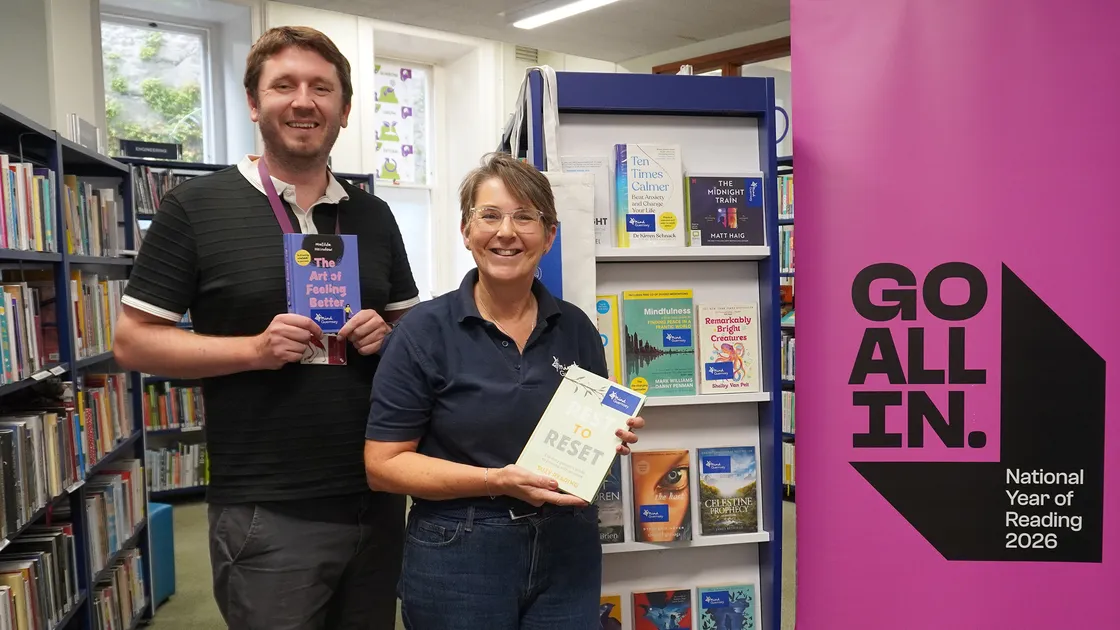
In the Guille-Alles, from today, you will find a wide range of books for all ages, out on display, with Guernsey Mind stickers on them. These have been chosen by the staff at the charity as good places to start, if you’re facing this same struggle to replace pixels with prose.
‘We’re a small team at Guernsey Mind – there’s only eight of us – but the majority of us are avid readers,’ Amanda says, ‘so we just sat down and had a really good discussion in the office about which books had really meant something to us, that made us feel differently about things. There’s a real mixture of books on the list. There are some really good self-help books out there that can be really beneficial to people but also just reading a good fiction can change your perspective on things and maybe think about things in a different way. We run some sleep groups, through Guernsey Mind, and a lot of people say that reading a few pages at night-time really helps them get off to sleep.’
She acknowledges that ‘mental health is important every day of the year – not just one day’ but sees today as ‘a focal point in the calendar’ and therefore a good time for one small resolution that could make a big difference. And to make such a difference, you really don’t have to start with War And Peace.
‘Another key thing for the National Year of Reading is to get away from the idea that there’s a certain type of reading that people should be doing,’ says Adam.
‘If someone hasn’t read a book for a long time, it might be a bit daunting to know where to start. Maybe there’s an idea that some books are better than others, but the National Year of Reading is saying look, just find a book that you love – it doesn’t matter what it is. If it’s a comic or a graphic novel or an audio book it all counts as reading – you still get all those same wellbeing benefits. Read about what you love. If you love football, read a book about football. If you love music, read a book about music. Find something that connects with your passions, because that’s what you’ll keep wanting to come back to.’
Adam is also keen to dispel the notion that if you find a book hard going, you’re somehow obliged to persevere.
‘I think people get a bit stuck on the idea that once you start reading something, you have to finish it,’ he says.
‘I feel that myself. I don’t often give up on a book but I have done it before. Sometimes people will say to me “Ah, I’m really not enjoying this book” and you think “Well, just stop then, it’s okay”. Maybe give it more than 10 pages but if you’re 150 pages in and you’re not enjoying it, what’s the point? Just put it down and pick up something else.’
I begin to suspect, at this point, that part of my own inertia comes from the idea that I’ve promised myself I will read more, therefore I feel a sense of obligation to do so, therefore I’ve inadvertently turned what is a pleasure, pure and simple, into yet another ‘must-do’ in my life – or, not to put too fine a point on it, a chore. Which it never is, once I actually get going.
Working in a library, Adam is always aware of the latest books that are causing a buzz in the literary world and has no shortage of recommendations from fellow staff and publications. He admits his ‘want-to-read pile is endless’. So there is no possibility that any one of us can ever read ‘even 1% of all the books in the world’. And really, that surely strengthens the notion that we should just reach for whatever floats our boats.
There’s no sense in this latest initiative of readers talking down to non-readers. Islanders are being encouraged to share their own reading recommendations and experiences of how books have helped them switch off, learn something new or feel connected. Adam makes the point that when he saw the statistic about 70% of children not seeing adults read, he reflected that ‘I probably don’t read around my children because – almost by definition – if I’m with my children, I haven’t got time to read.
‘But they aren’t seeing me read,’ he concludes, ‘so this idea of reading being a normal and a fun part of life is not something that children are seeing. So that’s something for all of us to think and talk about.’
Before I depart from the library, Adam gives me his own take on why all of this matters in the first place – why reading trumps, or should trump, all that other time-consuming consumption of culture.
‘When you think about it, it’s quite amazing that you can just open a book, look at some words on a page, and you’re just transported somewhere else,’ he says, ‘whether it’s Middle Earth or to another galaxy or wherever it might be, or even just a book that’s set in Guernsey but it’s somebody else’s life and somebody else’s experience. Readers will all recognise that feeling of being totally absorbed into a story, so that can take you away from whatever your worries might be. Whatever’s happening in your life, something else is happening in a book.’
And as well as escape, there is also connection.
‘I think one of the amazing things about reading is how it can develop empathy,’ he continues.
‘To me, it’s the only medium that puts you in the mind of someone else. If you’re watching something on TV or a film, you can be totally engrossed in that but you’re not actually experiencing the characters’ thoughts, whereas reading a book you do do that. So in terms of understanding other people and how they think, I think reading is almost like magic – enabling you to be put into the minds of others.
‘And I feel like, when you look around the world today, it seems like we need a bit more of that, doesn’t it?’