At one point during her nine-year stint with the Royal Artillery, Louise Mitchinson found herself taking shifts outside a British military base, during which she’d be at the controls of some seriously expensive kit which could detect incoming mortar fire and intercept it with bullets fired at the rate of 75 per second.
At another point, she was responsible for pressing the button that sounded the alarm that would alert her hundreds of fellow camp-dwellers of incoming mortar fire. The alarm was the very same siren sound we hear around the island on Remembrance Sunday.
‘It still gives me chills,’ Louise tells me.
With the date of military remembrance so closely tied to the end of the First World War, many of us can be forgiven for viewing the whole thing as an exercise in marking history – and century-plus history at that.
But for Louise – a military veteran by the age of 29 and still only 44 now – it has been an ever-evolving event which continues to tap into, and grow with, her lived experience. She has laid wreaths here and on foreign shores, in times of peace and war, commemorating the fallen soldiers of previous centuries and also those with whom she has served.
The daughter of two serving members of the Royal Navy, Louise joined up at the earliest opportunity.
‘I joined the navy straight from school, aged 17,’ she says.
‘After my basic training at HMS Raleigh I joined [Broadsword class frigate] HMS Cornwall and I was soon lost in the chaos of the duties. It all became too much and I left. But because I did so before reaching the age of 18, I only had to serve two weeks’ notice.’
This false start brought its own personal challenges. Louise’s graduation from basic training had made her father in particular – a lieutenant commander in the midst of a 30-year Royal Navy career – extremely proud, as the report in the Navy News of 1999 entitled ‘Following in Dad’s footsteps’ amply reflects.
To depart from this career path so suddenly did not go down well at home, to put it mildly, and Louise soon took off for adventures on her own terms, travelling the world as a backpacker.
But soon she found herself living the itinerant military life vicariously, by dint of dating a serving soldier. She ‘craved brotherhood’ while ‘exchanging blueys’ [military, lightweight, self-sealing air letters] and ‘fell in love with that way of life’.
Aged 20, Louise made her move to re-enter military service as a dog-handler – a position which attracted a huge number of applicants. She made it to the final step but wasn’t selected.
‘That’s when I was approached by someone from the Royal Artillery,’ she says.
‘They said “How would you like to blow stuff up for a living?” and I said “Alright,” and before long I was training in the Hebrides as an air defender, learning how to deal with surface-to-air missiles.’
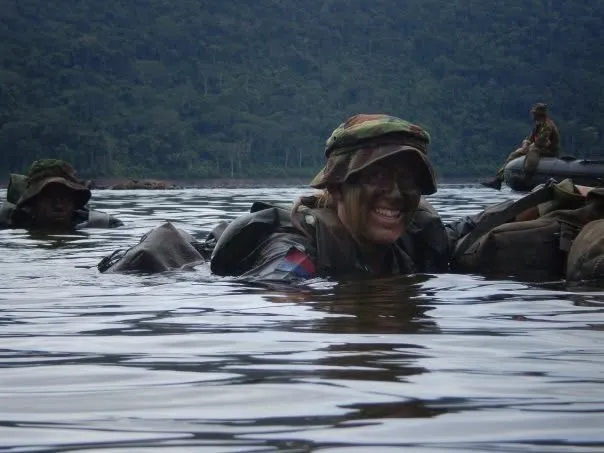
The way Louise talks about her subsequent jungle training in Belize – ‘skinning pigs and crossing rivers with crocodiles’ – I get the impression she’d go back in a heartbeat. In her reverie, she almost forgets to mention that she was the first female British infantry soldier to complete this form of training.
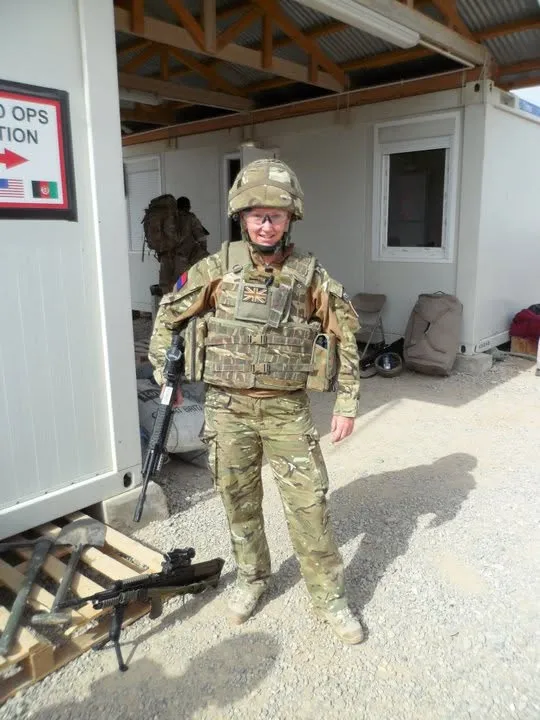
Joining the army in 2002 was a different prospect from joining a generation earlier. Post 9/11, the prospect of being sent into the Middle East was highly likely, and Louise’s first tour of duty was indeed to Iraq.
During her time there, she provided C-RAM cover (counter-rocket, artillery and mortar) and provided over-watch for infantry on the ground using a centralised bank of cameras.
She describes to me the sophistication of the surveillance, with ‘immaculate night vision’ enabling her to steer troops away from junctions, where a recently dug patch of earth could indicate an improvised explosive device.
‘You get sucked into viewing all this remotely and then sometimes you suddenly remember these guys are only a hundred yards away from where you’re sitting,’ she says.
During this tour of duty, in 2009, an incident very far away brought tragedy up close.
‘I was woken up in the middle of the night by my camp commander,’ Louise recalls, ‘so I knew something serious must have happened and I wondered whether it was my mum. But it was my cousin. He’d been shot and killed in Afghanistan while serving as a marine in Helmand province. It was his first tour after coming out of training only a few months earlier. It was the 14th of February. I hated Valentine’s Day for years after that.’
Marine Darren Smith of 45 Commando Royal Marines was 27 when he was wounded in an ambush by Taliban fire. Despite the efforts of his colleagues, he died of his wounds en-route to the medical facilities at Camp Bastion. He left behind his girlfriend Kelly and their two-year-old daughter Keira.
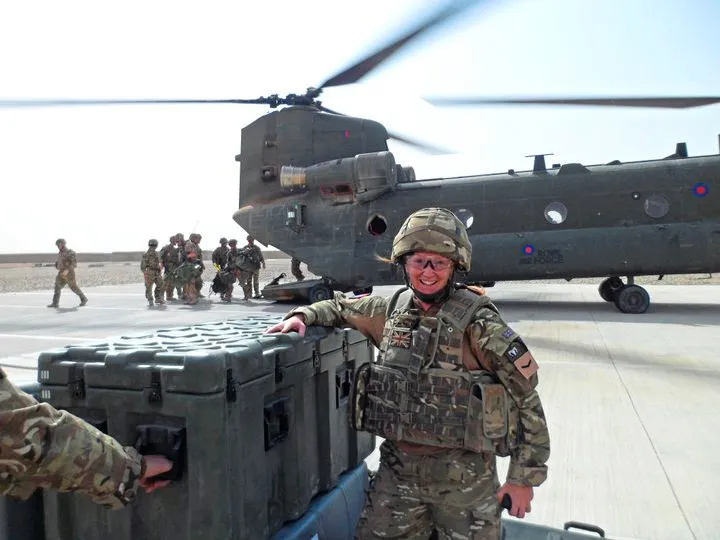
‘I wasn’t a close enough relative to be allowed to go home for the funeral,’ says Louise, ‘and within six months I was serving in Afghanistan, based at Camp Bastion.’
The payment of the ‘ultimate sacrifice’, as it’s so often termed, is never far from the thoughts of those colleagues who live on and continue to serve.
‘Remembrance is a big deal in the armed forces, for everyone from the top brass down to your new-intake soldiers,’ Louise says.
‘There’s always a parade, no matter where you are.’
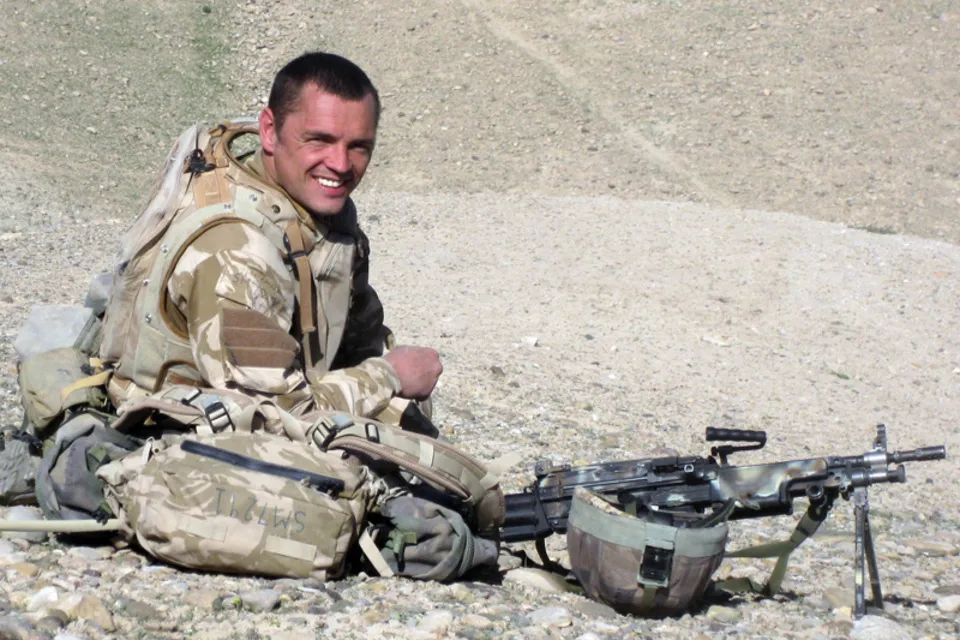
One such parade attended by Louise was in the Helmand town of Lashkar Gah.
‘It was in the camp and led by the padre – a memorial to the fallen of that and previous tours,’ she says.
‘When you’re in a place like that, remembrance is brought so much closer to home because you’re reading off the names of your serving men and women from maybe only two or three weeks ago, or four years ago, so you feel in that moment that what you are part of is real, it’s really happening. It feels different commemorating remembrance when you’re in an active war zone versus coming home and walking shoulder to shoulder with veterans of various ages. It feels different and I can’t really explain why.’
Louise had already previously marked the occasion during her first tour in Iraq, among an assembly of 5,000 at Basra Airport, and has gone on to do so in a variety of settings since.
‘I’ve been to Monte Cassino with my battery on a battlefield tour, and as the youngest participant on that endeavour I had the honour of laying a wreath at one of the memorials. That was quite poignant and it was lovely for me to be asked – a junior soldier amongst all this top brass.’
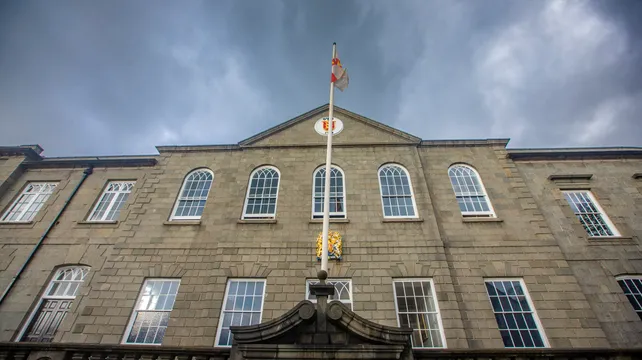
During her six years as school staff instructor at Elizabeth College – taking care of the Combined Cadet Force – she has stood among cadets as a mentor, responsible for their training and their welfare. In this capacity, she has laid a wreath at the Bailiwick War Memorial at the top of Smith Street.
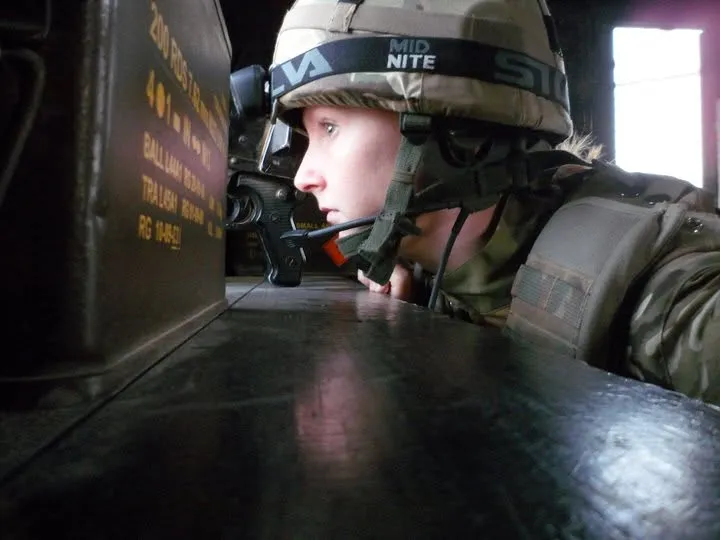
However, she has now taken a sideways move into learning enrichment at the college, on a new path towards ‘the eventual dream of getting my PGCE and hopefully staying within the college and expanding my repertoire that way’. So although she still gets involved in the end-of-week CCF activities, she now has the opportunity once more to ‘stand beside my serving brothers and sisters, remembering and commemorating fallen soldiers’.
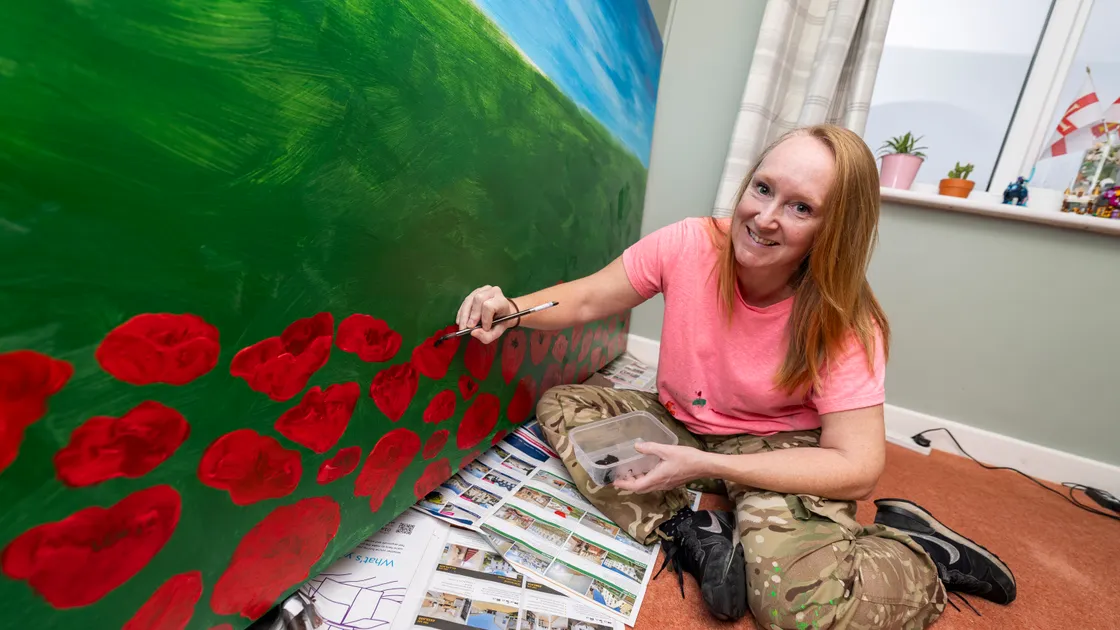
But there’s always room for something new, and this year will see Louise participate in remembrance in an entirely new capacity – as an artist.
‘I saw a Facebook post from Tessa Le Gallez asking if anyone would be able to paint a backdrop for a community project she was involved in,’ she tells me.
‘I didn’t initially know it had anything to do with remembrance and she hadn’t seen any of my artwork.’
However, when they got chatting, Louise discovered Tessa had coordinated a group of volunteer knitters and crocheters who had produced more than 1,000 poppies for display in Sark and in St Peter Port. And Tessa soon discovered what remembrance meant to Louise, whose painted backdrop will accompany the Town display.
‘Her eyes lit up at that and she felt it was really special to have an ex-serving soldier do something for the project,’ says Louise. 'It’s sort of full circle, isn’t it?’
The painting is deliberately simple, she explains.
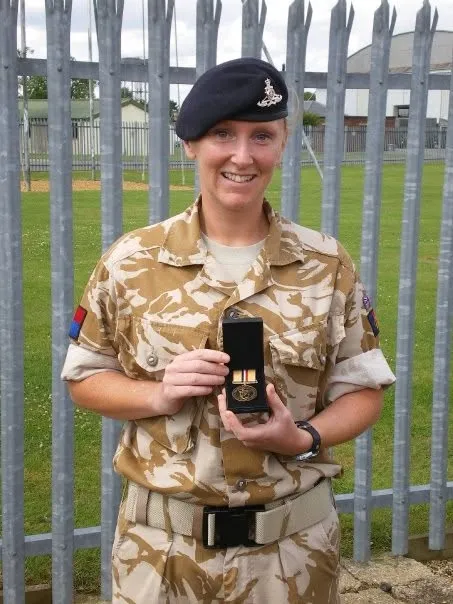
‘There’ll be some silhouetted figures on the horizon of soldiers and horses – very simple, because this is not the main event. The main feature is the beautiful field of hand-made poppies that all these lovely ladies have spent so much time creating.’
Louise has had the opportunity to meet some of these poppy-makers, some of whom have individually made 200-300 themselves.
The display will be unveiled at 10.30am on Saturday beside the Boer War Memorial on St Julian’s Avenue, and Louise explains that it will stay in place ‘for a few weeks’.
So what, I wonder, will happen to her painting after that?
‘We offered it to the hospital but their corridors are all full already,’ she says.
‘I’d like to find a home for it somewhere, or else it’ll just end up in my loft as floorboards, which would be a shame.’
Wherever it ends up, Louise will still have the memory after this weekend of honouring in another new way those of her fellow serving soldiers who fell.
And alongside the solemn remembrance is the more straightforward remembering. I’ve visited her to speak about the former, but there’s also a wealth of happier memories of a previous career – a former life that has engendered no regret.
‘I wouldn’t change a thing,’ she says with a big smile. ‘I loved it and I loved that version of myself. And I made friends for life.’