
Four-and-a-half years ago, on a Thursday afternoon, in one of those completely unexpected moments, the lives of myself and my husband (I’ll call him F) changed forever.
I know this happens across the world on a daily basis. Events happen and life is never quite the same again. Hundreds and thousands of people face a bewildering and abrupt turn from the pathways they had planned and need to face up to a new reality. Life goes in an instant, from normal day-to-day mundane, to something completely different.
For us, it was a stroke. The word itself is short for ‘struck by God’ or a ‘stroke of God’s hand’ – I looked it up out of curiosity one day because I felt that the word I was being given didn’t even begin to encompass the outcome.
Today is World Stroke Day. Talk to almost anyone about a stroke and there is a family story to be told. Sometimes recovery, sometimes lifelong challenges. And that’s the thing about strokes – the outcome can be nothing at all to see here, right through to being completely bed-bound and unable to move a muscle, and everything in between that.
Let me explain. Strokes, or to be more accurate, a cerebrovascular accident, are caused by either a clot or a bleed in the brain. Depending on where in the brain this occurs, the treatment that can be given (speed is of the essence) and the response to any treatment are what determine the outcome. The results can be minor, major or catastrophic. I remember bumping into a consultant friend of F’s while wandering the hospital corridors one day (he was in hospital for 11 and a half months – we had to do something with our time on weekends….) and he told us that stroke patients fall into thirds.
A third of them die. That was a sobering moment. It had been close for us really. I’d been out at work and meant to be there until late in the evening. F was home, alone. Thankfully, however, a meeting had taken him out of the house and so his stroke occurred in an environment with first-aiders and help on hand. Without that, I strongly suspect I’d be writing about him in the past tense.
A third recover quickly, often with no obvious remaining symptoms. Even so, the event itself can knock your confidence and affect your life in ways you hadn’t expected.
The final third recover slowly. And when I say slow, I’m talking about glacially slow. The type of slow where you think the end might never be in sight (bizarrely, a good thing in stroke recovery terms) and where every step forwards, no matter what it is, needs celebrating.
The thing about strokes is, of course, that it’s all to do with the brain. We’ve got a much better idea these days about how brains work and which bits are responsible for what. The impact of a stroke varies massively from person to person, although there are a few generalities. To begin with, the brain mostly operates a swap – for example, the left side of the brain mostly controls the right side of the body and vice versa. It’s not quite as straightforward as that (each side also supports its own side of the body and accounts for about 10% of the control). If you have a left brain stroke, your speech, language, right-side movement and cognitive ability might be impacted. If you have a right brain stroke, then the impact is likely to be physical, cognitive and behavioural.
The truth is, it’s rarely as simple as that. Stroke survivors face a long period of unpicking all that has happened. Supported by intense therapy, given as soon as is possible, they begin the process of putting their lives back together. We are four and half years into that process.
To begin with, it’s worth saying, right at the outset, that we would not be where we are today without the incredible support and care from Le Marchant Ward and the neuro-physio team. As it happens, although memory difficulties and occasional word-finding remains a problem for F, speech and language was never an issue. Numbers are a different matter, which is a type of language issue all of its own, but speech clarity and words were not a challenge at any point for us. I know that the PEH speech and language department also does amazing work with stroke patients but we needed very little of their services.
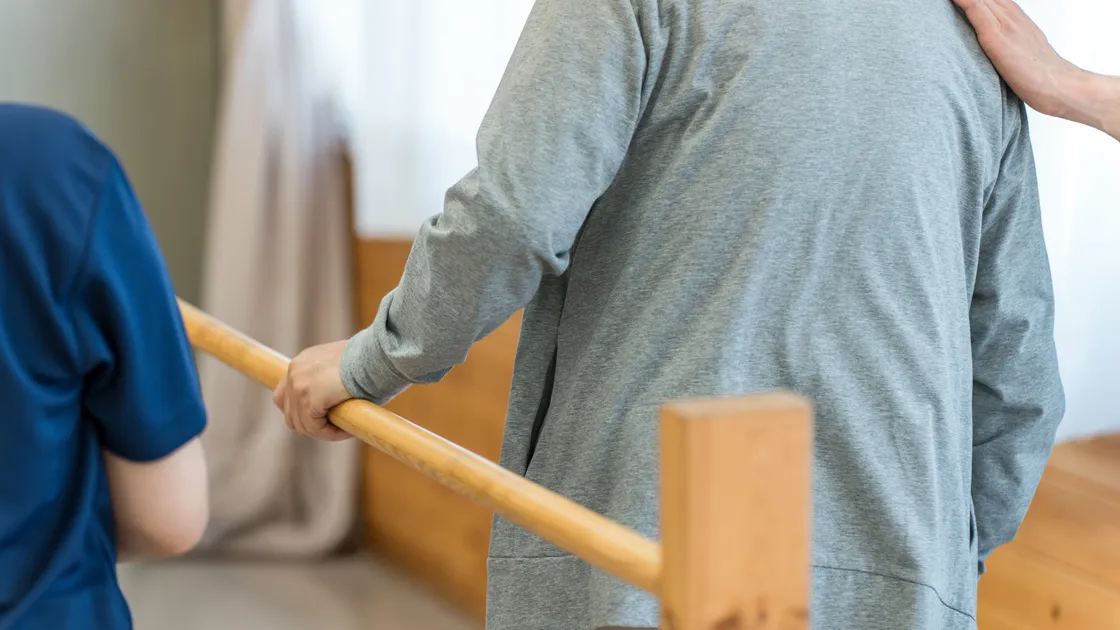
The focus initially was on getting F up and walking. That in itself took several months and, at the time, was our major motivation. Completely paralysed down the left-hand side, F needed to work with all the determination he had to be able to get moving again. Today, he needs a stick and is easily unbalanced, but otherwise walks with reasonable smoothness and stability once he’s up and moving. Without a stick, his walking is poorer; he limps heavily and battles to get around. F still also struggles to stand still for any time at all. When we are out and about, a wheelchair is the safest option.
F’s left hand and arm are, finally, showing signs of coming to life. However, having said that, it’s far from a useful, usable option at present. When I say there are signs of life, I’m talking about slightest of movement in fingers, wrist and elbow, but only when he thinks about it hard enough. We are, for example, a long way off him being able to unscrew the cap of his water bottle, refill it and put the top back on. We’re also a equally long way away from being able to use a knife and fork independently.
As I mentioned, number skills took a hammering and show no sign of returning. I’m not just talking about addition and subtraction though. It includes calendars, diaries, time and any scenario where you might need to use numbers. Most years, I now get a wedding anniversary card from F celebrating our ‘two’ years of marriage. Probably not that surprising when I’m also frequently asked which day of the week it is.
F can become emotionally dysregulated (this is, I have realised, a posh way of saying he loses his temper really easily...). Overwhelm, anxiety, frustration and an inability to ‘read’ a situation, or problem-solve it, will all contribute. When he’s bothered by something, he can, and does, say upsetting things to people.
Anxiety is another biggie. This filters into our lives regularly, usually at its worst when something is happening that’s out of our usual routine. F loves to travel but, for me, being away from home is a bit of a nightmare. We struggle without our things around us and the constant questioning and fretting from F wears me down.
I suppose the reason for sharing all this is to explain that a stroke is like nothing else when it comes to recovery. Some bits do get better, some don’t. But, and here’s the thing, you don’t know at any point which bits will do what. The brain can repair itself but it does it in a slightly haphazard and unpredictable fashion. There are no linear pathways in stroke survival and I can honestly say that continually caring for someone with a sustained head injury can only be described as ‘complete pants’.
The last four years have seen massive life changes for the both of us. The stroke for F and early retirement for me. From being one of the kindest people I’d ever met, I’ve now seen F say unkind things to people, because his social filter has gone. I’ve seen him shout aggressively at strangers and put himself in dangerous situations. I am a full-time carer for him because he needs someone around for most of the time. We’ve seen friends step up and then step back as the reality dawns on them. It hurts but I don’t really blame them. It’s hard to reconcile the new F with the old one some days.
It’s been a long journey and it’s one that will never be over. I know now, that we’ll never look back on F’s stroke recovery. We will always be in it and that’s a hard thing to get your head around.
So, on World Stroke Day, I urge you to spare a thought for all stroke survivors and their families. In one split second, their lives were altered and, in too many cases, will never be the same again. The battles that they and their loved ones face, every single day, are huge and they often end up facing them alone.
I am lucky. Despite everything, F is still here and there is enough of my husband left for me to love him as much as I ever did. He is very different to how he was before, but in quiet moments, my F is still in there. Battling to find his way back to me.
If he manages it, I’ll be waiting.
Guernsey Stroke Association
Guernsey Stroke Association runs stroke support groups where stroke survivors and carers can connect with people who really understand what they’re going through. It’s a safe space to socialise, try new things, feel supported, find their strength in their recovery and have fun.
The Stroke Association also provides a wide range of information and guidance for Guernsey residents via www.stroke.org.uk, including an online forum to chat with other stroke survivors and carers, downloadable resources, and the Stroke Support Helpline 0303 3033 100.
How can I find out more?
Online: www.stroke.org.uk/guernsey
By phone: Call our Guernsey engagement officer Beth Brown on 07797 888057
By email: Beth at guernsey@stroke.org.uk
Follow Stroke Association Guernsey on Facebook

You need to be logged in to comment.