I try to avoid being one of those pesky journalists who – as once described – watch the battle from the hills and then, when it’s all over, come down to bayonet the wounded.
Parliamentary sketch writers should be at their most compassionate when reporting Budget debates. We should be applying bandages to damaged limbs and egos, and if anything should be rubbed into raw wounds, it should be the soothing ointment of sympathy rather than the stinging vinegar of criticism. Let’s face it, these debates are nothing less than an elected elite discussing how they intend to spend other people’s money, and while that sounds superficially like a task that dreams are made of, it’s one conducted in a theatre full of dangerous pits in which a tangle of poisonous serpents writhe and squirm in certain anticipation that a careless finger or toe will stray into range.
For starters, the debaters are aware that somewhere along the line they will have to demonstrate that what they intend to spend other people’s money on is for the good of those who don’t get to be part of the decision-making, namely you and me. What’s more, they know that if they don’t get it right, they won’t be having too many chances to have another go after the next general election. It gets even trickier. In a debating chamber of 40 members, there are likely to be at least 41 different ideas about what is and what isn’t good for other people, so there is only limited refuge to be found in cosy alliances. The 41st is the inevitable debater who never made up their mind about anything in their life and would ask ‘Why start now?’
And that’s only the start of the problem for our debaters. Out in our community, there are a further 60,000 different ideas about how someone else’s money should be spent. Some will have the social conscience of a Mother Theresa, others that of Vlad the Impaler.
The upshot is that because there’s a limit even to other people’s money, every Budget debate is inevitably a competitive beauty contest, and as we all know, beauty contests are by nature bitchy.
While we are mercifully spared a parade of bikini-clad contestants – don’t even begin to picture it – we do have to observe an at-times-undignified scrap. Typically, the scrap is between committees, the rule appearing to be that everybody else’s committee needs to tighten its belt so that my committee can spend its way to happiness. At other times, the competition is between philosophies which can be diametrically opposed to each other, typically that of government needing to be simply everywhere or nowhere at all in our lives.
The tricky bit – for the bulk of deputies who haven’t foreseen all this and haven’t carefully avoided membership of any committees that actually do stuff and need money – comes when it is necessary to argue one philosophy for one’s own committee and the exact opposite for all others. During the ensuing displays of verbal gymnastics, it is evident that some deputies are more naturally talented contortionists than others, but for those who just don’t have the right build for it, it can be a painful sport – as it is also for those watching it. Even for those deputies who seek refuge in silence and hope nobody will notice, the crunch comes at the vote. Some manage to be conveniently out of the room when the time to vote arrives while others see abstention as an escape route, but that hatch should be opened with care. It introduces the risk that people like me, when assessing how many round thingummies the hatch-opener owns and how big they are, might come to a very low number indeed...
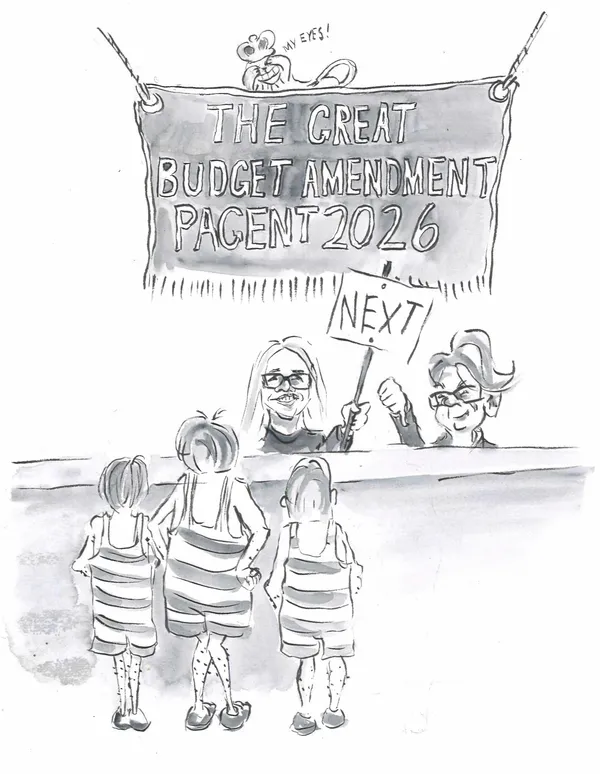
At this stage, I hear readers saying: ‘Never have so many metaphors been deployed in conveying so little’. And they would be right. Forget about bayoneting the wounded, ointment and vinegar, venomous snakes, bikini-clad deputies and gymnastics, and simply take the point that we should avoid excessively harsh judgement of how our government’s Budget was set last week.
Canny old bird that he is, Deputy Parkinson, in opening the debate, cast a pebble into the pond of debate whose ripples were certain to lap against all debaters and provide them with at least one point on which they could all agree. It was, he said, all about economic growth, the central problem being that there wasn’t any. His message was that a 1.3% growth in public expenditure wouldn’t matter if the economy was growing at 1.5% rather than at its recent average of 0.5%. Although this analysis is so basic that even my next-door neighbour’s cat finds it obvious, it was delivered with such portentous gravity that it had the entire nod-crafty Assembly nodding their heads knowingly, as if inhaling an air of rare wisdom to which only the great were granted privileged access.
Before you could say ‘Cor damme la’, every member was on about economic growth, even though hardly any of them showed the slightest sign that they knew what it looked like or how to achieve it. The debating chamber throbbed and quivered with the sound of the mantra. As I later trudged up the Grange, even the dachshund cocking his leg irreverently against the doorway to the tuck shop opposite Elizabeth College was muttering to himself ‘Gotta grow the economy’.
Anyway, the importance of economic growth proved to be the only point on which there was much agreement over the coming four days of debate. The huge number of amendments to the budget proposals had already given the game away and had offered clear hints of the various camps that were lining themselves up to have their say.
For observers such as me, the emergence of these raiding parties forming up for their assaults against Castle P&R was as boring as it was predictable – already, after only 15 months of the new political term, there is a ‘same-old, here we go again’ feel about the Assembly. It’s a bit of a nightmare for a political sketch writer when the desirable challenge to the governing establishment is so predictably scripted. Already, I feel that I know beforehand exactly what the likes of deputies Van Katwyk, McKenna, Goy, Vermeulen, Ozanne, Sloan, Camp and Curgenven will have to say.
I could write their scripts for them and they wouldn’t notice. As Shakespeare might have said of them, custom cannot stale their infinite predictability. Doesn’t anybody have something original to contribute? Or is Deputy Gollop, the Frank Bruno of Guernsey politics, my only hope?
At this point, readers may conclude that I have strayed from the compassion that I advocated at the beginning of this sketch. They would be right. I have. So, onto something different.
One of the most important of the States of Deliberation Rules of Procedure is RP 17 (1). It reads as follows: ‘When speaking in the States a member shall always address the presiding officer and must not address another member.’ At first glance, it seems fairly innocuous. Its intended civilising role is clear. If Deputy A were to look Deputy B in the eye and announce ‘You are a congenital idiot and a complete waste of space,’ Deputy B, quite apart from feeling miffed, might well be tempted to punch Deputy A on the nose. I can think of occasions in recent times when I would be inclined to cheer Deputy B on, but that is not generally regarded as an acceptable way to conduct business in our democratic debating chamber.
Hence RP 17(1) which requires Deputy A to look the Presiding Officer in the eye and advise her as follows: ‘Madam, Deputy B is a congenital idiot and a complete waste of space.’ Deputy B won’t be any the less miffed but, being obliged by RP 17 (1) to respond via the presiding officer, is somehow less likely to start a punch-up.
By and large, RP 17 (1) is generally successful in preserving debates from becoming a free-for-all characterised by slanging matches, but the current Assembly membership is proving to be exceptionally slow in learning how to observe the rule. A few members, some even after several years in the States, either simply can’t be bothered to master the parliamentary art or are too thick to distinguish between a chummy chat at the bar of the Rose and Crown and a structured debate in the States of Deliberation.
Either way, even the Bailiff’s patience, which is by now legendary after regular testing by certain frequent, slow-to-learn offenders, may prove to be exhaustible after all. In which case, I suggest she keeps handy on the top bench a stock of tall, conical-shaped caps defined by a large letter ‘D’ in red. Once awarded, these caps would have to be worn in a corner of the Assembly until the end of the ongoing session. Just an idea!
The Budget debate meandered to its close towards the end of the four days allocated to it. I will spare readers my view of its outcome, but I will share one thought. I have often wondered what it must be like to attend and report on the annual National Trainspotters’ Convention. Now I know.