
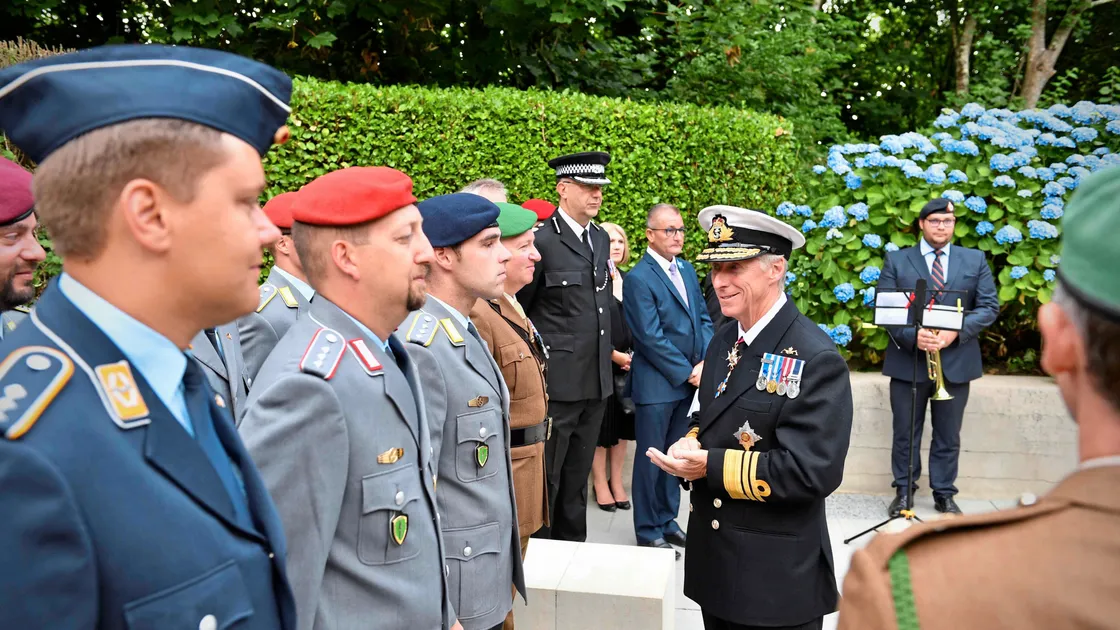
It was the first time since the Occupation that uniformed German soldiers have been operational in the island.
The troops serve with Nato’s Allied Rapid Reaction Corps based in Gloucestershire and were invited to work at the military cemetery at Fort George, which includes 111 German war graves.
A rededication ceremony involving Lt-Governor Sir Ian Corder, British and German veterans, as well as islanders, took place yesterday morning.
German Captain Sebastian Kühne from the Allied Rapid Reaction Corps said: ‘When we arrived on Guernsey we had a very warm reaction, so many people supporting us and they offered their spare time to help us with our endeavours, providing us with tools, and showing us around the island.
‘I feel very touched to work on the graveyard and see the names of the British and German soldiers that died here because they are very young, most younger than me.’
German businessman Johann Andreas Werhahn, whose father had served as a corporal during the Occupation, had travelled from northern Germany just to be part of the event.
‘I’m thankful that my father came back home.
‘He rarely spoke about the war, but he told us he was in Guernsey.
‘In Germany, commemoration is done very differently, so it was good to be here for the ceremony.
The service ended with the laying of a special wreath incorporating both the Poppy and the German flower of remembrance, the Forget-Me-Not – symbolic of the common bond that unites rather than divides today’s generation of Nato soldiers.
Organised by the Volksbund Deutsche Kriegsgräberfürsorge – the German War Graves Commission – and supported by the Commonwealth Graves Commission, the trip saw the soldiers spend 10 days repairing and cleaning the gravestones of all those buried there.
Guernsey’s Dean, the Very Rev. Tim Barker, described the ceremony as remarkable. ‘An occasion to remember how much has changed since Guernsey’s Occupation,’ he said.
Captain Erik W. of the ARRC said that although the group was apprehensive about what the local reaction would be to the visit from German soldiers in uniform to the island they wanted to thank the people of Guernsey for giving them such a warm welcome.
‘Everybody told us that the work that has been done was in a great condition. People came to us every day to say they appreciated what we were doing.
‘Maybe what we did here helped to improve the negative feelings some have towards German soldiers. When we were at the Bailiff’s reception [on Monday] we were told we were the first German soldiers in uniform to be in that room since the Commander said he would surrender the next day in 1945.
‘To be there in such a different context, it was quite emotional for us all,’ he said.
n More pictures of the ceremony will follow in tomorrow’s Guernsey Press




You need to be logged in to comment. If you had an account on our previous site, you can migrate your old account and comment profile to this site by visiting this page and entering the email address for your old account. We'll then send you an email with a link to follow to complete the process.